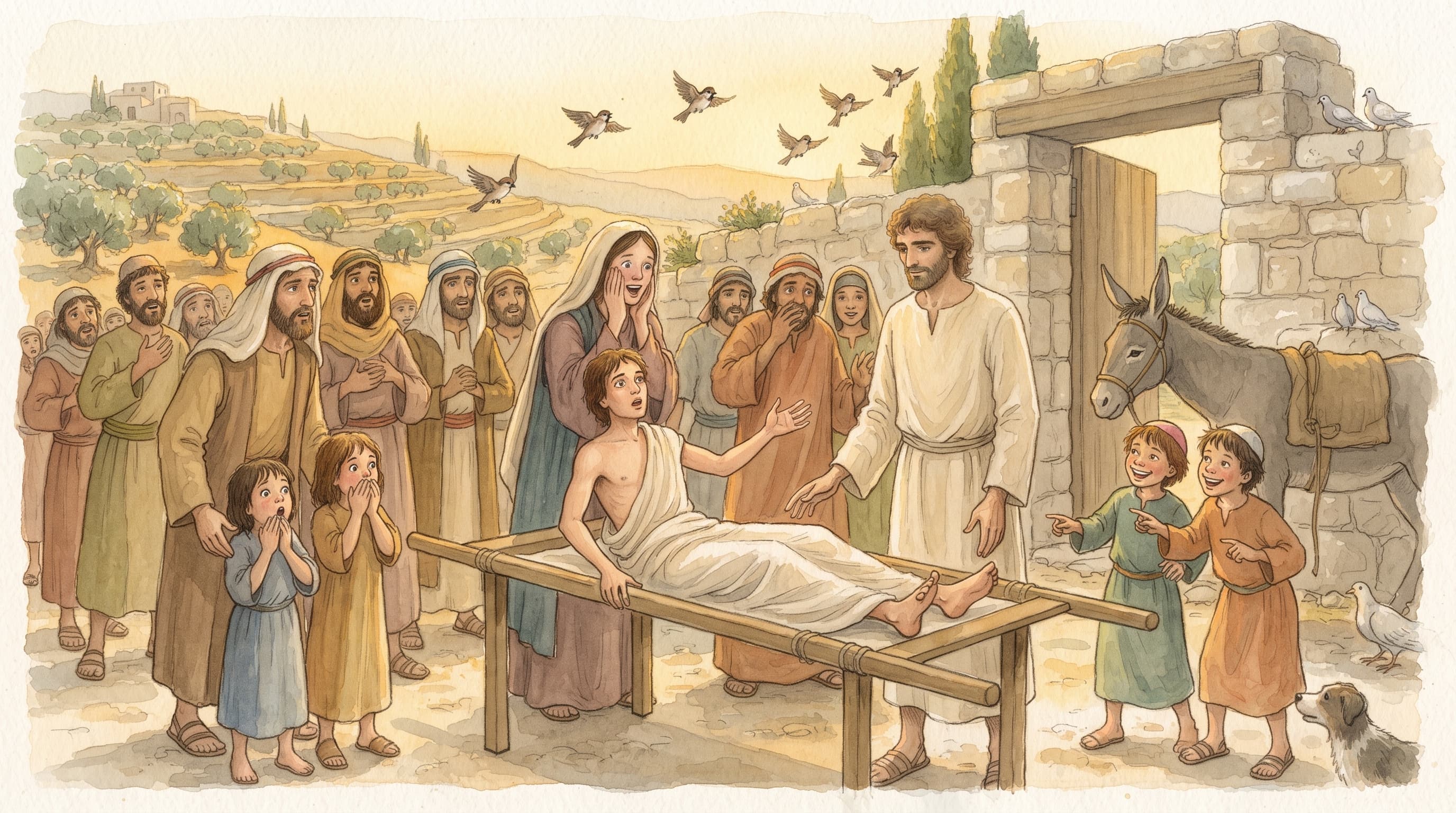
Jesus Raises the Widow’s Son
A lesson preparation guide for teaching 5–10 year olds
The Original Audience
What did this mean to the people who first heard it?
Movement 1: The Original Audience
Passage: Luke 7:11-17
"What did this mean to the people who first heard it?"
Two Crowds at One Gate
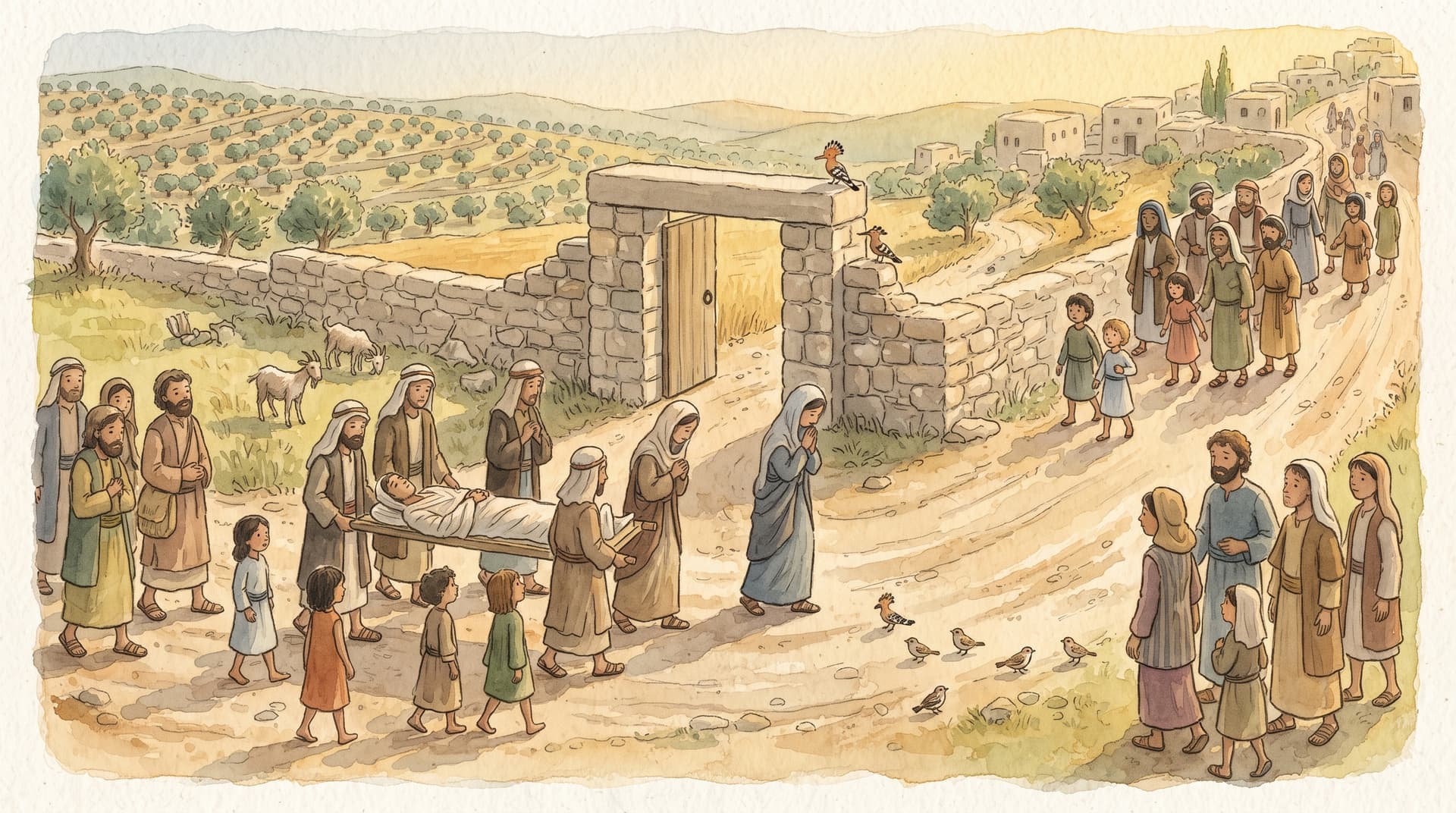
Nain was a small village on the northern slope of the hill of Moreh, in the plain of Jezreel — a day's walk from Capernaum. Ancient towns had one main gate, and a gate is a narrow place. Luke stages the whole scene there on purpose: as Jesus and a large crowd come up to the town, a funeral procession is coming down and out of it. Two crowds, two directions, about to collide in the one place neither can avoid.
What a Widow Losing an Only Son Actually Meant
Luke doesn't just say her son died. He says "the only son of his mother, and she was a widow" — two facts stacked for a reason. A widow in this world had already survived the first blow: no husband meant no income, no legal standing, no protection, unless a son was old enough to provide it. This woman had one son. He was her whole safety net. His death didn't just break her heart — it erased her future. She was now a woman with no husband, no son, and no one obligated to feed her. The original audience would have heard "widow" and "only son" and known immediately: this is as low as a person in their world could fall.
The Funeral Procession
Jewish burial happened fast, usually the same day. Professional mourners wailed and played flutes. The body — wrapped, not enclosed in a coffin — was carried on an open bier so the whole town could see the deceased on the way to the tomb outside the village. Luke notes "a large crowd from the town was with her" (7:12). This was not a private grief. The entire village had turned out, which tells you how much this family, and this loss, mattered to the community.
The Touch That Should Not Have Happened
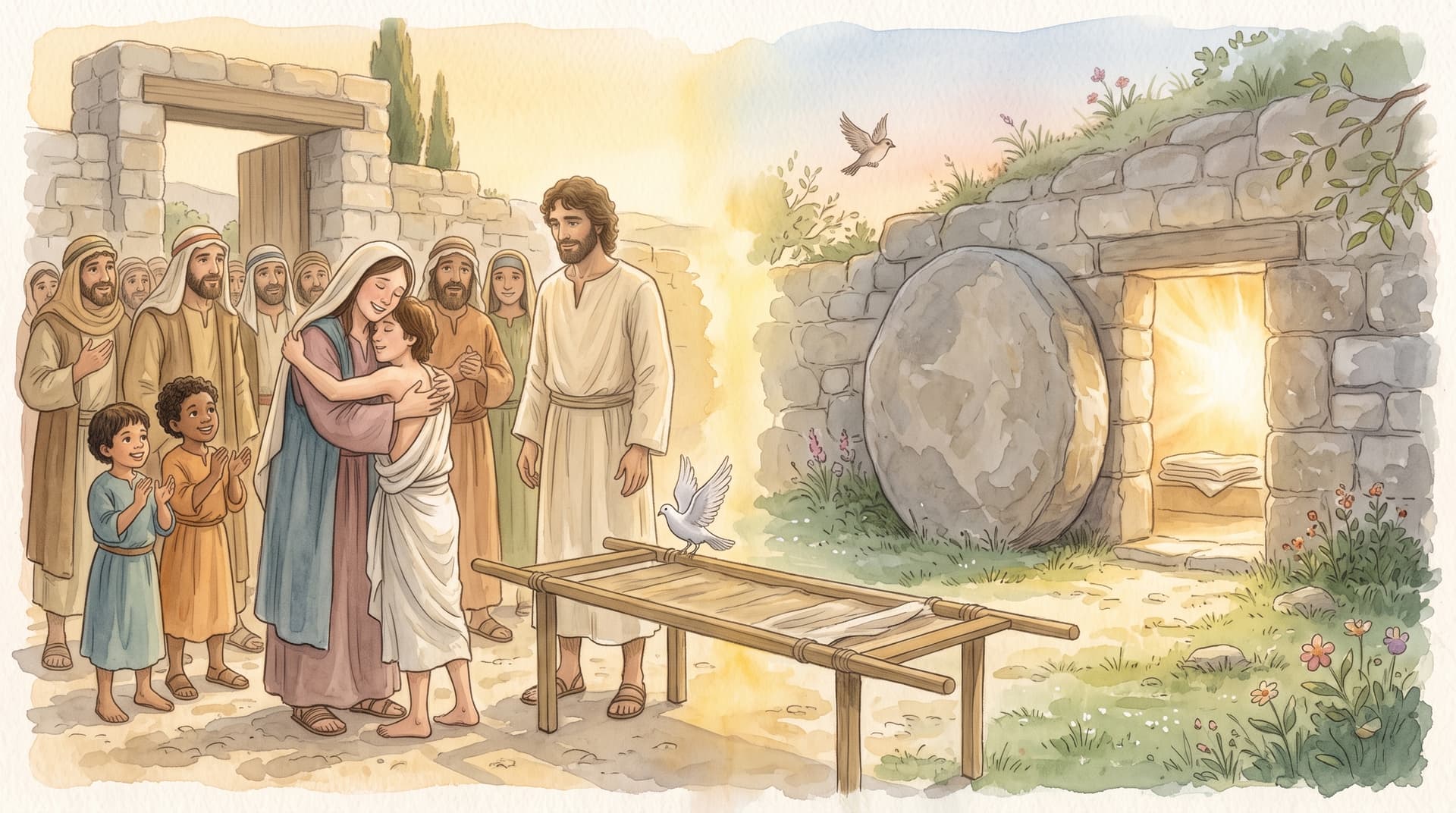
Touching a corpse or its bier made a person ceremonially unclean under the law (Numbers 19:11-16) — a whole week of purification, unable to enter the temple. Any observant Jew in the crowd would have flinched when Jesus walked up and touched the bier. Nobody asked him to. Unlike the centurion just before this story (7:1-10), who sent messengers begging Jesus to heal his servant, nobody in this scene asks Jesus for anything. He simply saw, and he simply acted.
Nain's Uncomfortable Neighbor
Shunem sat within sight of Nain, on the far edge of the same valley — the town where the prophet Elisha raised a widow's dead son back to life two centuries earlier (2 Kings 4:18-37), a story every one of Luke's Jewish readers would have known well. Anyone from this region hearing "a widow's son died, and a prophet reversed it" would have felt the echo before Luke ever spells it out.
What the Original Audience Heard
A funeral crowd meets a following crowd at a town gate. A woman who has lost everything a widow could still lose. A teacher who touches what makes him unclean instead of the reverse. And a region that already had one story about a dead son and a widow — about to get a second.
The Author’s Intent
What is Luke doing with this scene?
Movement 2: The Author's Intent
Passage: Luke 7:11-17
"What is Luke doing with this scene?"
The Pair with the Centurion
This story doesn't stand alone. Luke places it immediately after the centurion's servant (7:1-10) on purpose, and the contrast is the point:
- A Roman officer with status / a widow with none
- Someone who sends a request / someone who never asks
- Faith Jesus praises out loud ("I have not found such great faith in Israel") / faith never even mentioned
- Healing granted because a man believed / life given to a woman who wasn't looking for it
Luke is showing his readers two doors into the same mercy. One opens because someone asks in faith. The other opens because Jesus simply sees. Neither is the "real" way in. Both are.
"When the Lord Saw Her"
Verse 13 is one of the first places in this Gospel where Luke narrates Jesus as ho kyrios — "the Lord" — outside of dialogue or quotation. Up to this point the title mostly belongs to God or shows up on other people's lips. Here, Luke the narrator applies it to Jesus directly, and he does it at the exact moment Jesus's "heart goes out" to a grieving stranger. Luke is fusing two things his readers might not expect to travel together: supreme authority and gut-level tenderness. The Lord of the story is defined here by compassion before he's ever defined by power.
Borrowing Elijah and Elisha's Words on Purpose
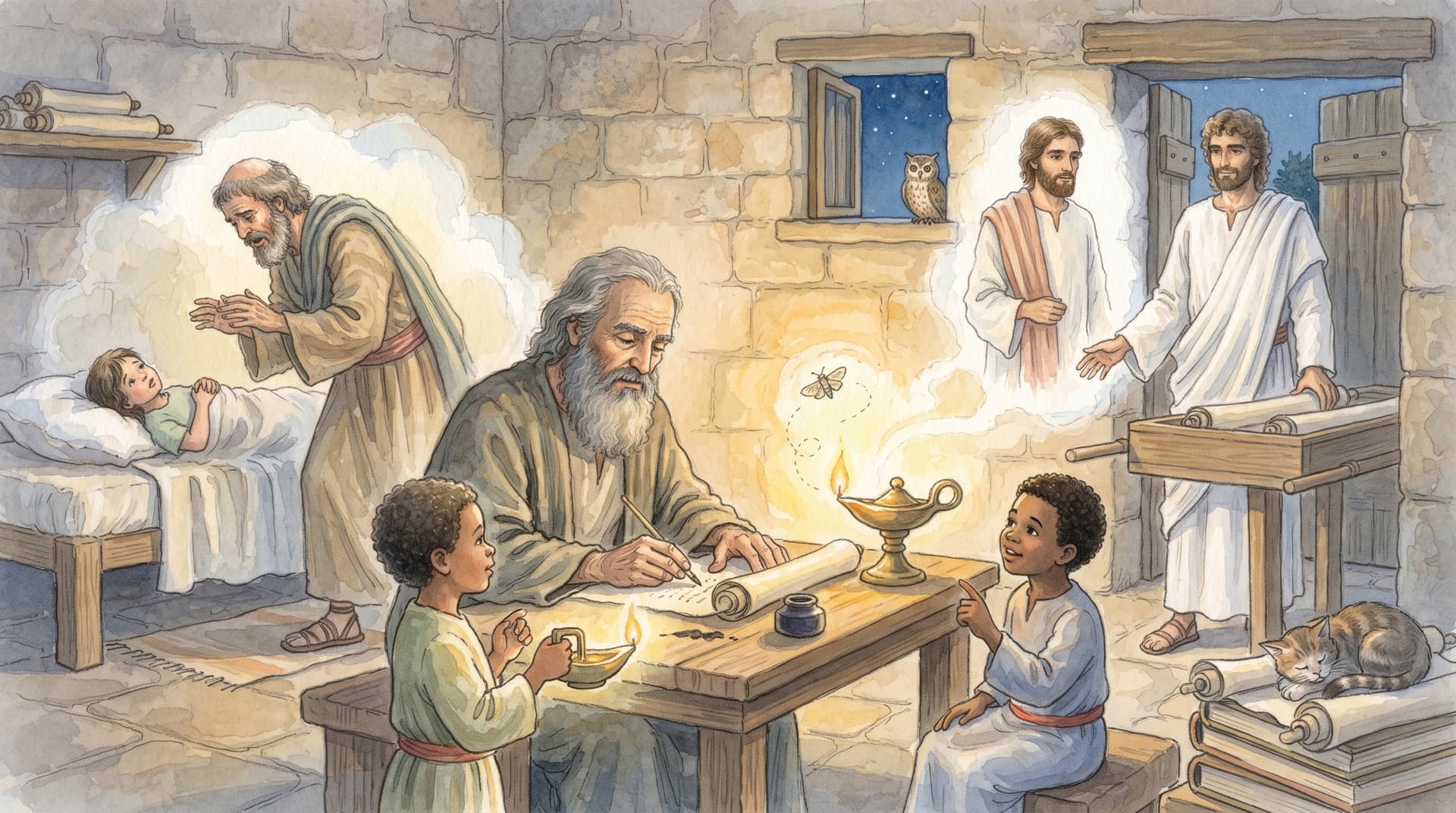
When Luke writes that Jesus "gave him back to his mother" (7:15), he is quoting — almost word for word — the Greek Old Testament's account of Elijah handing the Zarephath widow's son back to her (1 Kings 17:23). This is not an accident of phrasing. Luke wants his readers to hear the prophetic pattern and then watch Jesus exceed it. Elijah stretched himself over the boy three times and begged God to let his life return. Elisha did something similar for the Shunammite's son, from the very valley visible from Nain. Jesus does neither. He touches a bier and speaks four words. Luke is building the comparison specifically so his readers feel the gap between "a prophet who pleads" and "the one prophecy was always pointing to."
The Crowd Names Him Correctly (and Not Quite Enough)
"A great prophet has appeared among us... God has come to help his people" (7:16). The word behind "come to help" is episkeptomai — "visited" — the exact verb Zechariah used back in chapter 1 to prophesy that God would visit and redeem his people (1:68, 1:78). Luke is closing a loop he opened in his opening chapters: what the old priest sang about before Jesus was even born is now visibly happening in a village nobody had heard of. The crowd is right that God has visited them. They just don't yet know how completely.
The Useful Test
Luke is showing that the mercy that answers a believing request (the centurion) and the mercy that runs ahead of any request at all (the widow) come from the same Lord — and that this Lord doesn't plead with God for a life back like the prophets before him. He commands it, and death has no vote.
Seeing God
What does this passage reveal about who God actually is?
Movement 3: Seeing God
Passage: Luke 7:11-17
"What does this passage show us about God's beauty, glory, or character that we wouldn't see without it?"
The Facet of Beauty: Compassion That Moves Before Anyone Asks
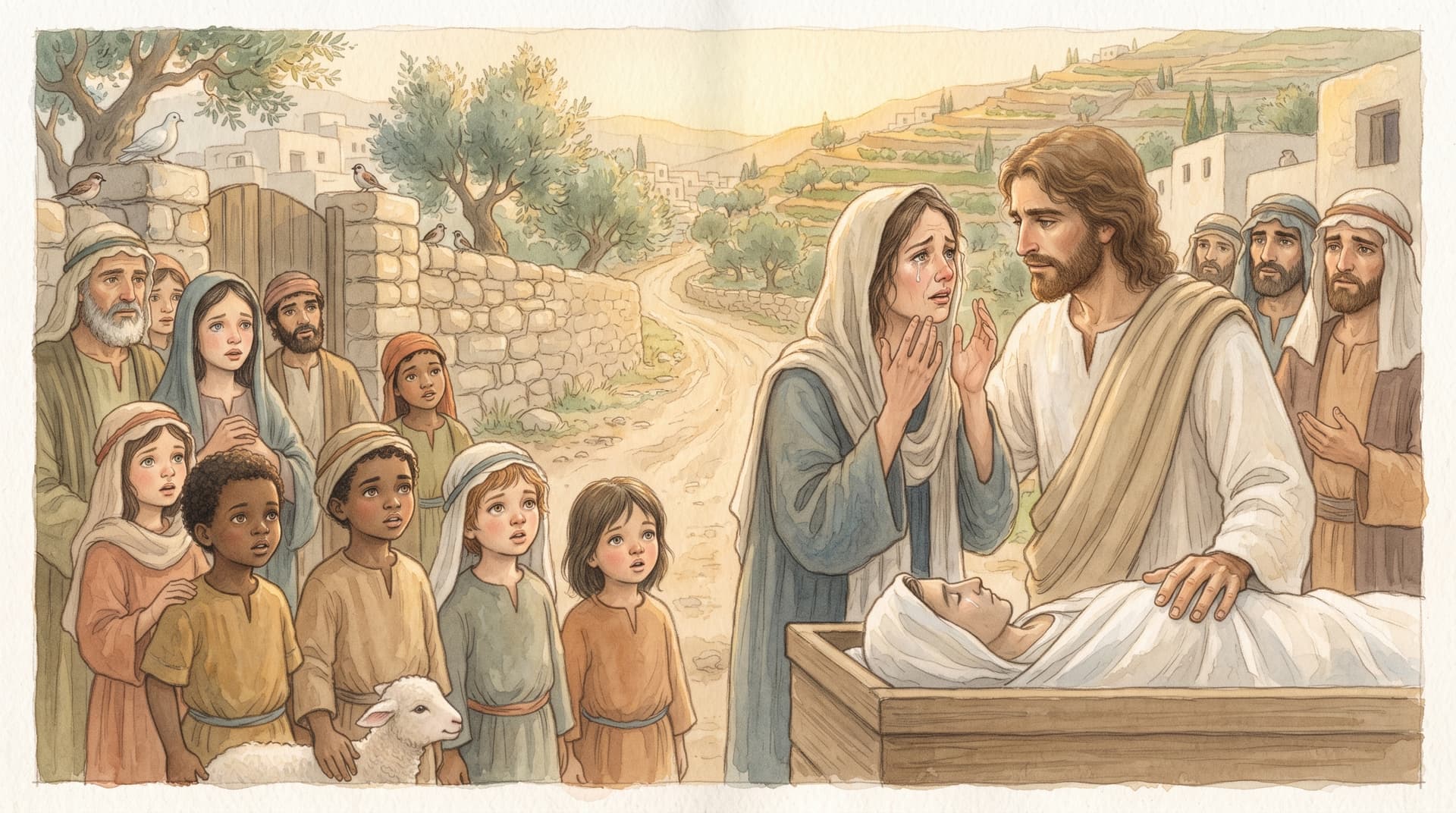
Every other miracle around this one in Luke's Gospel starts with a request. A centurion sends messengers. A leper begs. A friend lowers a paralyzed man through a roof. Here, nobody asks Jesus for anything. The widow isn't even looking at him — she's walking behind a bier, in a funeral crowd, doing what grieving people do. Jesus sees her first. His compassion is the whole engine of the story before a single word passes between them.
What Is Surprising About God Here
He Feels It Before He Fixes It
Luke says Jesus's "heart went out to her" — esplagchnisthē, a gut-deep word Luke uses elsewhere only for the father running to the prodigal son and the Samaritan stopping for the beaten stranger. This isn't polite sympathy. It's the same visceral ache a parent feels watching their own child hurt. God is not managing this scene from a safe emotional distance. He's undone by it, the same way she is.
He Touches What Should Have Made Him Unclean
The law said contact with a corpse defiles you. Jesus touches the bier anyway, in front of a crowd who would have known exactly what that meant. And nothing happens to him. Instead, something happens to death. This is the pattern of his whole ministry in miniature: he doesn't catch our uncleanness by getting close to it. He overpowers it. Death doesn't spread to Jesus. Life spreads from him.
He Commands What Prophets Could Only Beg For
Elijah stretched his own body over a dead child three times, crying out to the Lord, pleading for the boy's life to return. Elisha did the same. Both were desperate men asking a greater power to act. Jesus doesn't ask anyone. He speaks directly to a corpse — "Young man, I say to you, get up" — and it obeys him like a servant obeys its master. The prophets prayed to the one who could do this. Jesus simply is the one who can do this.
His Compassion Includes the Ordinary Losses, Not Just the Dramatic Ones
There's no demon here, no dramatic sin, no famous name. Just a widow nobody outside her village would have known, on an ordinary road, on an ordinary day. God's compassion in this passage isn't reserved for headline tragedies. It reaches an anonymous woman's very normal, very devastating grief — the kind that happens in every town, every generation, including this one.
What God's Emotions Look Like Here
Grief that moves toward the griever, not away. He doesn't observe her pain. He walks straight into it.
Tenderness before triumph. "Don't cry" comes before the miracle, not after — he speaks to her heart first, then to her son's body.
Quiet authority, not showmanship. No raised hands, no long prayer, no crowd-pleasing buildup. Four words, spoken directly, and it is done.
The Worship Test
The specific facet on display: God's compassion doesn't wait to be invited — and when it moves, nothing, not even death, is strong enough to say no to it.
Two crowds met at a gate. One was walking a body out to a tomb. The other was walking a Savior in. And for one widow in one small village, on one ordinary afternoon, the second crowd changed everything the first crowd thought was final.
Gospel Connection
How does this passage connect to the gospel?
Movement 4: The Specific Gospel Connection
Passage: Luke 7:11-17
"How does Jesus fulfill, complete, or embody what this passage reveals — SPECIFICALLY, not generically?"
The Rule
The connection has to live in this passage's own grain. Three threads only Jesus can close: the two processions colliding at the gate, the pattern he exceeds instead of repeats, and the fact that this resurrection was temporary while his own would not be.
Jesus Walks His Own Funeral Road, and No One Gives Him Back
The widow's son gets a second chance at the life he already had — and someday, he still died again, for good. That's the honest limit of this miracle: real, wonderful, and not final. A few years later, Jesus himself is carried out of a different town, on a different road, toward a different tomb — except this time it's his own funeral. Nobody touches his bier and speaks four words over him. He goes all the way into death, on purpose, because someone has to go there and not just visit. Then he does what he did for the widow's son, except for himself: he gets up. Not because a greater prophet commanded him to. Because death has no power to hold the one who has power over it.
Specific connection: the same voice that said "get up" to a stranger's son at Nain is the voice that could not be silenced by his own tomb. He gave someone else back their son once. Three days after his own funeral, he gave himself back to everyone who was grieving him.
He Exceeds Elijah Instead of Repeating Him
Luke wrote "he gave him back to his mother" to echo Elijah's exact words on purpose (Movement 2). The point of the echo is the gap it creates. Elijah begged. Elisha stretched himself over a cold body three separate times before it worked. Jesus speaks once, standing up, mid-conversation, uninvited. The gospel isn't "God sent another prophet like the old ones." It's "the one the prophets could only ask God on behalf of has now arrived in person, and he doesn't have to ask anyone."
Specific connection: every Old Testament resurrection was a prophet borrowing power he didn't own. This one is the owner showing up.
The Specific Mending
The brokenness this passage reveals: We are the widow. Not always in the specifics — but in the position. Things we depended on for our future get taken, and we have no leverage to get them back. Grief walks toward us on roads we didn't choose, at gates we can't avoid, and we have no power to reverse what it carries.
The specific mending: Jesus doesn't fix this by teaching us how to grieve better or promising to feel sad alongside us — though he does feel it alongside us. He fixes it by being the one person in history who has personally walked into death, come back out the other side under his own power, and can therefore promise the same "get up" to everyone who trusts him. This isn't a story about someone getting lucky once. It's the first public preview of what Jesus's own resurrection guarantees for good.
The new earth: "He will wipe every tear from their eyes. There will be no more death or mourning or crying or pain, for the old order of things has passed away" (Revelation 21:4). Every funeral procession any of us will ever walk in is temporary. One day it collides, permanently, with the only crowd that matters — and every "get up" Jesus ever spoke turns out to have been a preview of the one he'll speak over everyone who belongs to him.
The Anti-Moralism Checkpoint
-
"Have compassion for hurting people like Jesus did." True, but it skips the point. This passage isn't primarily about our compassion — it's about a compassion powerful enough to reverse death, which ours isn't.
-
"Trust God even when things look hopeless, like the widow." She isn't shown trusting anything. She's shown grieving. The miracle doesn't reward her faith; it meets her where faith wasn't even present yet.
-
"And this all points to Jesus who died for our sins." Too generic. This passage specifically points to Jesus as the one who exceeds every prophet who ever pleaded with God for a life back, and who proved it by walking out of his own tomb under his own authority.
Why Kids Care
How does this truth intersect with their actual lives?
Movement 5: Why Should a 5-10 Year Old Care?
Passage: Luke 7:11-17
"What does this mean for their actual lives of play, fun, friendship, and family?"
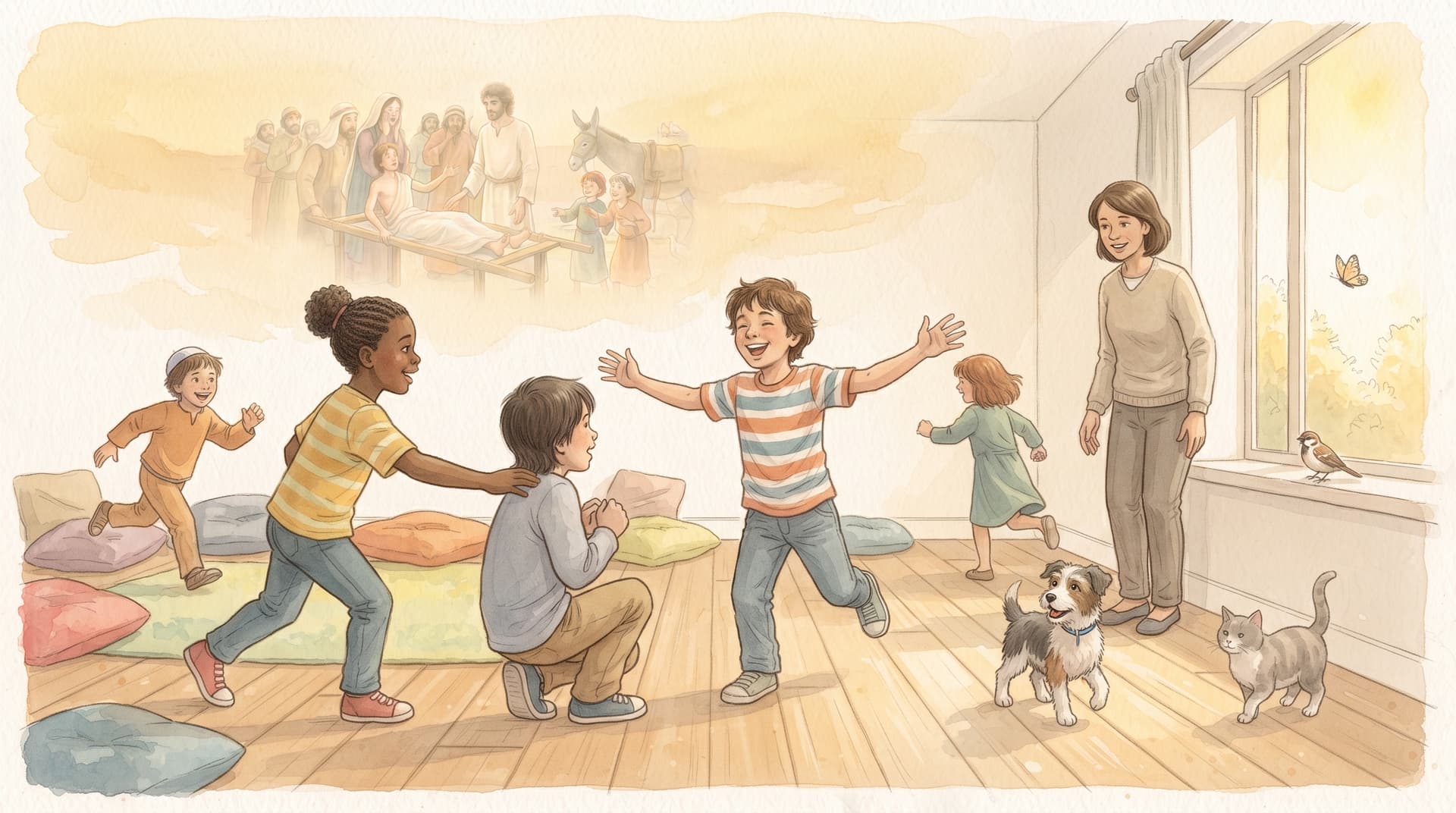
This movement is a brainstorm — a menu of angles for the teacher to pray through. Pick what fits your kids. Skip the rest.
The Lesson: The Two Crowds at the Gate
The Arc
Three truths kids need to feel:
1. "One crowd was walking a boy to his grave. The other crowd was walking Jesus into town." Two lines of people, headed opposite directions, about to meet at the same gate. Nobody planned it. It just happened — the way sad things and Jesus have a way of showing up at the same time.
2. "Jesus didn't wait to be asked." The woman wasn't looking for him. She wasn't praying for a miracle. She was just walking behind her son's body, doing what people do when someone they love has died. Jesus saw her first, and moved first.
3. "He touched the very thing that was supposed to be untouchable — and instead of it changing him, he changed it." Everyone knew you didn't touch a dead body. Jesus touched it anyway. And death didn't spread to him. Life spread from him.
The Role Play: Two Crowds at the Gate
Characters: Narrator (teacher), Jesus (volunteer), the Widow (volunteer), the Son (volunteer, lying still on a mat or blanket carried by two "bearers"), the Mourner Crowd (half the class), Jesus's Crowd (the other half).
Scene 1 — Two Lines. Split the class into two lines facing each other, a "gate" (two chairs, or a taped line) between them. One line — the Mourner Crowd — walks slowly toward the gate, quiet, carrying the Son on the mat, the Widow walking behind with her head down. The other line — Jesus's Crowd — walks toward the same gate from the other direction, talking, energetic.
Scene 2 — The Meeting. The two lines arrive at the gate at the same moment. Everyone stops. It's awkward — nobody expected this. Jesus sees the widow. The narrator says: "His heart went out to her." Jesus walks up to her, not to the crowd, not to the body first — to her.
Scene 3 — "Don't Cry." Jesus says it gently. The Widow doesn't understand yet — how can she not cry? Then Jesus walks to the mat and touches it. Everyone in the Mourner Crowd gasps and steps back — you're not supposed to touch that.
Scene 4 — "Get Up." Jesus says it plainly, not shouting. The Son sits up. (Let the volunteer actually sit up — the room will react.) Jesus takes his hand, helps him stand, and walks him over to his mother.
Scene 5 — The Crowd's Words. Everyone — both crowds, now one crowd — says together: "God has come to help his people."
Why Should They Care?
Angle 1: When Something Gets Taken and You Can't Get It Back
The kid's world: A pet that died. A grandparent who isn't there anymore. A friend who moved away. The powerless feeling of wanting something back that's just gone, and knowing wanting it hard enough doesn't work.
The God-first landing: The widow couldn't get her son back. Nobody in that whole crowd could. That's exactly the kind of "gone" Jesus walked into on purpose. He's not just sad with us when something is taken — he's the one being who has actually reversed it, in real life, in front of witnesses. He is not helpless in front of the things that make us feel helpless.
Landing statement: "There are things you can't get back by wanting them hard enough. Jesus is strong enough to give them back anyway — and one day, for everyone who loves him, he will."
Angle 2: You Don't Have to Ask the Right Way
The kid's world: Feeling like prayers have to sound a certain way to "count." Not knowing what to say when something is really wrong. Watching someone else get help and wondering if you have to be brave enough, or good enough, or say the right words to get noticed too.
The God-first landing: The widow never asked Jesus for anything. She didn't even know he was going to be at that gate. Jesus moved first, before she said a word, before she even looked at him. You do not have to find the right words to get Jesus's attention. He already saw you. He was already moving.
Landing statement: "You don't have to ask exactly right for Jesus to notice you're hurting. He sees you before you say anything."
Angle 3: Touching the "Untouchable" — and Nothing Bad Happens to Him
The kid's world: The rule that touching something gross or broken makes you gross or broken too — mud, a scraped knee, a friend who's "contagious" with a bad mood. The instinct to keep distance from anything messy so it doesn't rub off on you.
The God-first landing: Everyone at that gate believed touching a dead body would make you unclean too — it would spread to you. Jesus touched it anyway, and instead of death spreading to him, life spread from him to the boy. That's how Jesus works with every broken, messy, "untouchable" thing about us too. He doesn't stay far away so he doesn't get contaminated. He gets close on purpose, and what's broken doesn't infect him — his life fixes it.
Landing statement: "Jesus isn't afraid to get close to what's broken. He doesn't catch it. He cures it."
Object Lesson Option: Reverse Tag
Setup: No supplies needed. Play regular freeze tag first, quickly — one kid is "it," and everyone they tag freezes in place. After thirty seconds, stop and ask: "In this game, what happens when 'it' touches you?" (You get frozen. It spreads to you.)
Now play it backwards. One kid is "Life" (could be labeled with a sticker or headband). Everyone else starts "frozen" (crouched down, still). When "Life" tags someone, they get to stand up and move — and now they can go tag other frozen kids to unfreeze them too, spreading outward until the whole room is moving.
Debrief: "In the first game, touching someone spread the freeze. In the second game, touching someone spread the life. That's what happened at the gate in Nain. Everyone thought touching death would spread death to Jesus. Instead, Jesus touching death spread life to it. That's how Jesus works with everything broken about us — not staying away so he doesn't catch it, but getting close enough that his life spreads to us instead."
Follow-Up Questions
- "Why do you think Jesus went straight to the woman instead of the crowd, or the body, first?"
- "The widow never asked Jesus for help. Does that surprise you? Why do you think Jesus helped her anyway?"
- "Everyone thought touching a dead body was dangerous. What happened instead?"
- "Has something ever been taken from you that you couldn't get back? What would it feel like for Jesus to walk right up to you in that moment?"
Age Notes
Younger (5-6)
- Stay on the two crowds meeting and Jesus saying "get up." That's the whole story they need.
- Skip the ceremonial-uncleanness rules — just say, "Nobody was supposed to touch that. Jesus touched it anyway, because he's stronger than what everyone was afraid of."
- Landing: "Jesus walked right up to the saddest part of the parade and made it happy again."
Older (8-10)
- Bring in the Elijah/Elisha echo — a similar story happened near this very valley hundreds of years earlier, and the old prophets had to beg and try hard. Jesus just spoke. Let them sit with why that difference matters.
- Push on "you don't have to ask right." Ask them what it feels like to need help but not know how to ask for it.
- Connect forward: Jesus's own resurrection is the same "get up," except this time nobody had to touch him — and it's the one that never runs out.
What to Skip
- Ceremonial purity law citations (Numbers 19). Kids don't need the chapter and verse — just "you weren't supposed to touch that."
- The precise Greek wording of "gave him back to his mother." Useful for the teacher's own prep, invisible to a nine-year-old.
- The geography of Nain and Shunem. "Something like this happened near here a long time ago" is plenty; a map isn't necessary.
Landing Statements
Format: God is/does ___. And because of that, you ___.
- "Jesus's heart moves toward sad things before anyone even asks him to. You don't have to get his attention. He already has it."
- "Everyone thought touching death was dangerous. Jesus touched it anyway, and it turned out death was the one in danger."
- "The old prophets had to beg God for a life back. Jesus just said the word. He didn't need to ask anyone — because he's the one everyone else was asking."
- "Whatever gets taken from you that you can't get back — Jesus is strong enough to reverse it. One day, for everyone who trusts him, he will."
Kid Questions
"Did the boy die again later?" "He probably did, eventually — everyone in that story has died since then. This miracle gave him more years with his mom, which was a real and wonderful gift, but it wasn't the final fix. The final fix is what happened when Jesus rose from his own grave. That resurrection doesn't run out. Ours won't either, if we belong to him."
"Why didn't Jesus get in trouble for touching a dead body?" "Under the old rules, touching a dead body was supposed to make you unclean for a while. But instead of the deadness rubbing off on Jesus, his life rubbed off on the boy. Jesus isn't like us — things that would break us don't break him. He's stronger than everything that scares us."
"How did Jesus know the boy would come back to life?" "Because Jesus isn't just someone who hopes things will work out. He's the one who made life in the first place. When the maker of life tells death to give someone back, death doesn't get a vote."
"Was the widow praying for this to happen?" "We're not told that she was. That's actually one of the best parts of the story — Jesus helped her before she asked for anything. Sometimes you'll be praying hard for something. And sometimes Jesus will just show up before you even find the words. Both are him being close to you."
The Bottom Line
This lesson gives kids a Jesus who walks straight into a funeral he wasn't invited to, sees a woman who isn't even looking at him, and moves toward her before she says a single word. He touches the one thing everyone else was afraid to touch — and instead of it changing him, he changes it.
The temptation will be to land on "have compassion for hurting people" or "trust God even when it's hard." Resist both. This lesson is about a God whose compassion runs ahead of every request, and whose power over death doesn't need to beg, borrow, or wait to be asked. He just says, "Get up." And the thing that seemed final, isn't.