Jesus, Lord of the Sabbath
A lesson preparation guide for teaching 5–10 year olds
The Original Audience
What did this mean to the people who first heard it?
Movement 1: The Original Audience
Passage: Matthew 12:1-14; Mark 2:23-3:6; Luke 6:1-11
"What did this mean to the people who first heard it?"
Two Scenes, One Sabbath
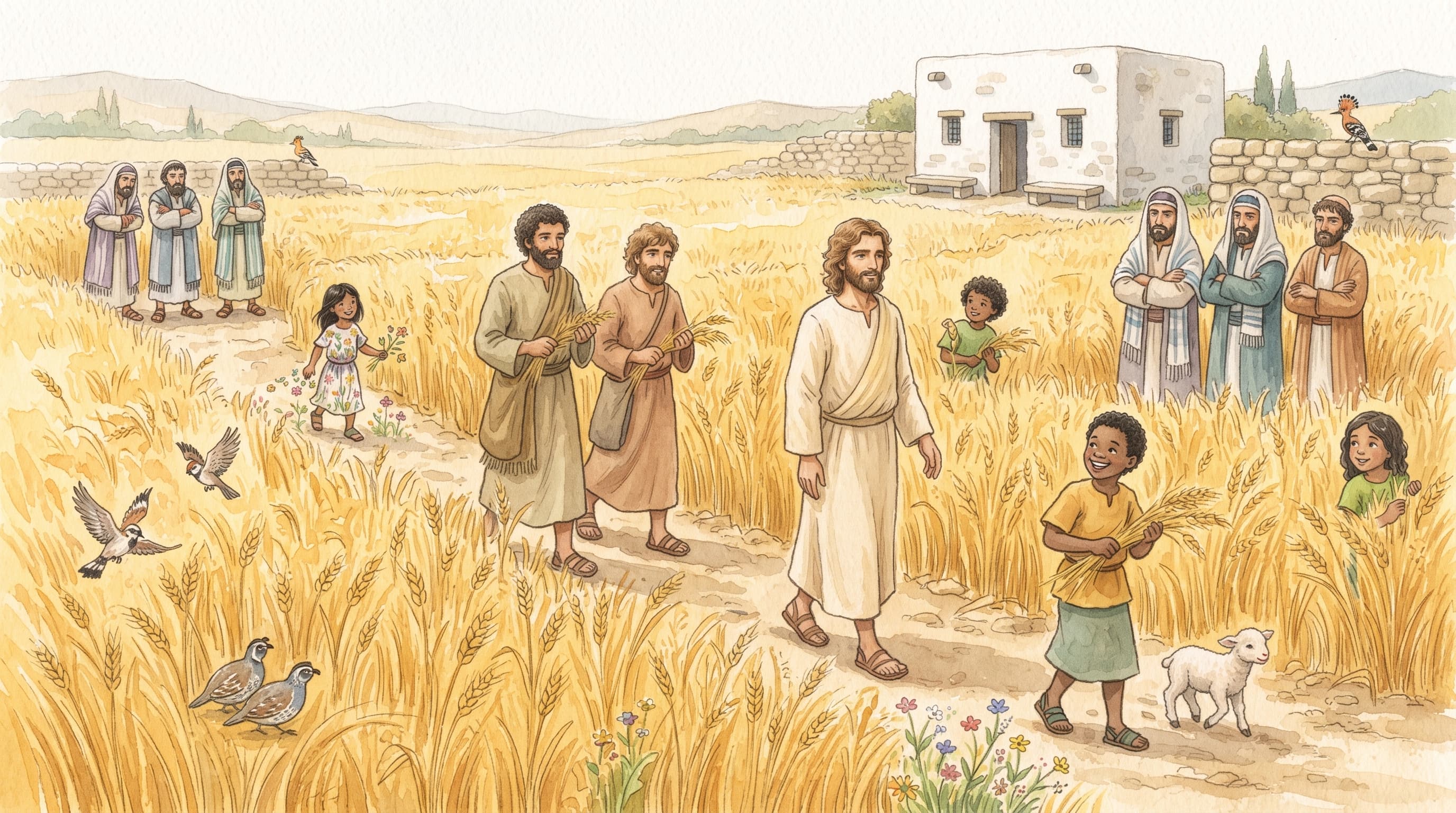
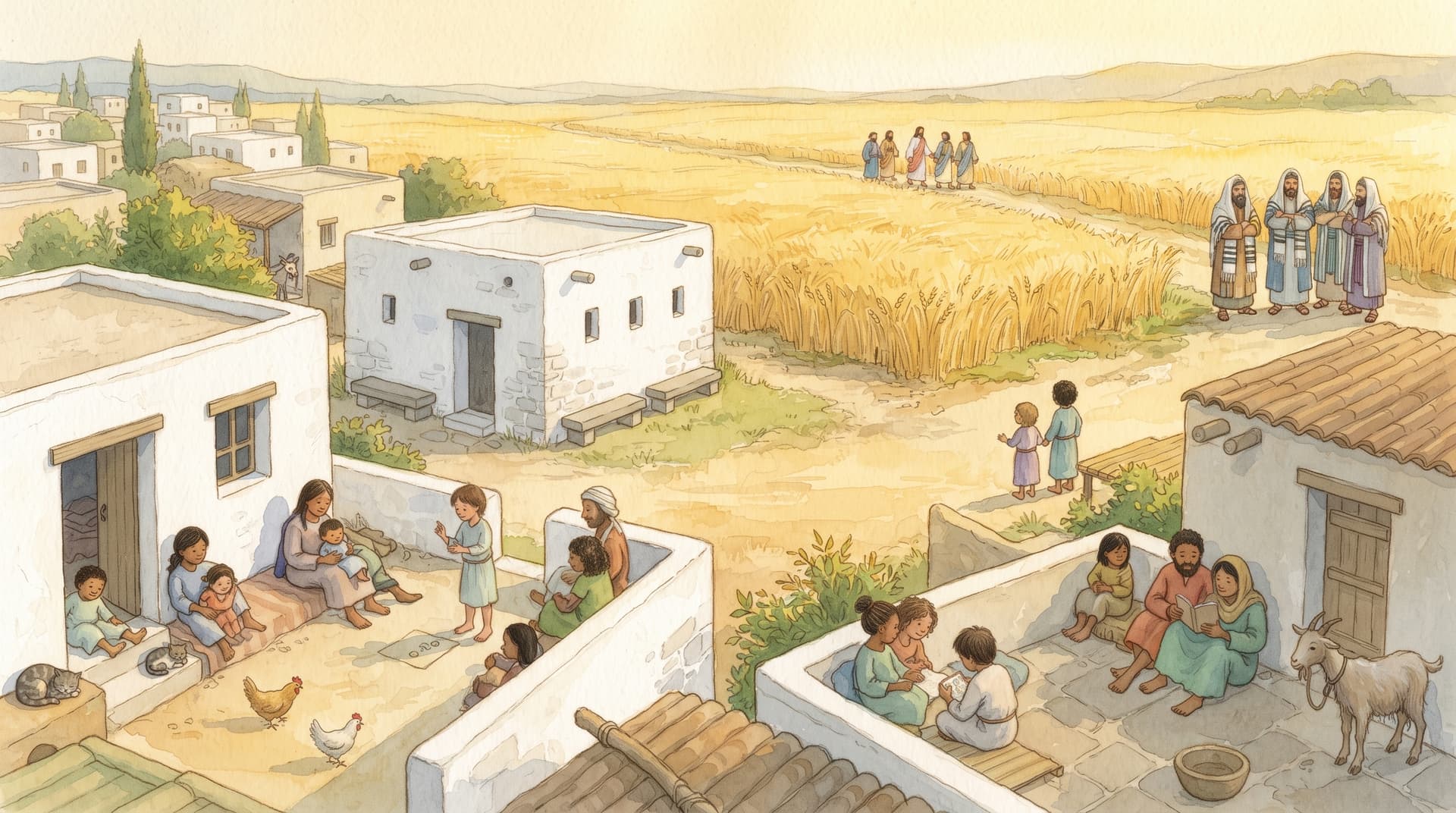
All three Gospels place these scenes back to back: Jesus and his disciples walking through a grain field on the Sabbath, and Jesus healing a man's withered hand in the synagogue on another Sabbath. Both times the Pharisees are watching. Both times they are looking for a reason to accuse him. Read together, they are one confrontation in two acts.
Why the Sabbath Carried So Much Weight
It went back to creation itself. God rested on the seventh day (Genesis 2:2-3) and later commanded Israel to do the same (Exodus 20:8-11) -- not as an arbitrary rule, but as a rhythm built into the universe. Sabbath-keeping was one of the Ten Commandments, carved in stone alongside "do not murder" and "do not steal."
It was the sign of the covenant. "You are to keep my Sabbaths, for this will be a sign between me and you for the generations to come" (Exodus 31:13, NGET). Circumcision marked a Jewish body. Sabbath marked a Jewish week. To keep it was to say: I belong to the God who rescued us from Egypt.
It was given to interrupt the instinct to earn what only God could give. The Sabbath command brackets the tabernacle instructions on both ends -- once right after the full blueprint, immediately before the two tablets are handed down (Exodus 31:12-17), and again right before construction begins (Exodus 35:1-3). In between sits the golden calf (Exodus 32): Israel's attempt to manufacture God's presence with their own labor and gold while Moses was on the mountain. The placement is deliberate. At the exact moment Israel was doing its most sacred work ever -- building the place where God would dwell among them and where their sin would be atoned for -- God said: stop, one day in seven, even on this. "...that I am the LORD who sanctifies you" (Exodus 31:13, NGET) -- not who empowers them to sanctify themselves. The Sabbath was less a rule about rest and more a weekly confession: nearness to God is a gift, not an achievement.
Breaking it was tied to exile. The prophets were blunt about why the exile happened: "you did not listen to me... you did not keep my Sabbaths holy" (Ezekiel 20:8, 13, 16, 21, 24, NGET, repeated five times in one chapter). Nehemiah confronted Sabbath-breaking directly, connecting it to the disaster that had already befallen their ancestors (Nehemiah 13:17-18). For a first-century Jew, guarding the Sabbath was not fussy legalism. It was guarding against repeating the worst thing that had ever happened to their nation.
Generations of teachers had built a fence around the command. By Jesus' day, rabbis had catalogued categories of forbidden Sabbath work -- reaping, threshing, and winnowing among them. The disciples plucking grain with their hands technically brushed against all three in miniature. The Pharisees watching Jesus in the synagogue were not inventing a problem. They were applying a system built, generation by generation, to protect Israel from ever losing everything again.
The Grain Field
The disciples were not stealing. Deuteronomy 23:25 explicitly permitted a hungry traveler to pluck grain by hand while passing through a field -- just not to bring a sickle. The issue was never theft. It was the day.
The Man with the Withered Hand
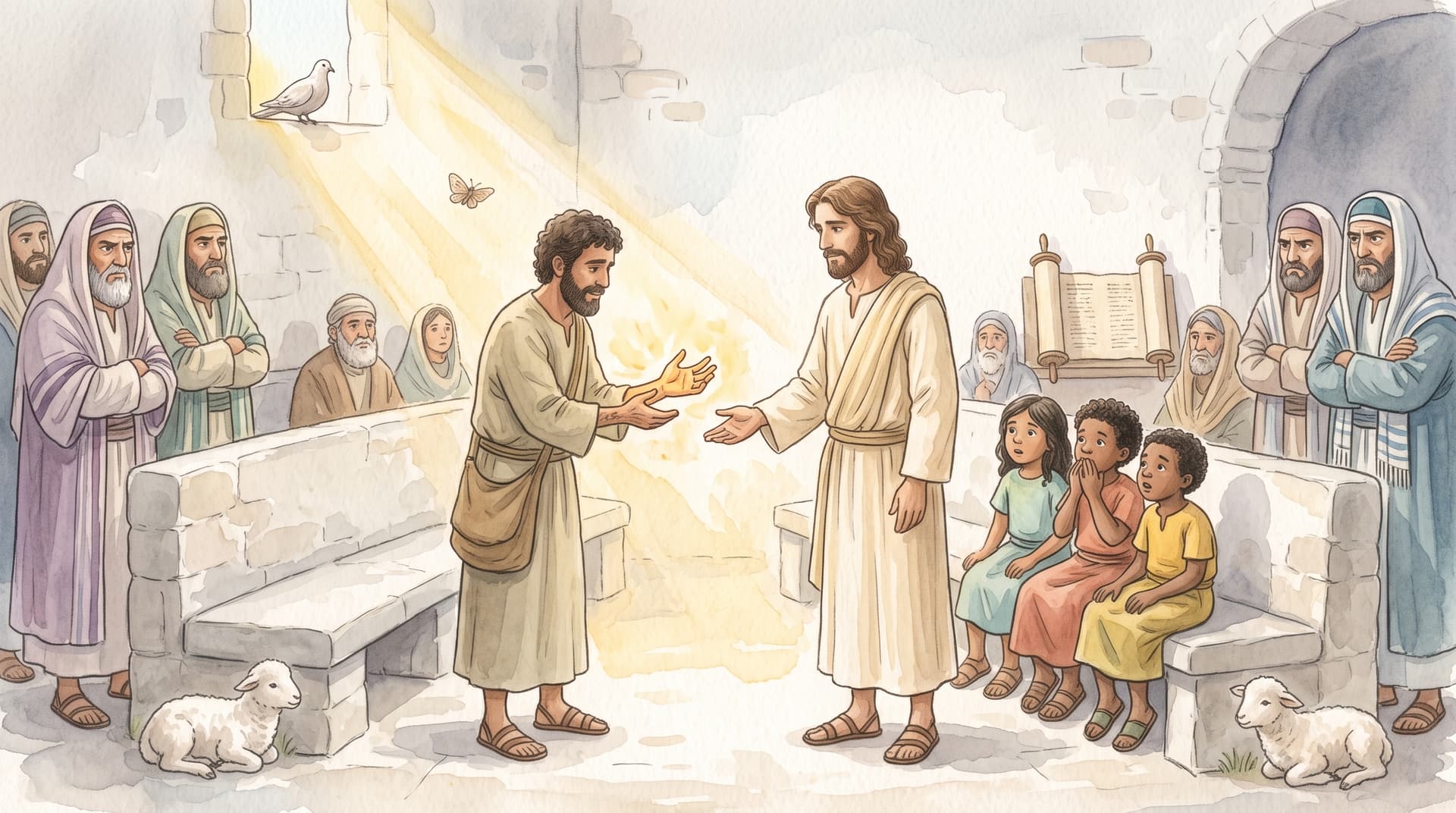
Luke is precise: the scribes and Pharisees "watched him closely, to see whether he would heal on the Sabbath, so that they might find a reason to accuse him" (Luke 6:7, NGET). This was not curiosity. It was surveillance -- a trap set in advance, with the sick man as the bait.
The Emotional Temperature
The Pharisees felt responsible for the nation's survival, and Jesus looked, to them, like a threat to the very thing that had kept Israel distinct through centuries of pressure to assimilate. What they did not expect was Mark's report of what happened next: after Jesus healed the man, "the Pharisees went out and immediately held counsel with the Herodians against him, how to destroy him" (Mark 3:6, NGET). Pharisees despised the Herodians -- collaborators with Rome, everything the Pharisees resisted. Two groups with nothing else in common found one thing that could unite them: opposition to Jesus.
Why This Matters for Kids
"Imagine a rule that everyone agreed was there to protect people -- like a lifeguard whistle at the pool. Now imagine some people started using the whistle to stop kids from helping a friend who was struggling in the water, because technically jumping in without permission broke a pool rule. That is what had happened to the Sabbath. A gift meant to give people rest had turned into a whistle used to stop people from getting help."
The Author’s Intent
What were the three Gospel writers each trying to show?
Movement 2: The Author's Intent
Passage: Matthew 12:1-14; Mark 2:23-3:6; Luke 6:1-11
"What were the three Gospel writers each trying to show?"
One Event, Three Angles
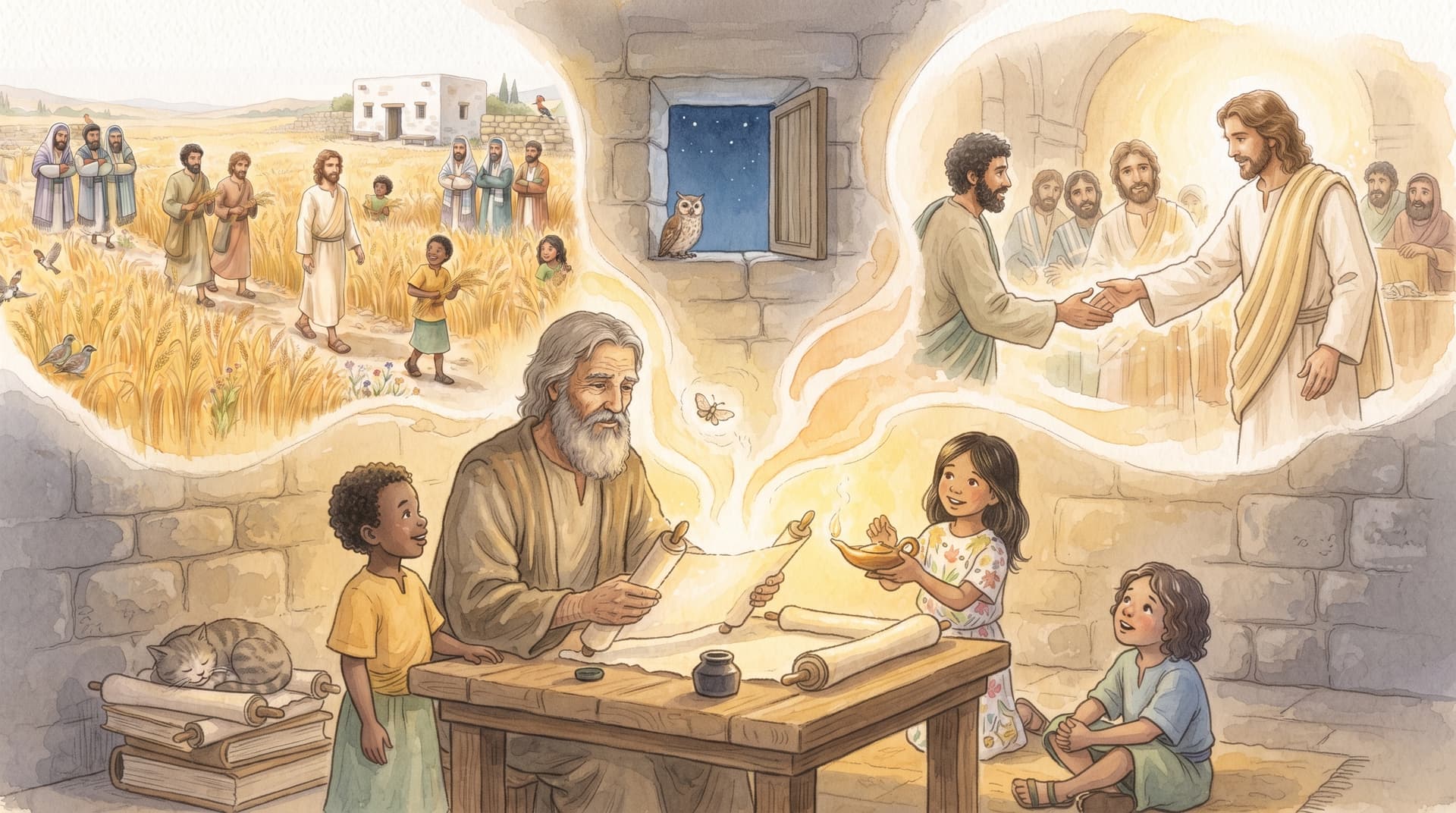
Matthew, Mark, and Luke all place these two Sabbath scenes together, in the same order, at a point where opposition to Jesus is visibly rising. But each writer is building a slightly different case.
All three open with the same shared image before any of them adds their own spin: Jesus defends his hungry disciples by pointing to David eating the Bread of the Presence (Matthew 12:3-4; Mark 2:25-26; Luke 6:3-4) -- bread kept in the tabernacle's Holy Place, inside the very structure the Sabbath command was built to interrupt-with-rest even during its own construction (Exodus 31:12-17; 35:1-3). That echo is not a Matthew-only flourish. It is baked into the tradition all three writers received, and each one leans on it differently.
Matthew: Something Greater Has Arrived
Matthew places this chapter right after Jesus says, "Come to me, all who labor and are heavy laden, and I will give you rest" (Matthew 11:28, NGET). Then, in the very next scene, Jesus is confronted about rest -- about the Sabbath itself. That placement is not an accident. Matthew wants readers to feel the collision: the true rest-giver is standing in a field, being questioned about a day that was only ever supposed to point to him.
Matthew is also the only Gospel writer to include Jesus quoting Hosea: "I desire mercy, and not sacrifice" (Matthew 12:7, NGET, quoting Hosea 6:6). And only Matthew has Jesus say plainly, "something greater than the temple is here" (12:6, NGET). Matthew is stacking claims -- greater than David, greater than the priests, greater than the temple -- to build toward the conclusion Mark states outright: this man outranks the Sabbath itself.
The Hosea quote is doing real theological work, not just rhetorical color: mercy and sacrifice are the same two poles the tabernacle-Sabbath pairing always held apart -- what God freely gives versus what human hands labor to produce. Matthew has Jesus name that polarity outright.
Mark: The Fifth Domino in a Row of Five
Mark groups five straight conflict stories in chapters 2-3: Jesus forgiving sins, eating with sinners, being questioned about fasting, the grain field, and the withered hand. This pair is the last two -- the climax of the set. Mark is building a case for Jesus' authority by showing every kind of religious objection Jesus provokes, and then letting readers watch the objections turn lethal: "the Pharisees went out and immediately held counsel with the Herodians against him, how to destroy him" (Mark 3:6, NGET). That sentence lands in chapter three of sixteen. Mark wants you to know, this early, exactly where the story is headed.
Mark alone preserves the fullest statement of the point: "The Sabbath was made for man, not man for the Sabbath. So the Son of Man is lord even of the Sabbath" (Mark 2:27-28, NGET). Every other detail in both scenes serves that sentence.
That statement is a claim about the day's original design, not an afterthought -- "made for man" in the sense of made for what actually serves him, which is exactly what the Sabbath's tabernacle-adjacent origin was for: sparing Israel from believing they had to labor for what only God could give. Mark's own account carries that origin story in miniature -- the bread David ate came from the tabernacle itself (2:25-26).
Luke: Authority Before the Sermon
Luke places both Sabbath scenes immediately before Jesus chooses the twelve apostles and delivers the Sermon on the Plain. The sequencing is deliberate: before Luke shows Jesus teaching with authority, he shows Jesus acting with authority -- over Scripture's meaning, over the Sabbath, over sickness. By the time Jesus opens his mouth to teach in Luke 6:20, the reader already knows exactly who is speaking.
It is worth noticing what that sermon says once he does speak: "be merciful, even as your Father is merciful" (6:36, NGET), blessing poured out on the poor and hungry rather than the accomplished (6:20-21). Luke stages two acts of unearned mercy right before a sermon built entirely on unearned mercy. The sequencing makes the same argument Matthew states and Mark defines -- without a single quotation.
The Useful Test
The three writers wrote this passage because their audiences needed to understand that Jesus was not offering a new interpretation of an old law. He was claiming the authority of the one who gave the law in the first place -- and that authority would cost him his life before the story was over.
Seeing God
What does this passage reveal about who God actually is?
Movement 3: Seeing God
Passage: Matthew 12:1-14; Mark 2:23-3:6; Luke 6:1-11
"What does this passage show us about God's beauty, glory, or character that we wouldn't see without it?"
The Facet of Beauty: A God Whose Rules Serve People, Because He Is Love
Most kids assume rules and love pull in opposite directions -- rules are the strict thing, love is the soft thing. This passage shows a God for whom that split does not exist. He gave the Sabbath because he loved his people -- not only so weary bodies could rest, but so they would stop believing that nearness to him was something they had to build. When rule-keeping started crushing the very people it was meant to protect, the God who wrote the rule stepped in to say so -- with his own authority, in person.
What Is Surprising About God Here
He Claims Ownership of His Own Gift
"The Son of Man is lord even of the Sabbath" (Mark 2:28, NGET). Only the one who instituted the Sabbath at creation has the standing to say what it actually means. This is not a rabbi offering a clever new interpretation. This is the Lawgiver walking back into his own law and correcting how it had been used.
Their Precision Became Their Own Golden Calf
The very command they were enforcing had been given, generations earlier, to interrupt exactly what they were now doing. The Sabbath was bracketed around the tabernacle instructions to teach Israel that nearness to God could not be built by human hands -- and in the same book, while Moses was still on the mountain, Israel built a golden calf to secure that nearness by their own labor and gold anyway (Exodus 32). The Pharisees' meticulous fences around Sabbath-keeping were a quieter version of the same instinct: something achieved by human effort -- precision, case law, generations of careful scholarship -- that they had come to trust in and measure others by. Watching a hurting man rather than helping him was not a random cruelty. It was the golden calf again, dressed up as devotion.
His Priorities Are Backwards From What Anyone Expected
"Is it lawful on the Sabbath to do good or to do harm, to save life or to kill?" (Mark 3:4, NGET; Luke 6:9). The Pharisees came to catch Jesus breaking a rule. Jesus reframes the entire question: on this day made for rest and life, is it possible that doing nothing has become the actual violation? God's law was never neutral. Silence in the face of someone's suffering is not automatically safe.
He Feels Something Rare in the Gospels
"He looked around at them with anger, grieved at their hardness of heart" (Mark 3:5, NGET). This is one of the only places any Gospel names Jesus' anger outright -- and it is paired immediately with grief. He is not angry that a rule might be bent. He is grieved that people would rather watch a man stay broken than see their system disrupted. God's anger has an address, and it is pointed at hardness of heart, not at mercy.
He Heals in Public, on Purpose, Knowing the Cost
Jesus does not wait for a private moment. He tells the man to stand up in front of everyone (Luke 6:8) and heals him in the open, fully aware that religious leaders were watching for exactly this. He does not hide the good thing to avoid the conflict it will cause. He does the good thing and lets the conflict come.
What God's Emotions Look Like Here
Righteous anger, aimed precisely. Not at the man with the withered hand. Not at his own disciples for being hungry. At leaders who would rather protect a system than heal a person.
Grief over hard hearts. The same verse holds both anger and grief together -- God is never merely irritated. He is wounded by what hardness of heart does to people.
Unhurried authority. Jesus does not argue his way into permission. He states what is true -- "the Son of Man is lord of the Sabbath" -- and acts on it.
The Worship Test
The specific facet of beauty on display: God's rules were always meant to serve people, because the God who made them is love -- and he has the authority to say so, even when it costs him.
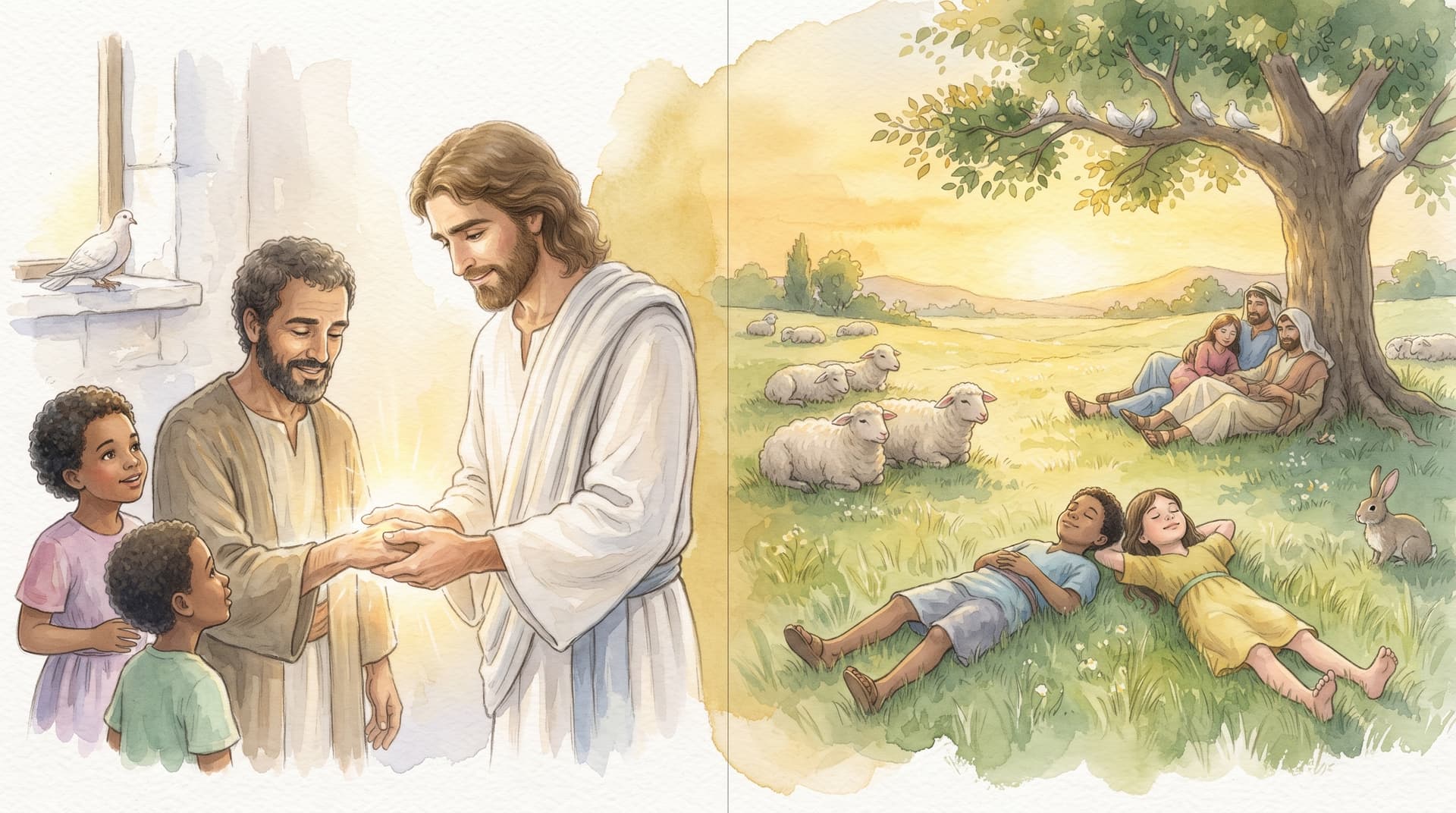
The beauty is this: a God who could have stayed silent and safe instead stood in front of watching enemies, looked at a man's ruined hand, and healed it anyway -- not because he needed to prove a point, but because a hurting man was standing right in front of him on the one day that was supposed to be about rest and life. He would rather be hated for doing good than be safe for doing nothing.
Gospel Connection
How does this passage connect to the gospel?
Movement 4: The Specific Gospel Connection
Passage: Matthew 12:1-14; Mark 2:23-3:6; Luke 6:1-11
"How does Jesus fulfill, complete, or embody what this passage reveals -- SPECIFICALLY, not generically?"
The Rule
The connection has to be specific to what these two Sabbath scenes reveal. If the same point fits any other passage, it is not specific enough.
Jesus Is the Rest the Sabbath Was Pointing To
"Come to me, all who labor and are heavy laden, and I will give you rest" (Matthew 11:28, NGET) sits one paragraph before the grain field. That is not a coincidence -- it is the connection. The Sabbath was a weekly rehearsal of a rest that was still coming. Hebrews says it plainly: "there remains a Sabbath rest for the people of God" (Hebrews 4:9, NGET). The next verse says what that rest actually is: "whoever has entered God's rest has also rested from his own works, as God did from his" (Hebrews 4:10, NGET) -- the tabernacle-Sabbath pairing in one sentence, rest from the labor of trying to secure your own nearness to God. Jesus is not cancelling the Sabbath. He is the reality the Sabbath was a shadow of.
Specific connection: Every Sabbath before Jesus was practice for resting in him. You do not earn rest from Jesus by keeping a perfect record. You receive it by coming to him, tired, exactly as you are.
Jesus Is Greater Than David and Greater Than the Temple
Jesus defends his disciples by pointing to David, who ate consecrated bread reserved for priests when he and his men were hungry and fleeing for their lives (1 Samuel 21:1-6; Matthew 12:3-4). Then Jesus goes further: "something greater than the temple is here" (Matthew 12:6, NGET). He is not just claiming a loophole David used once. He is claiming to outrank the king Israel most revered and the building Israel considered God's own address.
Even David's exception proves the point: the bread he ate was consecrated bread from the tabernacle's Holy Place, given to him not because he had earned it but because he was in need. Jesus is not finding a loophole in that story. He is standing in the middle of the very building whose entire existence taught Israel that access to God runs on mercy, not merit -- and telling everyone he outranks it.
Specific connection: If Jesus is greater than the temple, then -- just like the temple-cleansing revealed -- access to God does not run through a building or a bloodline anymore. It runs through him. He is not bending the old system's rules. He is the reason the old system existed at all.
The Hand That Could Not Move Itself
The man's hand was withered -- shriveled, powerless, unable to obey his own will no matter how hard he tried. Jesus does not touch it first. He says, "Stretch out your hand" (Mark 3:5, NGET), a command the man could not obey on his own strength a moment before he obeyed it. The man's own effort could not have produced this. Jesus' word did what the man's will alone never could.
This is not a generic illustration of grace. It is a precise reenactment of what the Sabbath was built to teach. On the very day instituted to interrupt Israel's instinct to labor for what only God can give, Jesus heals a man for whom labor is not even an option -- there is no effort the hand could contribute, no trying harder that would move it. Rescue has to come from entirely outside the man, on the day set aside to teach Israel that rescue always does.
Specific connection: Every kid has something in them that will not just fix itself no matter how hard they try -- a temper, a fear, a habit, a broken friendship. Jesus does not just give advice for trying harder. He speaks, and dead things move. Salvation works the same way: he commands what we cannot do on our own, and his word supplies the power to do it.
The Specific Mending
The brokenness this passage reveals: We take good gifts God gives -- rules, routines, traditions -- and quietly turn them into tools for measuring who is in and who is out, who is good enough and who is not. The Pharisees did not set out to become people who valued a rule over a hurting man. It happened slowly, rule by rule, until the system mattered more than the person it was built to protect -- the same slow drift Israel fell into at the foot of the mountain, trading a gift they could not build for a god they could (Exodus 32).
The specific mending: Jesus does not throw out the Sabbath. He restores it to what it was always for -- rest, mercy, life -- by placing himself at the center of it as Lord. He does not let good things stay twisted into cages. He reclaims them.
The new earth: The Sabbath rest that began at creation and was rehearsed every week points to an unending rest still ahead -- "there remains a Sabbath rest for the people of God" (Hebrews 4:9, NGET). One day, the striving to keep rules, to measure up, to prove you belong, ends completely. What is left is rest that never runs out, in the presence of the one who is Lord of it.
The Anti-Moralism Checkpoint
-
"Be like Jesus and stand up to unfair rules." Misses the point. This is not a lesson in defiance. Jesus was not rebellious -- he was the Lawgiver restoring his own law to what it meant.
-
"Don't be like the Pharisees, always judging people." True but shallow if left there. The deeper issue is that anyone -- including us -- can turn a good gift into a weapon without noticing it happening.
-
"Jesus shows us it's okay to break rules sometimes." Dangerous without context. Jesus had the authority to define the Sabbath because he made it. We do not have that same authority over rules we did not write.
-
"And this all points to Jesus who died for our sins." Too generic. This passage specifically reveals Jesus as the rest the Sabbath always pointed to, greater than David and the temple, and the one whose word moves what our own effort cannot.
Why Kids Care
How does this truth intersect with their actual lives?
Movement 5: Why Should a 5-10 Year Old Care?
Passage: Matthew 12:1-14; Mark 2:23-3:6; Luke 6:1-11
"What does this mean for their actual lives of play, fun, friendship, and family?"
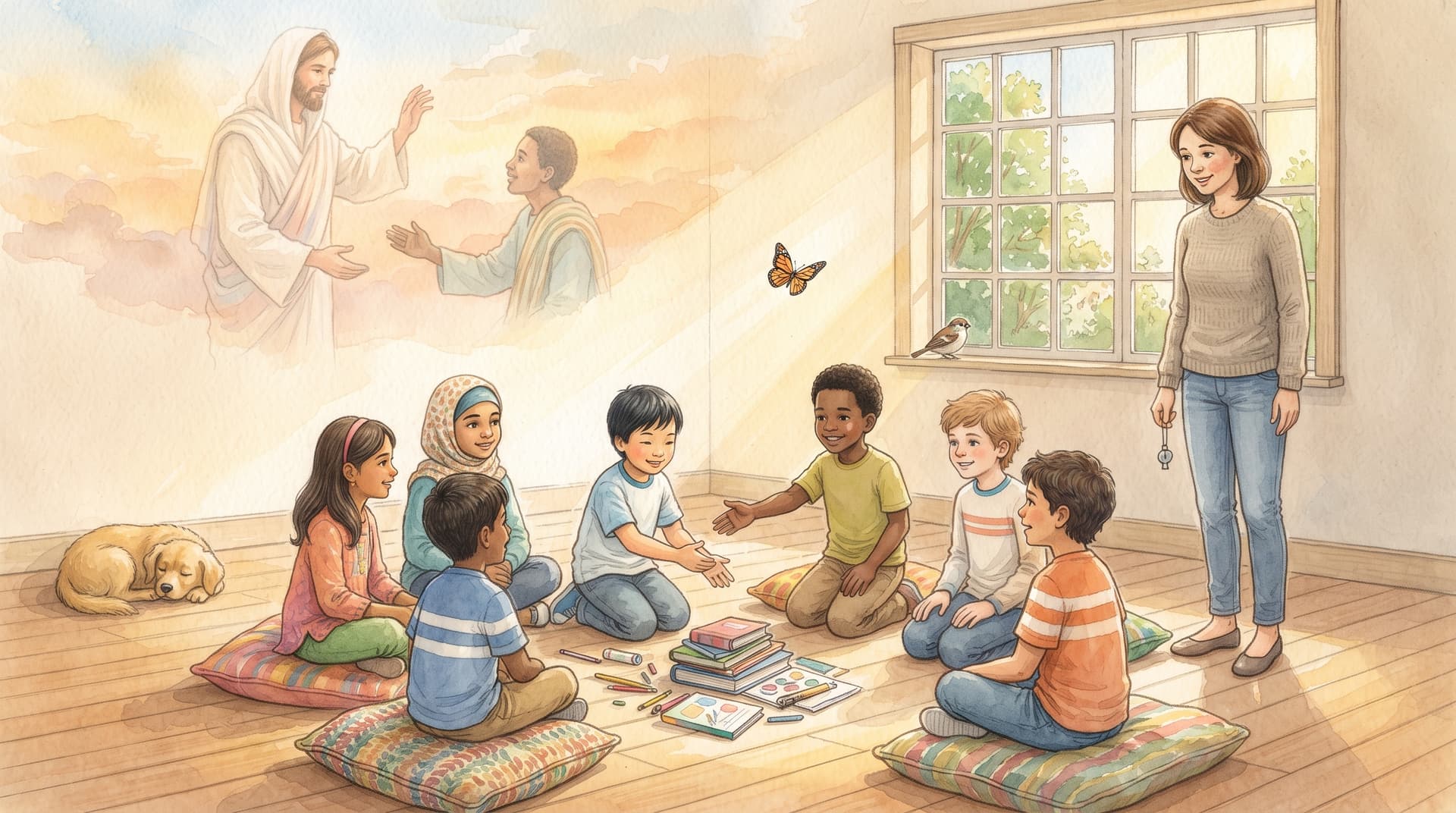
This movement is a brainstorm -- a menu of angles, illustrations, and landing points for the teacher to pray through. The Spirit knows what your specific kids need. Pick what resonates, adapt freely, let the rest go.
The Lesson: The Rule and the Hand
The Arc
Three truths to land across the two scenes:
1. "Jesus and his friends were hungry, so they picked some grain to eat -- and people got mad about the day, not the eating." God's rules were never supposed to stop people from getting help when they needed it.
2. "Jesus saw a man with a hand that couldn't move, and some people were more worried about a rule than about the man." Jesus asked: is it better to do good or to do nothing? Then he healed the man, right in front of everyone.
3. "Jesus said, 'I am the Lord of the Sabbath.'" That is not a small thing to say. It means Jesus made the rule -- so he gets to say what it actually means. And what it means is: rest and mercy, not rules that hurt people.
The Role Play
Characters: Narrator (teacher), Jesus (volunteer), Disciples (2-3 kids), Pharisees (2-3 kids with clipboards), Man with the withered hand (1 kid, one arm tucked behind their back or held still).
Scene 1 -- The Grain Field. Set up a "field" with paper "grain" (torn paper strips or yellow pom-poms) scattered on the floor. Jesus and the disciples walk through, hungry, picking some up to eat. The Pharisees rush in with clipboards: "That's against the rules! It's the Sabbath!" Teacher: "What do you think Jesus is about to say?"
Scene 2 -- David and the Bread. Teacher narrates briefly: "Jesus said, 'Remember when David and his friends were starving and ate the special bread that was only for priests? Nobody said David was wrong. Because God cares more about a hungry friend than a rule about bread.'"
Scene 3 -- The Synagogue. Move to a new spot -- "the synagogue." The Pharisees stand off to the side, watching closely, clipboards ready. The kid playing the man with the withered hand stands in the middle. Jesus says, "Stand up here, where everyone can see." Ask the group: "Why do you think Jesus wants everyone watching?"
Scene 4 -- The Question. Jesus turns to the Pharisees: "Is it right to do good on the Sabbath, or to do nothing? To help, or to let someone stay hurt?" Let the silence sit for a second -- narrate: "Nobody answered him."
Scene 5 -- The Healing. Jesus says, "Stretch out your hand." The kid brings the tucked arm out and holds it up, healed. Cheering optional. Then narrate: "The Pharisees were so angry, they left and started planning how to get rid of Jesus." Let that land -- healing a hand led straight to a plan to kill him.
Why Should They Care?
Angle 1: When You Can't Fix It Yourself
The kid's world: Trying and trying to stop being scared of the dark, to control a temper, to stop a habit -- and no matter how hard you try, it doesn't budge. Like a hand that just will not move no matter how much you want it to.
The God-first landing: The man could not heal his own hand. No amount of trying would have worked. Jesus said, "Stretch it out" -- and the same moment he said it, the man could actually do it. Jesus' word did what the man's own effort never could.
Teacher note (the deeper thread): This is bigger than the hand. Even when God's people were building his special tent -- the most important building project they had ever done -- God told them to stop and rest one whole day a week (Exodus 31:12-17; 35:1-3). Not because the work wasn't important. Because he wanted them to know, every single week, that being close to him was never something they could build their way into. It was always a gift. The withered hand says the same thing with skin on: some things you cannot fix by trying, no matter how important the project.
Landing statement: "Some things you can't fix by trying harder. Jesus doesn't just tell you to try harder. He speaks, and things that were stuck start moving."
Angle 2: You Don't Have to Earn What's Already Yours
The kid's world: Adults work a job for money and security. Kids work too -- just for a different currency. Being extra good, extra quiet, extra helpful right after doing something wrong, hoping it makes a parent forget or love you the same as before. Trying hard to be funny or agreeable so you don't get left out of the group chat, the team, the lunch table. Being the "good kid" at school or church not because you want to be, but because it feels like that's what keeps you noticed, wanted, safe. An invisible scorecard, running all day: was I good enough today to deserve the hug, the smile, the "good job"?
The God-first landing: Even when God's people were doing their most important work ever -- building the tent where he would live with them -- he told them to stop working, once a week, on purpose (Exodus 31:12-17; 35:1-3). Not because rest is nice. Because he wanted them to feel, over and over, that his nearness was never a paycheck for good behavior. It was a gift, before they did anything to deserve it. When Jesus healed the man's hand, the man did not perform his way into being helped -- he just needed help, and Jesus gave it. That is how God feels about you too: not "be good enough and I will love you," but "I love you, so come close." Even really religious grown-ups get this wrong sometimes -- it is not just a kid thing. It is what people do.
Landing statement: "You don't have to earn a place next to God. He already made room for you -- before you did anything to deserve it."
Angle 3: When a Good Rule Turns Into a Trap
The kid's world: A game rule meant to keep things fair getting used to be mean instead -- "you moved a half-second early so you're out, no do-overs, ever," even when everyone knows it was an accident. A chore chart meant to help the family turning into a weapon: "you didn't do it exactly right, so it doesn't count."
The God-first landing: The Sabbath was a gift -- a whole day for rest, for family, for being with God, no working required. Somewhere along the way, some people had turned that gift into a trap, using it to catch people instead of helping them rest. Jesus did not throw the rule away. He showed everyone what it was for in the first place.
Landing statement: "God's rules are gifts, not traps. Jesus is the one who gets to say what they're actually for -- and it's always for helping people, not hurting them."
Angle 4: Jesus Knows the Rules Better Than Anyone -- Because He Wrote Them
The kid's world: A kid who knows a game so well -- board game, sport, playground rules -- that they can settle any argument about what's actually allowed, because they know it better than anyone else at the table.
The God-first landing: The Pharisees had studied the Sabbath rules their whole lives. Jesus still knew them better -- because Jesus made the Sabbath in the first place, all the way back at creation. When Jesus tells you what a rule is really for, he is not guessing. He wrote it.
Landing statement: "Jesus isn't breaking God's rules. Jesus is the one who made them, so he gets the final word on what they mean."
Angle 5: Doing Good Even When It Makes People Mad
The kid's world: Wanting to help a kid who's being left out, but worrying the popular kids will be annoyed. Staying quiet about something kind you want to do because it might cause a scene.
The God-first landing: Jesus knew the Pharisees were watching, waiting to be angry. He healed the man anyway, right in the open, right in front of them. He would rather do good and face the anger than stay quiet and safe.
Landing statement: "Jesus did the kind thing even though he knew it would make people furious. You can do the kind thing too, even if someone might not like it."
Object Lesson Option: The Whistle That Changed Jobs
Setup: Bring a whistle (or any noisemaker). Explain: "This whistle's job at a pool is to keep people safe -- the lifeguard blows it if someone is in danger, and everyone knows to help." Demonstrate a normal use: blow the whistle, everyone "freezes" to check on a pretend swimmer in trouble.
Now flip it: "But imagine the whistle started getting used a different way." Blow the whistle every time someone almost does something helpful -- reach out a hand to a friend, offer to share, get up to help someone who dropped something -- and shout "Rule broken!" and make them stop. Do this a few times, exaggerating how silly and frustrating it feels to be stopped from helping.
Debrief: "How did that feel -- getting stopped from doing something kind because of the whistle? The whistle didn't change. But what it was being used for changed completely. It went from protecting people to stopping people from helping each other.
That is what had happened to the Sabbath by the time Jesus showed up. It started as a gift -- a whole day of rest that God gave his people because he loved them. But by Jesus' time, some people were using it like that flipped whistle -- blowing it every time someone tried to do something good.
Jesus didn't throw out the Sabbath. He is the one who made it in the first place, so he had the right to say what it was actually for. He picked up a hurting man's hand and healed it right there, on the Sabbath, in front of everyone -- because that is exactly what the day was supposed to be about: people getting help, people getting rest, people getting to be near God without being afraid.
That matters for you because sometimes you will see a rule -- at school, in a game, even at home -- being used to stop someone from getting help instead of to protect them. Jesus shows you what to do: don't be afraid to do the good thing. Rules are supposed to serve people. Jesus said so, and he should know -- he wrote them."
Follow-Up Questions
- "Why do you think the Pharisees were watching Jesus so closely?"
- "What do you think it felt like for the man to hear, 'Stretch out your hand,' and not be able to yet?"
- "Have you ever seen a rule used to stop someone from helping instead of to protect them?"
- "Why do you think Jesus healed the man out in the open instead of somewhere private?"
- "What does it mean that Jesus is 'Lord of the Sabbath'?"
Age Notes
Younger (5-6)
- Lean on the physical: hungry friends picking grain, a hand that couldn't move and then could. Have them stretch out their own hands together when you get to that part.
- Skip the David and the temple comparisons -- they will lose the thread. Land on: "Jesus made the special rest-day, so he gets to say what it's for. And it's for helping people."
- Landing: "Jesus loves it when you help someone, even on a day for resting."
Older (8-10)
- Push into "something greater than the temple is here." Ask: "What is Jesus saying about himself by saying that?" Let them sit with how big that claim is.
- Connect to Mark 3:6 -- healing a hand led directly to a plan to kill Jesus. Ask: "Why would healing someone make people want to hurt Jesus?" This age can handle that goodness sometimes provokes anger, not gratitude.
- Wrestle with anger and grief together: "Jesus was angry AND sad in the same moment (Mark 3:5). Can you feel both those things at once? What does that tell you about how Jesus feels when people choose hardness over mercy?"
- For kids ready for it, mention that the rest-command was given right alongside the instructions for building God's special tent (the tabernacle) -- even that most important project had to stop for the Sabbath. Ask: "Why would God tell them to stop working on the most important project ever, once a week?" Let them wrestle toward: because being close to God was never about how hard they worked.
What to Skip
- The full list of 39 categories of forbidden Sabbath work. One sentence is enough: "There were a lot of detailed rules about what counted as work on the Sabbath."
- A deep dive into the Pharisee-Herodian political alliance. Just note: "Two groups that usually disagreed about everything agreed on one thing -- they wanted to stop Jesus."
- Debating exactly which Old Testament laws were ceremonial versus moral. Not useful for this age. Stay on the passage's own point: rules exist to serve people.
Landing Statements
Format: God is/does ___. And because of that, you ___.
- "Jesus is Lord of the Sabbath. He made the rule, so he gets to say what it's for -- and it's always for helping people, not hurting them."
- "Jesus would rather do good and face anger than stay quiet and safe. You can do the kind thing too, even when someone might not like it."
- "Jesus speaks, and things that were stuck start moving. Some things you can't fix by trying harder -- but he can fix them by a word."
- "Jesus is greater than the temple, greater than David, greater than any rule. He is the rest every rule was pointing toward."
- "Being close to God was never something to build. It was always a gift he wanted to give you."
Teacher Quick Reference
Framing Sentences
- The setting: "Two Sabbaths. Two moments where people watched Jesus closely, hoping to catch him doing something wrong."
- The grain field: "Jesus' friends were hungry. They picked some grain. People got upset -- not about the eating, about the day."
- The synagogue: "A man's hand couldn't move. Jesus asked, 'Is it better to help or to do nothing?' Then he healed him, right there, in front of everyone."
- The claim: "Jesus said, 'The Son of Man is Lord of the Sabbath.' He wasn't bending a rule. He was the one who wrote it."
Themes Already in Kids' World
- A rule that's supposed to help, twisted into something that hurts. Every kid has felt this in a game or at home.
- Trying so hard to fix something and it just won't budge. Every kid knows this feeling.
- Working hard to be good enough for love, acceptance, or approval. Every kid has felt this with a parent, a friend group, or a teacher -- and quietly assumes God works the same way.
- Doing the kind thing even when someone might get mad. Every kid has faced this choice.
- Someone who knows the rules better than anyone because they made them. A parent, an older sibling, a coach.
Kid Questions
"Were the disciples doing something wrong by picking the grain?" "No -- the Bible actually said hungry travelers could pick grain by hand as they walked through a field. The only issue some people had was that it happened on the Sabbath. Jesus showed them that helping a hungry friend was never against God's real rule."
"Why did healing someone make the Pharisees so angry?" "They cared so much about protecting their rules that they forgot rules are supposed to help people, not the other way around. When Jesus helped someone instead of following their system exactly, it made them furious instead of glad."
"What does it mean that Jesus is 'Lord of the Sabbath'?" "It means Jesus isn't just someone who follows the rule about rest -- he's the one who made it. So when he says what the rule is really for, he's not guessing or bending it. He's the only one who actually gets to say."
"Did the man do anything to heal his own hand?" "He couldn't -- that's the whole point. His hand wouldn't move no matter how hard he tried. All he did was listen to Jesus and try to stretch it out when Jesus told him to. Jesus' word did the healing."
"Are rules bad, then?" "No -- God gives good rules because he loves us. The problem isn't rules. It's when people forget what the rules are for and start using them to hurt people instead of help them. Jesus shows us what every good rule is actually for."
"Do I have to be really good for God to love me?" "No. That's exactly the thing this story is about. Even God's people, while they were doing the most important work they'd ever done, were told to stop and rest -- so they'd remember his love wasn't something they had to earn. You don't have to be extra good, extra quiet, or extra impressive for God to want you close. He already does."
The Bottom Line
This lesson gives kids a Jesus who is Lord over the very rules people thought he was breaking. He does not dismiss the Sabbath -- he restores it, standing in the middle of a system that had lost its way and showing everyone what it was for all along: not a reward for labor, but rest, mercy, and life, freely given.
The temptation will be to land on "don't be legalistic like the Pharisees" or "it's okay to break rules for a good reason." Resist both. The lesson is not a warning about legalism or a permission slip for rule-breaking. The lesson is that Jesus has the authority to define what God's good gifts are for -- because he is the one who gave them. And what he shows, every time, is that they were always for people he loves.