Treasures in Heaven
A lesson preparation guide for teaching 5–10 year olds
The Original Audience
What did this mean to the people who first heard it?
Movement 1: The Original Audience
Passage: Luke 12:13-34
"What did this mean to the people who first heard it?"
An Ordinary Interruption
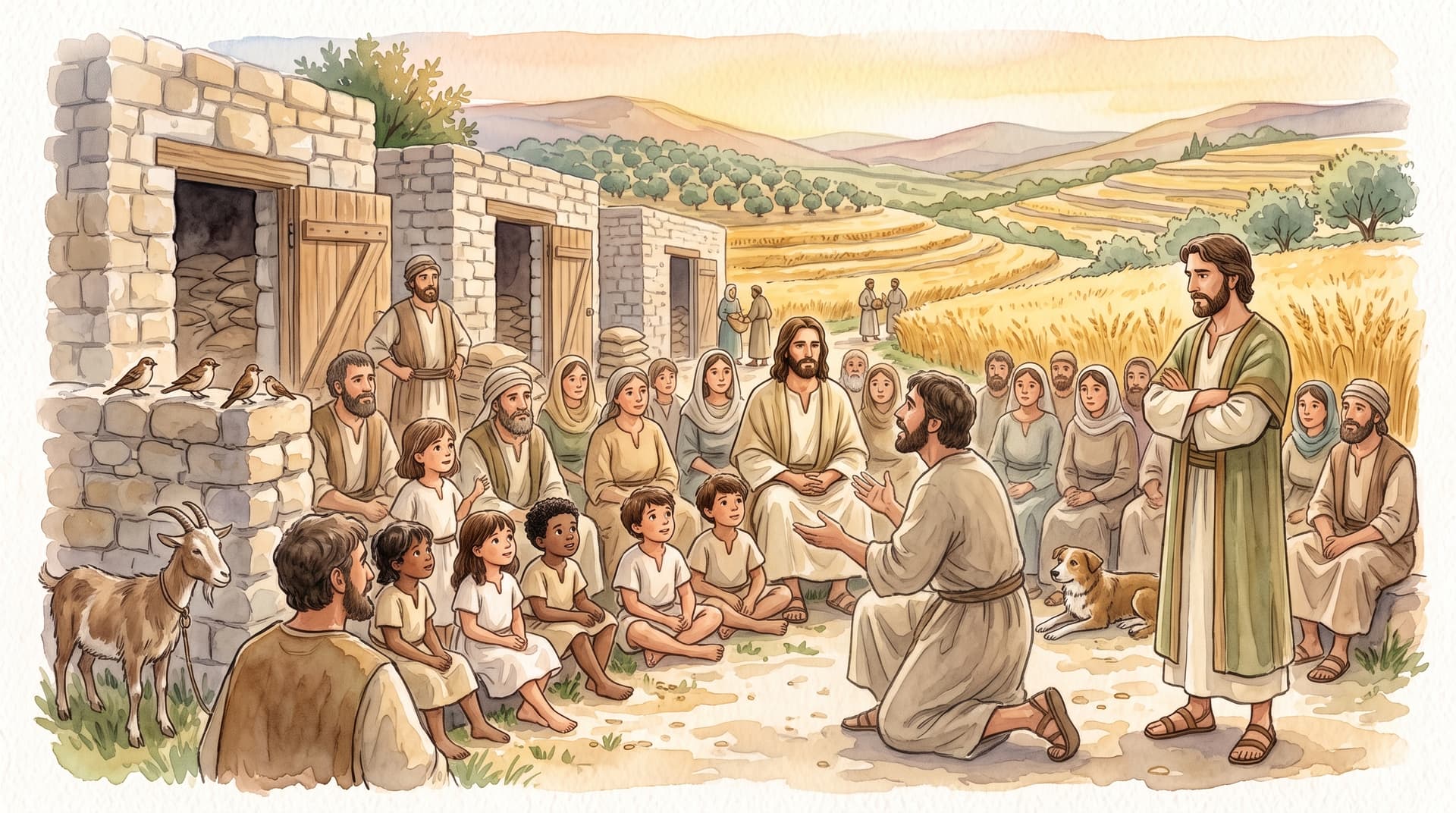
A man calls out from the crowd: "Teacher, tell my brother to divide the inheritance with me" (12:13). This wasn't strange. Rabbis were regularly asked to settle inheritance disputes, and under Jewish custom the firstborn received a double portion (Deuteronomy 21:17) — plenty of room for brothers to fight over what was "fair." The original audience would have leaned in, expecting Jesus to rule on the case. He refuses outright, then does something sharper: he skips past the legal question entirely and names the disease underneath it. "Watch out! Be on your guard against all kinds of greed" (12:15).
A Harvest Too Big for Its Barns
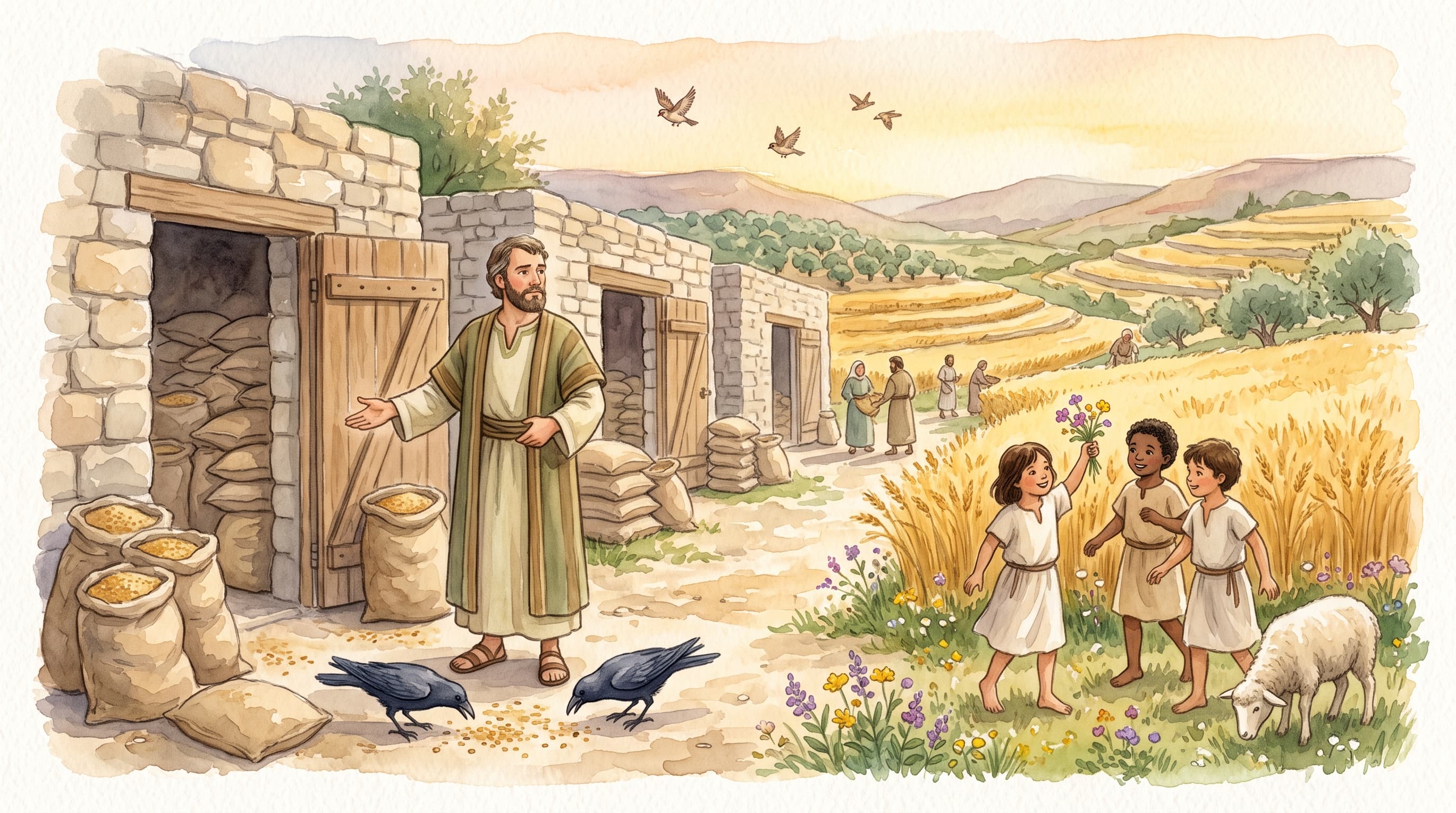
Grain in first-century Galilee was stored in stone barns or underground pits — modest structures, sized for an ordinary year. A harvest so large it overflowed existing storage was a farmer's dream, the kind of windfall most of Jesus's listeners, many living close to subsistence, would never see in a lifetime. This man isn't reckless or lazy. He's the most secure person in the story. That's what makes the ending land so hard — even the safest possible life, by the world's math, is one bad night from over.
Talking Only to Himself
"What shall I do?" he asks — and answers himself (12:17-19). Six times in three verses, the words "I" and "my" appear: my crops, my barns, my grain, my goods, my soul. No wife, no children, no neighbor, no God enters this conversation. The original audience — an honor-shame culture built on kinship, hospitality, and shared harvests — would have felt the isolation immediately. A rich man in their world was supposed to have people all around him. This one has only himself.
"Eat, Drink, and Be Merry"
The phrase echoes Ecclesiastes' refrain (2:24, 8:15) — but stripped of the Preacher's constant tether to the fear of God. Anyone who knew Ecclesiastes would hear half the quotation and wait for the other half. It never comes. God's interruption — "You fool! This very night your life will be demanded of you" (12:20) — uses courtroom language: a debt suddenly called due. His life was never his to plan around. It was on loan.
Ravens and Lilies
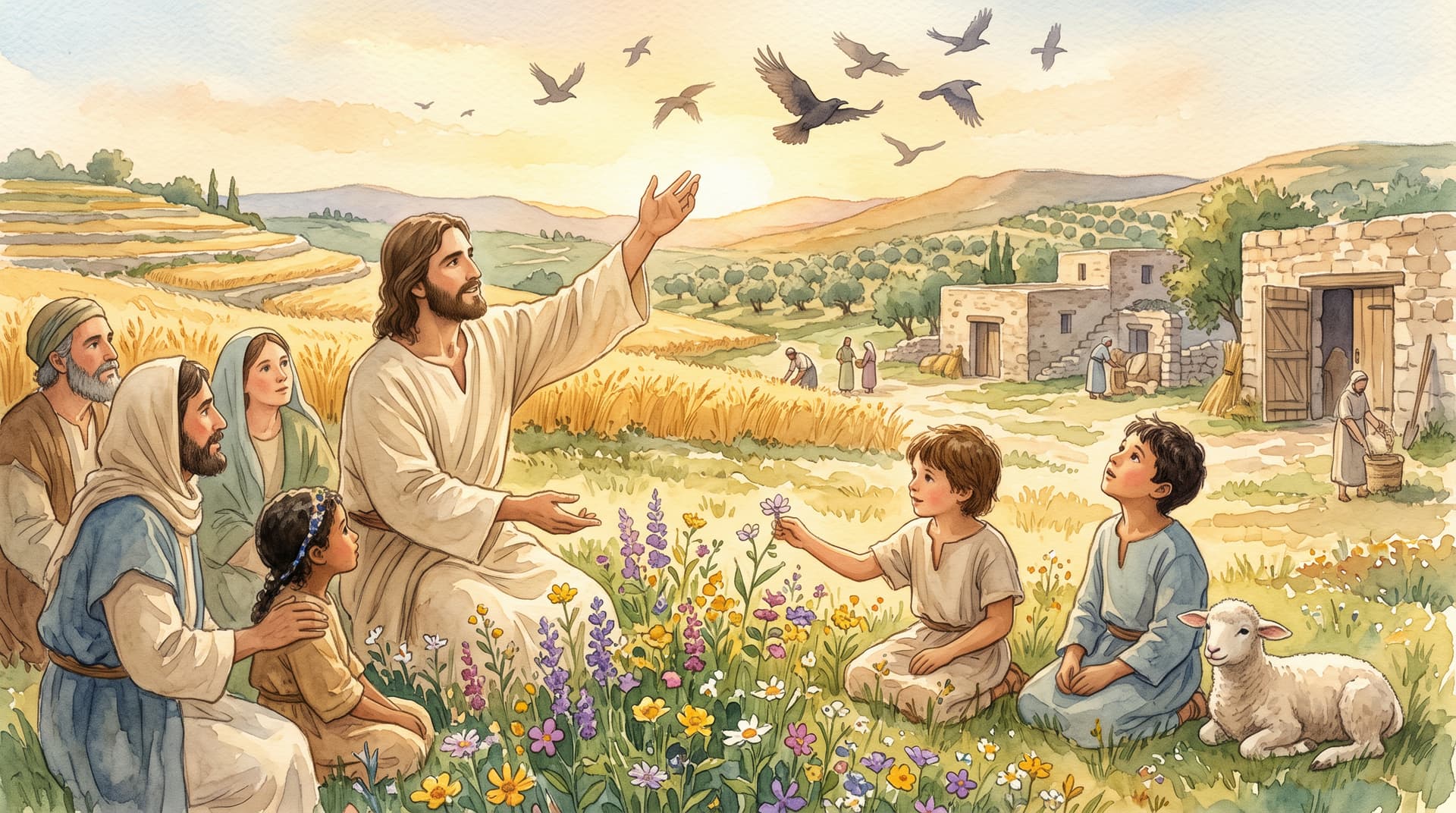
Jesus doesn't illustrate God's care with an eagle or a cedar. He picks a raven — a scavenger bird, ceremonially unclean under the law (Leviticus 11:15), the kind of bird nobody farms or stores grain for — and a wildflower that blooms for a season and gets burned as oven fuel. To an audience that knew exactly which animals were "clean" and "useful," the choice was pointed: God provides lavishly for the very things his own law calls worthless. How much more for you.
What the Original Audience Heard
A man wanted Jesus to referee a fight over land. Jesus answered a bigger question nobody asked: what happens to a person who builds his whole future on barns that can't outlive a single night — and what happens to the ravens, the flowers, and the "little flock" who trust a Father instead.
The Author’s Intent
What is Luke doing with this passage?
Movement 2: The Author's Intent
Passage: Luke 12:13-34
"What is Luke doing with this passage?"
The Gospel Most Concerned with Money
No Gospel writer returns to wealth and possessions as often as Luke. Mary's song reverses the rich and the hungry before Jesus is even born (1:53). Jesus opens his ministry pronouncing woes on the rich (6:24). Only Luke tells the parable of the rich fool, the rich man and Lazarus (16:19-31), and the story of Zacchaeus (19:1-10). This passage sits at the center of gravity of a theme Luke has been building since chapter 1: the kingdom inverts who ends up secure.
Why the Question Gets Sidestepped
"Who appointed me a judge or an arbiter between you?" (12:14) echoes Exodus 2:14 almost word for word — the question thrown at Moses in Egypt: "Who made you ruler and judge over us?" Luke's readers, steeped in the Greek Old Testament, would catch the deliberate echo. Jesus is refusing a role Moses was also refused, and doing something the text wants you to notice: declining to arbitrate property so he can address something underneath property that no inheritance settlement could ever fix.
One Long Argument, Not Two Separate Teachings
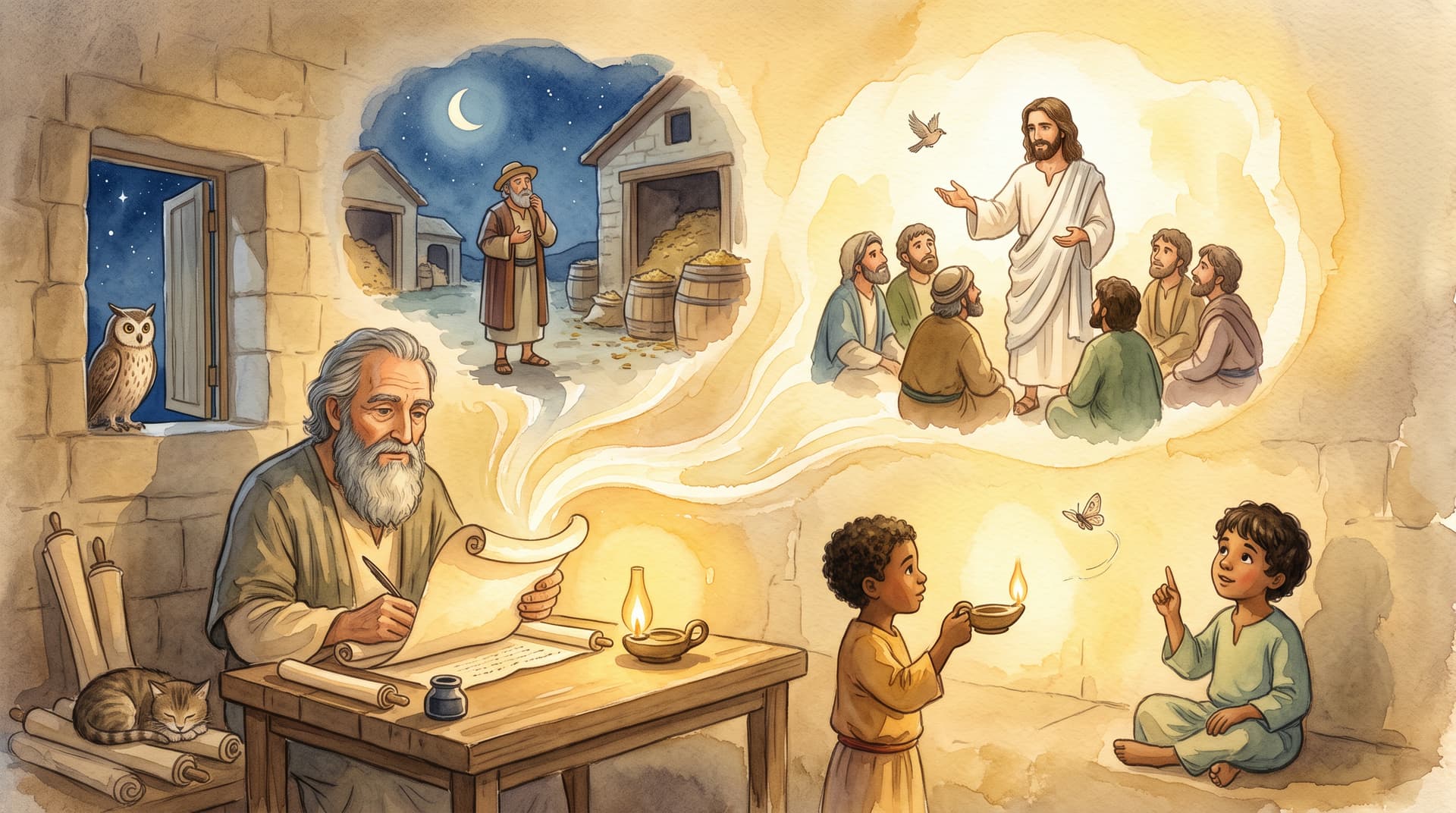
Luke doesn't tell the rich fool parable and then, separately, add a teaching about worry. He welds them together with "Therefore" (12:22): because a rich man trusted his barns and lost everything in a night, therefore do not build your security the same way. The failure of self-made security in the parable is the argument for Father-given security in the teaching that follows. Luke wants one continuous unit read as a single case being built, not two loosely related sayings.
A New Phrase Luke Invents for This Moment
"Rich toward God" (12:21) appears nowhere else in Scripture. Luke coins it specifically as the counter-term to being rich toward yourself — a whole life spent stockpiling for an audience of one. It functions as the thesis statement for everything that follows: the alternative to the rich fool's monologue isn't poverty, it's aim. Whose column does your abundance get entered into?
The Weight of "Little Flock"
When Jesus tells his disciples "Do not be afraid, little flock, for your Father has been pleased to give you the kingdom" (12:32), Luke uses eudokēsen — the same verb the voice from heaven used at Jesus's baptism (3:22), "with you I am well pleased." Luke is letting his readers hear an echo: the same delight the Father takes in his own Son, he takes in giving the kingdom to this small, ordinary, unimpressive group of people worried about their next meal.
The Useful Test
Luke is building one argument across this whole passage: a man who trusted a barn full of grain lost everything overnight, so Jesus tells his followers not to build the same kind of security — because the Father who feeds unclean birds and dresses wildflowers has already decided, with the same pleasure he takes in his own Son, to hand them his whole kingdom.
Seeing God
What does this passage reveal about who God actually is?
Movement 3: Seeing God
Passage: Luke 12:13-34
"What does this passage show us about God's beauty, glory, or character that we wouldn't see without it?"
The Facet of Beauty: A Father More Interested in Your Heart Than Your Property Line
Everyone in this scene cares about the same thing: who gets what. The brother wants his share. The rich man wants bigger barns. Even the disciples, watching, likely wondered what Jesus would decide. God is the only one in the story not fighting over the pile. He ignores the very question everyone came for, and goes straight for the anxious, grasping thing underneath it.
What Is Surprising About God Here
He Refuses to Referee the Fight He Was Asked to Referee
Jesus could have settled the inheritance dispute in a sentence. He doesn't. Not because the money didn't matter, but because fixing the split would have left the deeper hunger untouched. God's silence on the question everyone wanted answered is itself a kind of mercy — he's after something better than a fair settlement.
He Interrupts a Man Mid-Sentence, Not Mid-Sin
The rich fool isn't caught stealing or cheating. He's caught planning — dreaming about a comfortable, self-sufficient future built entirely on what he already owns. God's interruption isn't cruelty; it's the one voice of reality breaking into a closed conversation a man has been having only with himself. "You fool" isn't contempt. It's what love sounds like when it finally gets a word in.
He Feeds What His Own Law Calls Unclean
Ravens are scavengers, off the approved list in Leviticus 11. Nobody plants a field for them. God feeds them anyway, extravagantly, without being asked. If his care reaches that far down the ladder of "usefulness," it was never going to run out before it reached his own children.
He Delights in Giving, Not Just Providing
"Your Father has been pleased to give you the kingdom" (12:32) is not grudging permission. It's the same word used when the voice from heaven called Jesus his beloved Son. God isn't reluctantly meeting a minimum. He's handing over everything, with evident joy, to people who own almost nothing.
What God's Emotions Look Like Here
Grief, not glee, at the fool's ruin. The verdict is delivered as tragedy — a wasted life, not a gotcha.
Tenderness toward the anxious. "Do not be afraid, little flock" is spoken to people worried about food and clothing, not people who have it together.
Evident pleasure in generosity. Giving the kingdom away is described as something that pleases him, not something extracted from him.
The Worship Test
The specific facet on display: God cares far more about what your heart is quietly building its whole life around than about anything you could ever divide, store, or lose.
A man spent a lifetime building bigger barns for a harvest he'd never get to keep. On the same afternoon, ravens with no barns at all were fed, and flowers that would be ash by evening were dressed better than a king. The question was never whether God provides. The question was always where the man had decided to look for safety.
Gospel Connection
How does this passage connect to the gospel?
Movement 4: The Specific Gospel Connection
Passage: Luke 12:13-34
"How does Jesus fulfill, complete, or embody what this passage reveals — SPECIFICALLY, not generically?"
The Rule
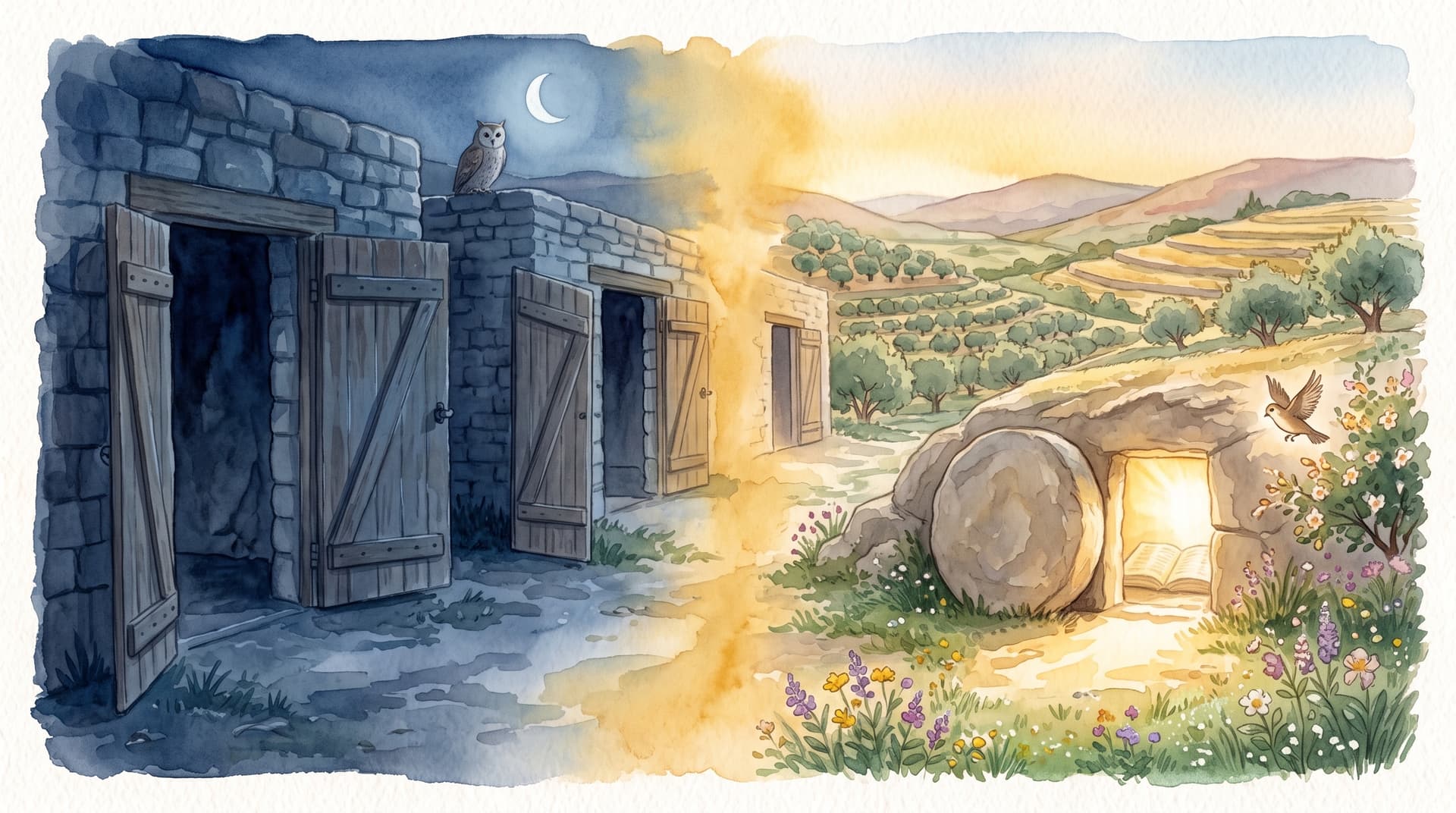
The connection has to live in this passage's own grain. Two threads only Jesus can close: the trade the rich fool refused to make in reverse, and the treasure that "will never fail" actually being purchased at a cost.
Jesus Builds No Barns for Himself — He Empties Them for Us
The rich fool's whole plan was addition: bigger barns, more stored up, all of it his. Jesus runs the exact opposite math. "Though he was rich, yet for your sake he became poor, so that you through his poverty might become rich" (2 Corinthians 8:9). He held the one estate actually worth hoarding — the glory of heaven itself — and instead of building a bigger barn around it, he gave it away on purpose, to people who hadn't earned a share of it. The rich fool couldn't take his harvest with him when his life was demanded of him. Jesus gave his life freely, and it's precisely what makes our treasure possible.
Specific connection: the rich fool held on and lost everything in one night. Jesus let go of everything and, three days after his own life was "demanded" of him on a cross, rose to give it back to everyone who trusts him.
The Treasure That "Will Never Fail" Cost Him Everything
"Provide yourselves... a treasure in heaven that will never fail, where no thief comes near and no moth destroys" (12:33) isn't a financial tip. It's a promise resting entirely on Jesus's own work. A treasure no thief can steal and no moth can ruin has to be kept somewhere thieves and moths can't reach — which means it has to be secured by someone stronger than death itself. The cross and resurrection are how that vault gets built. Jesus doesn't just tell us where to store treasure; he is the storehouse, and he paid with his own life to make sure nothing stored in him can ever be lost.
Specific connection: "where your treasure is, there your heart will be also" (12:34) describes Jesus himself before it describes us — his treasure, from before the world began, was people who hadn't done anything to deserve him. He spent everything to get us. That's not a coincidence next to this teaching; it's the pattern the teaching is describing.
The Specific Mending
The brokenness this passage reveals: We build barns constantly, even when they're invisible — around achievements, approval, control, comfort, popularity, screen time, a full calendar. Like the rich fool, we can do this while being genuinely blessed, genuinely hardworking, and still be one bad night from discovering none of it was ever load-bearing.
The specific mending: Jesus doesn't fix this by shaming our barns or demanding we build none. He fixes it by giving us something to actually put our hearts into that can't be emptied by a thief, a moth, or a single bad night — himself, freely given, permanently secured by his own resurrection.
The new earth: Revelation pictures streets paved with gold (21:21) — the very thing this world hoards most, trodden underfoot in the new creation, because unhindered nearness to God makes hoarding laughably unnecessary. The rich fool needed bigger barns because his world was the only security he had. In the world that's coming, the treasure is everywhere, because the treasure was never really the gold. It was always him.
The Anti-Moralism Checkpoint
-
"Don't be greedy like the rich fool." True, but thin. The passage isn't mainly a warning against a vice — it's an invitation into a Father's delight, which greed only ever gets in the way of.
-
"Give away your stuff to be generous." Real, but too quick. Generosity here is the overflow of trusting the Father, not a rule to follow to earn his approval.
-
"And this all points to Jesus who died for our sins." Too generic. This passage specifically points to Jesus as the one who reversed the rich fool's math — emptying himself instead of hoarding — so that the treasure he purchased at the cross could never be stolen, rusted, or lost.
Why Kids Care
How does this truth intersect with their actual lives?
Movement 5: Why Should a 5-10 Year Old Care?
Passage: Luke 12:13-34
"What does this mean for their actual lives of play, fun, friendship, and family?"
This movement is a brainstorm — a menu of angles for the teacher to pray through. Pick what fits your kids. Skip the rest.
The Lesson: The Man Who Built Bigger Barns
The Arc
Three truths kids need to feel:
1. "A man had so much stuff, he didn't have anywhere to put it." Not a little extra — so much that his barns couldn't hold it. Most kids will immediately think: that sounds amazing. Good. Let them sit in that before the turn comes.
2. "He talked to himself about it, and never talked to anyone else." Walk through his little speech — my crops, my barns, my goods, my soul — and ask, "Notice who he never once talks to?" No friend. No family. Not God. Just himself, planning a party for an audience of one.
3. "That same night, it was all over — and none of it was his anymore." Not because someone stole it. Because his life was never a barn he could keep filling forever. And the birds outside his window, who had no barns at all, had been fed the whole time.
The Role Play: The Man and His Barns
Characters: Narrator (teacher), the Rich Man (volunteer), Barns (2-3 kids standing in a row holding out their arms like shelves), the Ravens (a few kids flapping and "cawing" off to the side), the rest of the class as Villagers watching.
Scene 1 — So Much Grain. The Rich Man walks along the row of Barns, miming piling grain higher and higher into each kid's arms until they're overflowing. He steps back, delighted, hands on hips.
Scene 2 — Talking to Himself. The Rich Man paces back and forth, thinking out loud: "What should I do? I know! I'll tear down these barns and build BIGGER ones!" He gestures for the Barn-kids to stretch even taller. "Then I'll say to myself: you have plenty of good things stored up. Relax! Eat! Drink! Enjoy!" Ask the class: "Who has he talked to this whole time?" (Just himself.)
Scene 3 — The Ravens. While the Rich Man is mid-speech, the Ravens kids flutter by, cawing, clearly fed and fine, with no barns anywhere near them. The narrator says, quietly: "They don't plant. They don't store. And they've never once gone hungry."
Scene 4 — The Interruption. The narrator, as the voice of God, says gently but firmly: "Tonight, your life will be asked of you. Then who gets everything you stored up?" The Rich Man freezes, arms still half-raised toward his barns.
Scene 5 — The Little Flock. The narrator turns to the whole class: "Jesus said: don't be afraid, little flock — your Father is pleased to give you the whole kingdom." Have the class say it back together: "The whole kingdom."
Why Should They Care?
Angle 1: The Bigger-Barn Feeling
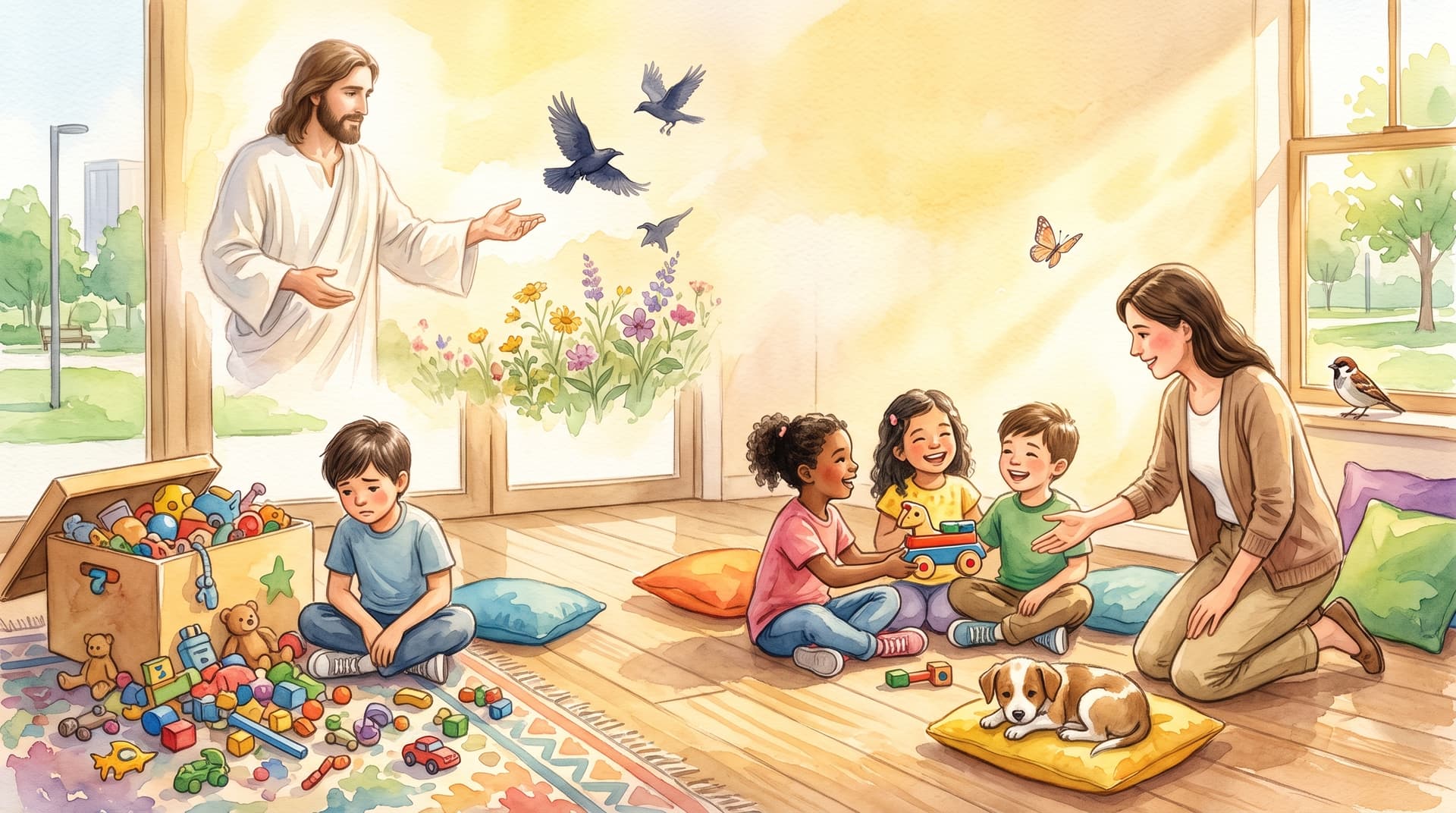
The kid's world: Wanting one more toy even with a full toy box. Not wanting to share because "it's mine." The itch for a bigger collection, a higher score, one more thing before it's finally enough.
The God-first landing: The rich man didn't need more. He had so much he ran out of room, and he still wanted bigger barns. That itch doesn't go away by getting more stuff — it goes away by trusting someone bigger than the barn. God isn't stingy with good things. He just doesn't want your heart living inside a barn that could be empty by tonight.
Landing statement: "More stuff doesn't fix the 'I want more' feeling. Only trusting God does."
Angle 2: Worrying About Having Enough
The kid's world: Wondering if there will be enough snacks, enough turns, enough friends to sit with. The quiet fear of being left without.
The God-first landing: Jesus points at birds that don't even farm and flowers that only last a week, dressed better than the richest king who ever lived. If God takes that much care with a bird and a flower, a kid who belongs to him is not going to be forgotten.
Landing statement: "God feeds birds who don't even have a plan. You don't have to have a plan either. He already does."
Angle 3: Where Your Excitement Goes Is Where Your Heart Is
The kid's world: What a kid gets most excited about — a game, a show, a collection, being picked first — shows what they're actually chasing, even if they couldn't explain it that way.
The God-first landing: Jesus said, "Where your treasure is, there your heart will be also." That works both directions — find out what a kid's heart chases hardest, and you've found their treasure. Jesus isn't asking kids to feel less excited about fun things. He's inviting their hearts toward something that can never be taken away, broken, or outgrown: him.
Landing statement: "Whatever you get the most excited about — that's what your heart is chasing. Jesus wants to be the thing you chase hardest, because he's the only treasure that never runs out."
Object Lesson Option: The Bank That Can't Be Robbed
Setup: Bring two containers — a piggy bank or jar with a visible crack (or one you tap gently until it "breaks" during the lesson), and a small locked box you can't open without a key, which only the teacher holds.
Put a few coins in the cracked piggy bank. Tap it until it cracks and the coins spill out. Ask: "What happened to the treasure?" (It got lost.)
Put a few coins in the locked box. Ask: "Can anyone take these coins out right now?" No — not without the key. Explain: "This is what Jesus means by treasure in heaven. Things down here can crack, get lost, get stolen, wear out. But treasure you store with Jesus is locked up safe — nothing can crack it, steal it, or wear it out. Ever."
Debrief: "The rich man kept all his treasure in barns that could burn down, get robbed, or just not matter anymore the night he died. Jesus said: store your treasure somewhere nothing can touch it. That's not really about money. It's about what you give your heart to. Give it to Jesus, and it's locked up safe forever."
Follow-Up Questions
- "What do you think the rich man should have done with all that extra grain?"
- "Who did the rich man talk to about his plan? Why do you think that matters?"
- "Ravens don't plant or store food, and God still feeds them. What does that tell you about how God feels about you?"
- "What's something you get really excited about? What do you think that says about what your heart is chasing?"
Age Notes
Younger (5-6)
- Stay on the barns getting too full and the birds who never worry. That's the whole story they need.
- Skip the inheritance dispute at the start — it won't land for this age. Start straight at the barns.
- Landing: "God takes care of the birds. God takes care of you even more."
Older (8-10)
- Bring in the "rich toward God" phrase and ask them to define it in their own words.
- Push on the "who did he talk to" question — have them notice how isolated the rich man's whole plan is, and connect it to what it feels like to make plans without including God or anyone else.
- Connect forward to Jesus emptying himself instead of hoarding (2 Corinthians 8:9) — the opposite move from the rich man, made on purpose, for them.
What to Skip
- The Deuteronomy 21:17 inheritance-law detail. Useful for the teacher's own prep, invisible to a kid.
- The Greek wordplay on "rich toward God" and eudokēsen. Keep the ideas; skip the vocabulary.
- A deep dive on ravens' unclean status under Leviticus. "Nobody thought these birds even mattered, and God still fed them" carries the whole point without the citation.
Landing Statements
Format: God is/does ___. And because of that, you ___.
- "More stuff never fixes the 'I want more' feeling. Trusting God does."
- "God feeds birds who don't even have a plan. You don't need a perfect plan either — you have him."
- "Whatever you get most excited about is what your heart is chasing. Jesus wants to be the treasure you chase hardest, because he's the only one that never runs out."
- "Your Father isn't reluctant with you. He's pleased — genuinely happy — to give you his whole kingdom."
Kid Questions
"Was it wrong for the man to have a big harvest?" "No — the harvest itself was a gift. What went wrong was what he did with it: he made a plan that only included himself, and he trusted the barns to keep him safe instead of trusting God. Having a lot isn't the problem. Trusting the 'lot' instead of God is."
"Why did God call him a fool? That seems harsh." "It wasn't said to be mean — it was said because it was true, and because love tells the truth. He built his whole future on something that couldn't outlast one night. God wasn't attacking him. God was the only one in the story willing to tell him what was actually going on."
"Does this mean I shouldn't save my allowance or my toys?" "Not at all — saving is wise. The question isn't whether you keep anything, it's who you're trusting to keep you safe. You can save your allowance and still trust God more than the piggy bank. The rich man's problem wasn't the barn. It was that the barn had become his whole god."
"What does 'treasure in heaven' actually mean?" "It means anything you do out of love for Jesus — being kind, being generous, trusting him instead of worrying — gets stored up somewhere nothing can ever touch it. Not a barn. Not a piggy bank. Somewhere safer than anywhere on earth, forever."
The Bottom Line
This lesson gives kids a Jesus who skips right past a fight over money to ask a better question: what is your heart actually building its whole life around? The rich man's barns were full and his life was still one bad night from over. The ravens had no barns at all and were never once forgotten.
The temptation will be to land on "don't be greedy" or "share your toys." Resist both. This lesson is about a Father who is genuinely pleased — not grudging, not reluctant — to hand his whole kingdom to ordinary, worried, small people. The barns were never the point. He was.