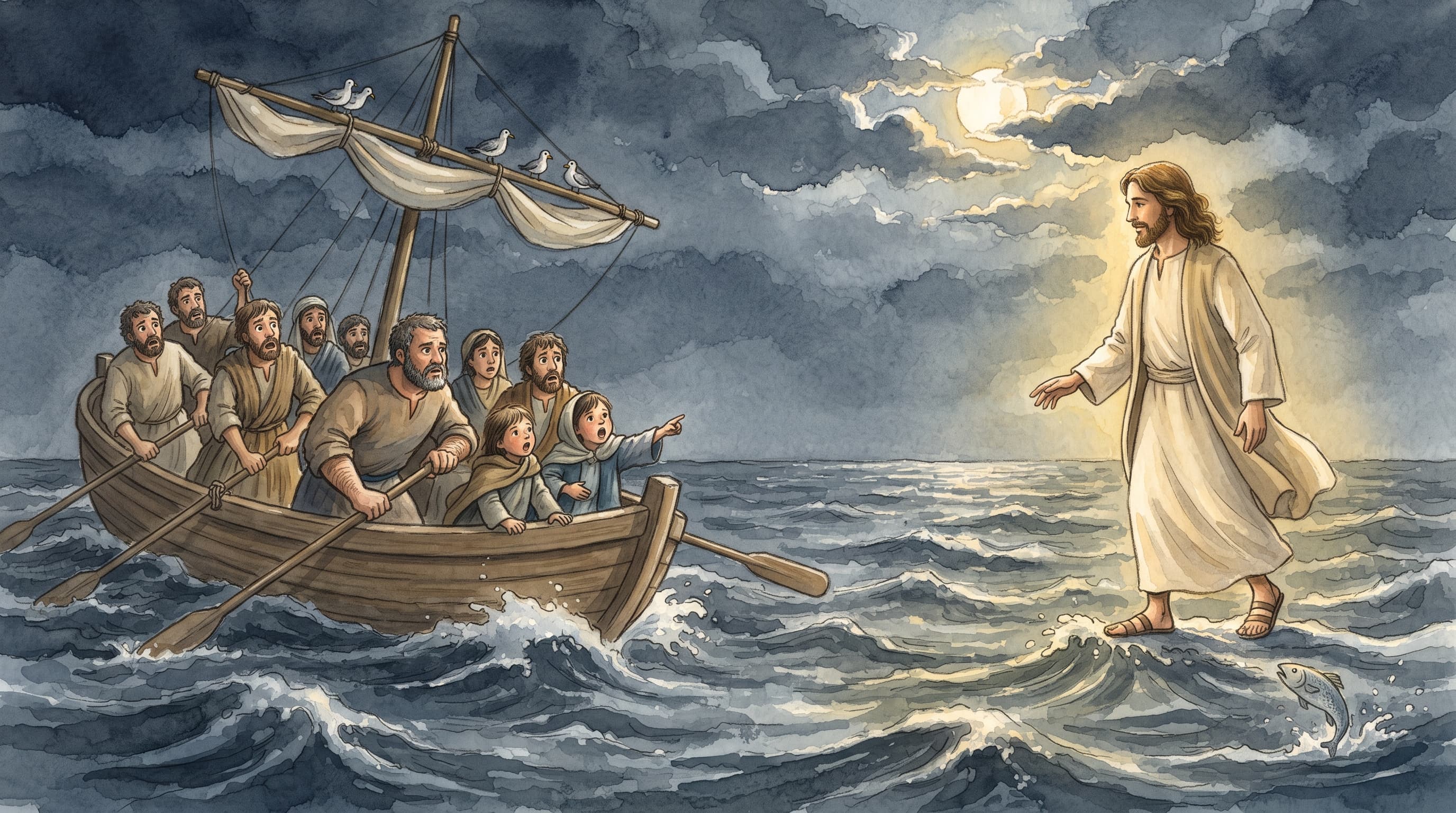
Jesus Walks on Water
A lesson preparation guide for teaching 5–10 year olds
The Original Audience
What did this mean to the people who first heard it?
Movement 1: The Original Audience
Passage: Matthew 14:22-33; Mark 6:45-52; John 6:16-21
"What did this mean to the people who first heard it?"
The Night After the Bread
All three Gospels tell this story the same night as the feeding of the five thousand. That afternoon, Jesus fed a crowd of thousands from five loaves and two fish, and twelve baskets of leftovers came back. John tells us what the crowd wanted to do next: they were about to "come and take him by force to make him king" (John 6:15). A man who could feed an army with a boy's lunch looked like exactly the king Israel had been waiting for.
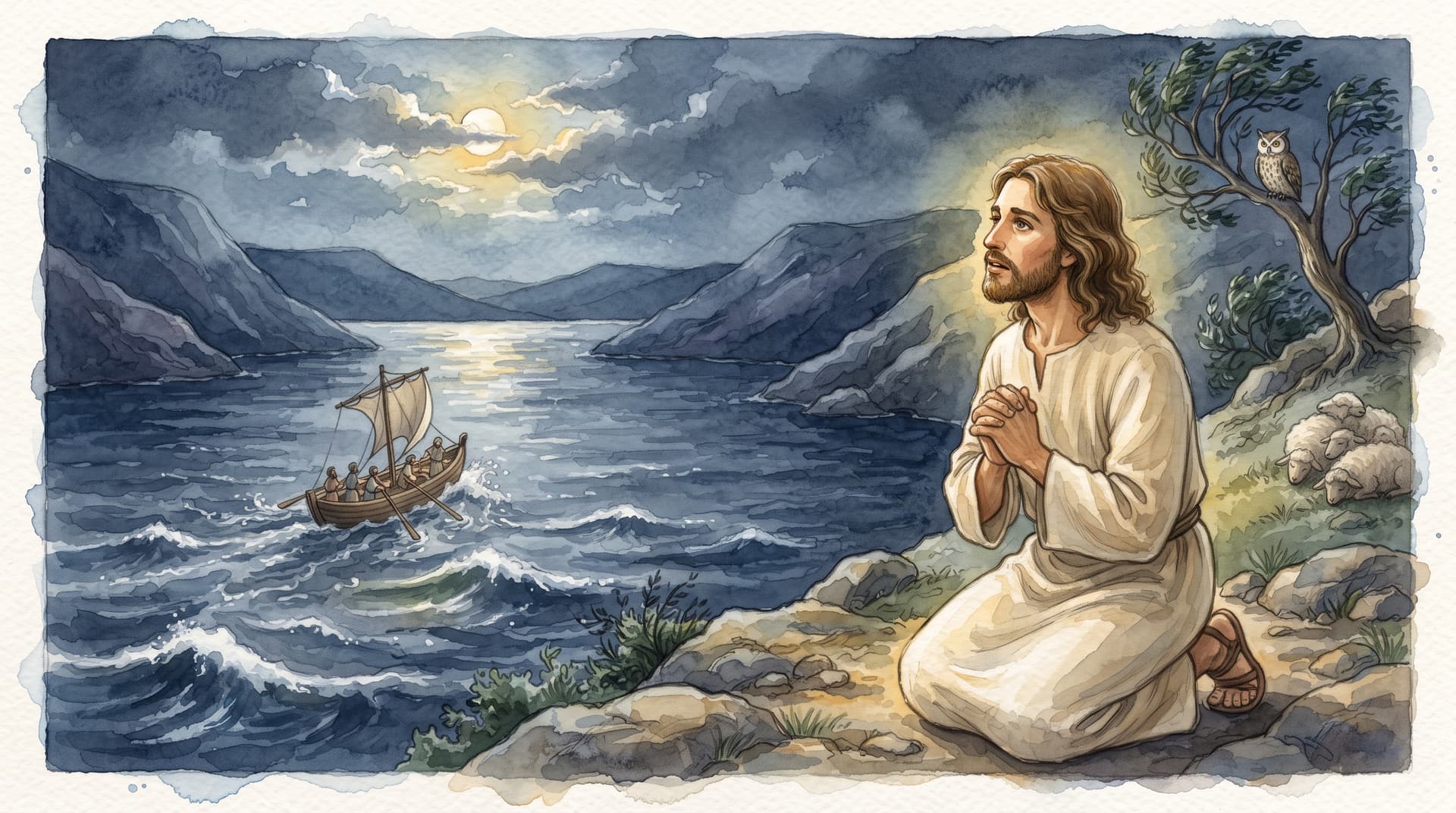
Jesus would not let it happen. Matthew and Mark both say he made the disciples get into the boat and go ahead of him (Matthew 14:22; Mark 6:45). The word is forceful. He sent his friends away from the crowd before the excitement could catch them too, dismissed the people, and climbed the hillside alone to pray.
Matthew adds one more detail about that day. It began with the news that John the Baptist had been beheaded in Herod's prison, and "when Jesus heard this, he withdrew from there in a boat to a desolate place by himself" (Matthew 14:13). He had been trying to get alone since morning. He spent the afternoon feeding people instead, and only now, at nightfall, did he get the hours on the mountain he had gone looking for.
The Lake They Knew
At least four of the twelve were professional fishermen who had worked this water their whole lives. They knew things about it that the story assumes:
It is small and low. The Sea of Galilee is a freshwater lake about thirteen miles long and eight wide, sitting nearly seven hundred feet below sea level in a bowl of hills.
The wind comes down fast. Cool air from the heights pours through the ravines on the hills and drops onto the warm water. A calm evening can turn into a violent storm with almost no warning, and the wind tends to blow hardest at night.
Rowing into it is brutal. A fishing boat of that era was about twenty-six feet long, with a small sail and oars. Against a headwind, the sail is useless and every stroke gets thrown back. John says they had rowed "about three or four miles" (John 6:19). Mark says they set out in the evening and Jesus came to them in "the fourth watch of the night" (Mark 6:48), the Roman watch between three and six in the morning. They had been fighting the wind for something like nine hours and were stuck in the middle of the lake.
What the Sea Meant
To a first-century Jew, the sea was more than weather. In the opening lines of Scripture, the world is dark water until God speaks (Genesis 1:2). The psalms picture the sea as the roaring, rebellious thing that only God can quiet: "The floods have lifted up their voice... Mightier than the thunders of many waters, mightier than the waves of the sea, the LORD on high is mighty!" (Psalm 93:3-4). God brought Israel out of Egypt by splitting the sea, and the prophets kept returning to that moment: "Thus says the LORD, who makes a way in the sea, a path in the mighty waters" (Isaiah 43:16).
One line from Job would have been sitting in the back of any Bible-literate mind that night. God is the one "who alone stretched out the heavens and trampled the waves of the sea" (Job 9:8). Walking on the sea was something Scripture said only God does.
"It Is a Ghost!"
Sailors in the ancient world believed that spirits haunted the water at night. When the disciples saw a figure walking toward them over the waves in the dark, they did not think "Jesus." They thought phantasma, a ghost, and they screamed (Matthew 14:26; Mark 6:49). These were grown men who had faced storms before. The wind had worn them out, but the figure on the water terrified them.
Then they heard a voice they knew: "Take heart; it is I. Do not be afraid" (Matthew 14:27; Mark 6:50; John 6:20). In Greek, "it is I" is egō eimi, literally "I am." It is an ordinary way of saying "it's me," and it is also the name God gave Moses at the burning bush (Exodus 3:14) and the phrase God repeats through Isaiah: "I, I am he who comforts you" (Isaiah 51:12). A man was standing on the water God tramples, saying the words God says.
The Emotional Temperature
Exhaustion first: a night of rowing that got them nowhere. Then terror at the shape on the water. Then, depending on which Gospel you read, worship, astonishment, or plain gladness. Matthew ends with the disciples on their knees: "Truly you are the Son of God" (14:33). Mark ends with them "utterly astounded" and still not understanding (6:51-52). John ends with them glad to take him into the boat (6:21).
Why This Matters for Kids
"Imagine rowing a boat all night long with the wind pushing you backward the whole time. Your arms are shaking. It's pitch dark. And then you see something walking toward you across the top of the waves. You'd scream too. The disciples did. And then the something spoke, and it was the voice of their best friend: 'It's me. Don't be afraid.'"
The Author’s Intent
What were the three Gospel writers each trying to show?
Movement 2: The Author's Intent
Passage: Matthew 14:22-33; Mark 6:45-52; John 6:16-21
"What were the three Gospel writers each trying to show?"
One Night, Three Angles
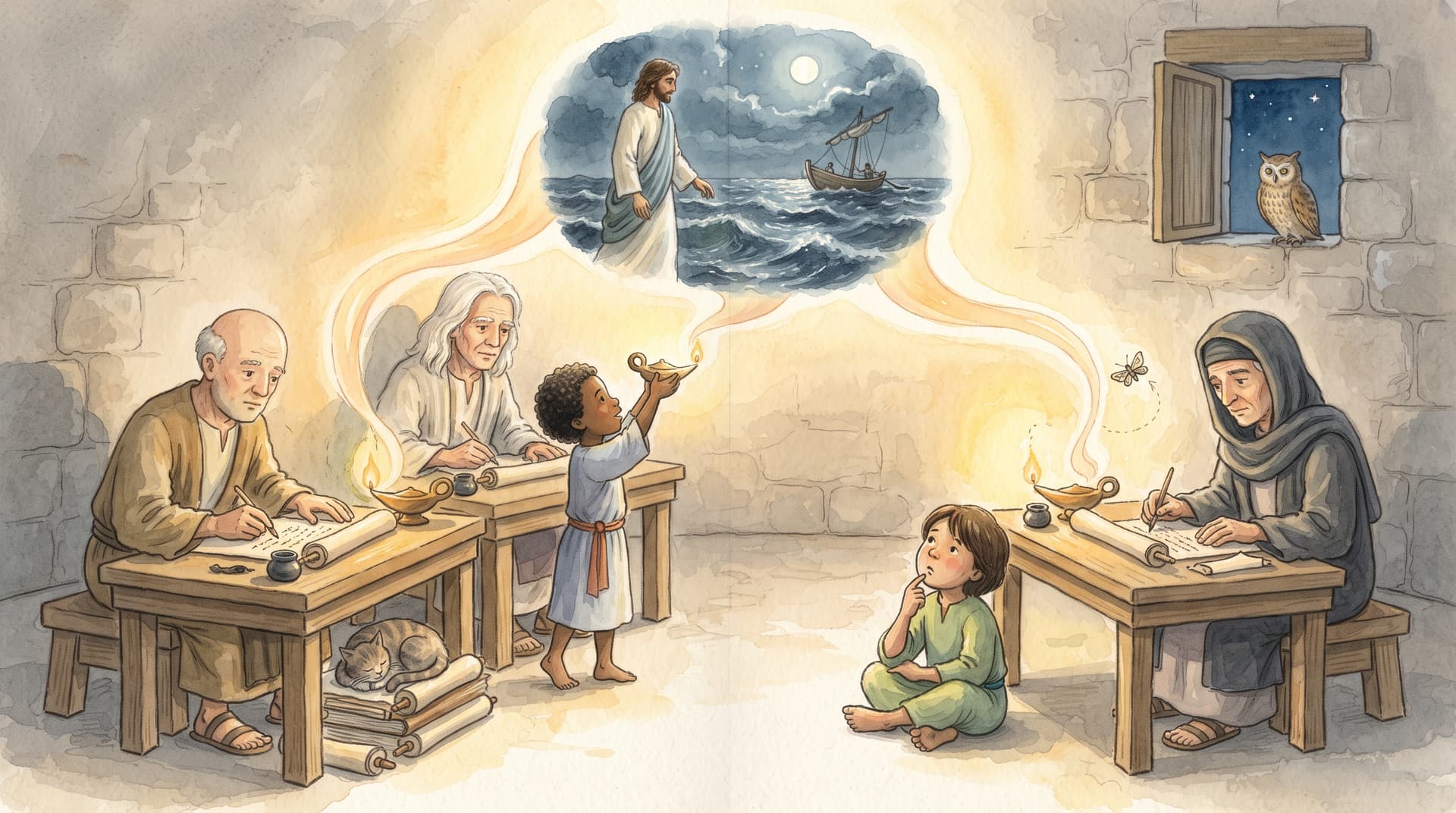
Matthew, Mark, and John all tell this story, and all three place it in the same spot: the night after Jesus fed the five thousand. (Luke skips it; his Gospel goes from the feeding straight to Peter's confession.) The three agree on the frame: the disciples sent ahead by boat, a wind against them, Jesus coming to them on the water, their fear, and his words "It is I; do not be afraid." Each writer then shapes the ending differently, and the ending is where each one shows his hand.
Matthew: Peter Steps Out, and the Boat Worships
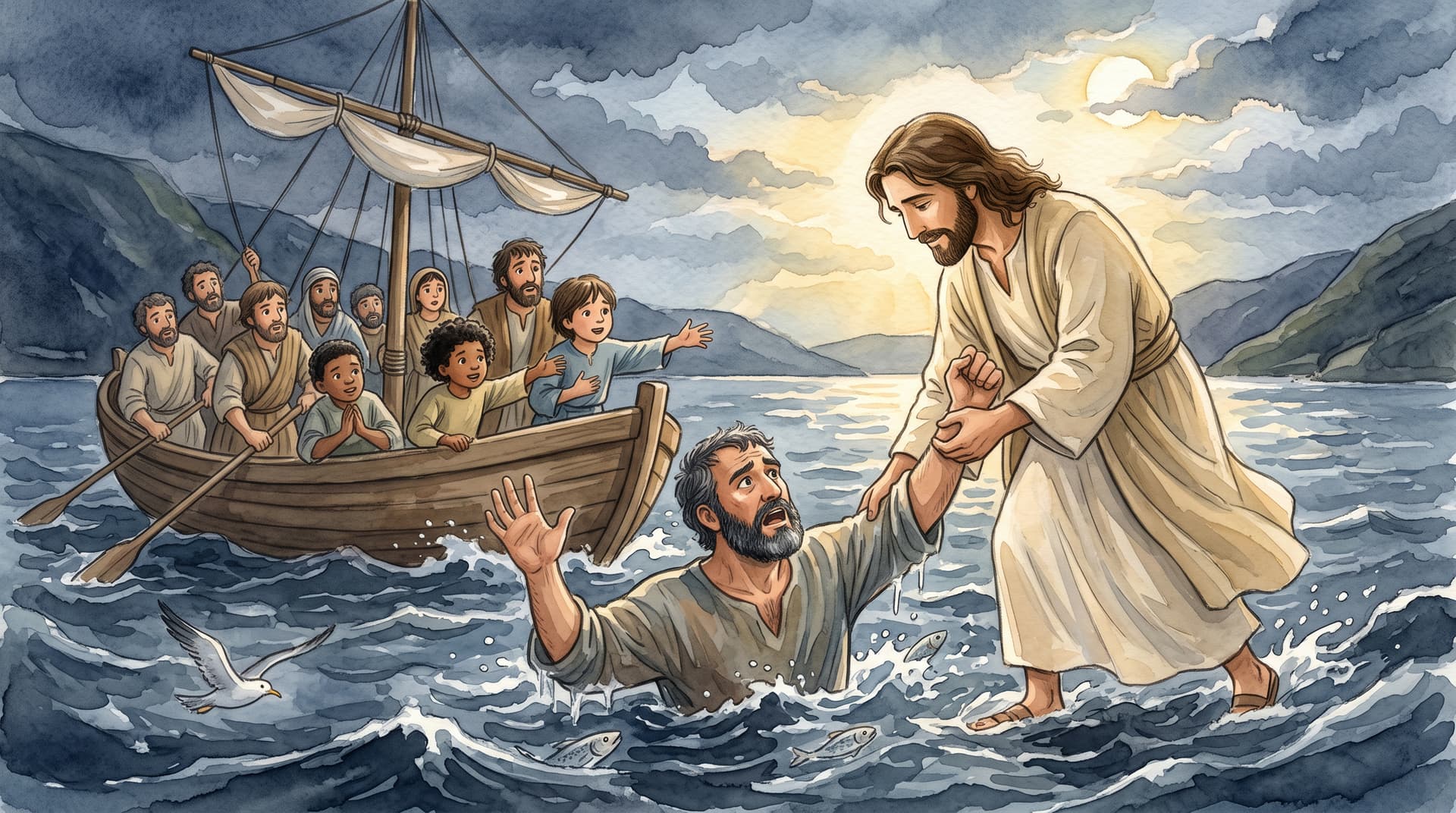
Only Matthew tells us that Peter walked on the water. Peter calls out, "Lord, if it is you, command me to come to you on the water." Jesus says one word, "Come," and Peter climbs over the side (14:28-29). He walks. Then "when he saw the wind, he was afraid, and beginning to sink he cried out, 'Lord, save me'" (14:30).
Matthew's next word is immediately. "Jesus immediately reached out his hand and took hold of him" (14:31). The rescue comes before the rebuke, and the rebuke is gentle: "O you of little faith, why did you doubt?" The word Matthew uses for doubt, distazō, means to be pulled two ways. Peter was not faithless. He trusted enough to step out and then got pulled between the man in front of him and the wind beside him.
Matthew alone ends with worship: "those in the boat worshiped him, saying, 'Truly you are the Son of God'" (14:33). This is the first time in Matthew's Gospel that the disciples call Jesus the Son of God. Matthew wants his readers, a largely Jewish church, to see the disciples doing what Israel did at the Red Sea, when "the people feared the LORD, and they believed in the LORD" (Exodus 14:31). The rescue at sea ends on its knees.
Mark: He Meant to Pass By
Mark tells the shortest version and leaves out Peter's walk entirely. Early church tradition says Mark wrote down the preaching of Peter himself. If that is right, Peter told this story for years and left out the part where he walked on water.
Mark keeps two details nobody else has. The first is that Jesus "saw that they were making headway painfully, for the wind was against them" (6:48). From the mountain, in the dark, he saw them. The second is stranger: "He came to them, walking on the sea. He meant to pass by them" (6:48).
That phrase, "pass by," is a Bible phrase. When Moses begged to see God's glory, God said, "I will make all my goodness pass before you," and then he passed by Moses on the mountain, proclaiming his own name (Exodus 33:19-22; 34:6). God did the same for Elijah on Mount Horeb: "Behold, the LORD passed by" (1 Kings 19:11). And Job, right after describing God trampling the waves, says, "Behold, he passes by me, and I see him not" (Job 9:11). Mark is telling his readers that what happened on the lake that night was a passing-by of God's glory, the same thing Moses and Elijah saw.
Mark's ending is the hardest of the three: "they were utterly astounded, for they did not understand about the loaves, but their hearts were hardened" (6:51-52). He is writing for a church that may have been struggling under persecution in Rome, and he does not flatter the apostles. They had seen bread multiply that afternoon and still could not take in who was in the boat. Mark's readers would have recognized themselves.
John: "I Am," and Then Immediately the Shore
John's account is the barest of all: five verses, no Peter, no stilling of the wind, no confession. It is the setting that does the work. John places it between the crowd trying to crown Jesus king (6:15) and the long teaching in Capernaum the next day, where Jesus says "I am the bread of life" (6:35).
John builds his Gospel around Jesus saying egō eimi, "I am." Seven times Jesus fills it in: the bread of life, the light of the world, the door, the good shepherd, the resurrection and the life, the way and the truth and the life, the true vine. And several times he says it bare, with nothing after it: "Before Abraham was, I am" (8:58), and in the garden, when the soldiers fall backward at the words (18:5-6). On the lake, John lets "It is I" stand bare, and the next day Jesus fills it in with bread.
John's last detail is his own: "Then they were glad to take him into the boat, and immediately the boat was at the land to which they were going" (6:21). They had rowed all night and gotten nowhere. The moment Jesus was in the boat, they were there. A Jewish reader would hear Psalm 107, about sailors in a storm who "cried to the LORD in their trouble... He made the storm be still... and he brought them to their desired haven" (Psalm 107:28-30).
The Useful Test
All three writers put this story on the night after the bread, and all three have Jesus say "I am" to frightened men in a boat. Matthew shows a disciple who sinks and a hand that saves him, and ends in worship. Mark shows the glory of God passing by men too hard-hearted to see it. John shows the I Am stepping into the boat, and the boat reaching shore at once.
Seeing God
What does this passage reveal about who God actually is?
Movement 3: Seeing God
Passage: Matthew 14:22-33; Mark 6:45-52; John 6:16-21
"What does this passage show us about God's beauty, glory, or character that we wouldn't see without it?"
The Facet of Beauty: A God Who Walks on the Thing You Are Afraid Of
The disciples spent the night fighting the sea. The sea was the enemy: the wind, the waves, the dark water that could drown them. Jesus came to them standing on it. The thing that was about to swallow them was the floor under his feet. That is the God this passage shows: one whose power is so far above what terrifies us that it becomes the road he walks to reach us.
What Is Surprising About God Here
He Sends Them Into the Storm
Matthew and Mark both say Jesus made the disciples get in the boat. He sent them out onto a lake he knew, on a night he could see coming. God does not only rescue people from hard places. Sometimes he is the one who sends them there, and he does it with the rescue already planned.
He Watches Before He Comes
"He saw that they were making headway painfully" (Mark 6:48). Jesus was on the mountain praying, miles away, in the dark, and he saw them. Their long night was not hidden from him. He did not come at the first wave, and he did not leave them alone either. He was watching and praying the whole time they rowed.
He Comes in the Middle of the Night, Not After It
The fourth watch is three to six in the morning, the coldest and darkest hours. Jesus did not wait for the storm to blow itself out or for dawn to make things easy. He walked out to them at the worst point of the worst night.
He Shows His Glory to People Who Are Failing
Mark says he "meant to pass by them," the way God passed by Moses and Elijah to show them his glory. Moses was a prophet on a holy mountain. These were exhausted, frightened men who screamed "Ghost!" when they saw him, and Mark says their hearts were hard. God showed them his glory anyway.
His Hand Comes Before His Words
When Peter sank, Jesus "immediately reached out his hand" (Matthew 14:31). The question about doubt came after Peter was safe, held, and standing again. God does not make sinking people pass a test before he grabs them.
He Names Himself to Calm Them
"Take heart; it is I. Do not be afraid." The comfort in that sentence is a name. Jesus did not explain the physics, promise the storm would end, or tell them to be brave. He told them who was there. The cure for their fear was finding out who was walking toward them.
What God's Emotions Look Like Here
Attentive concern. He sees them straining from the mountain. Their struggle has his full attention.
Steady calm. He walks through the same wind that is wearing them out, and his first words are "take heart."
Eager rescue. "Immediately" twice in Matthew: immediately he spoke to them (14:27), and immediately he reached for Peter (14:31).
Gentle correction. "Why did you doubt?" is asked by a man still holding Peter's arm.
The Worship Test
The specific facet on display: God sees us in the dark long before we see him, and he comes to us walking on top of the very thing we fear, saying his own name.
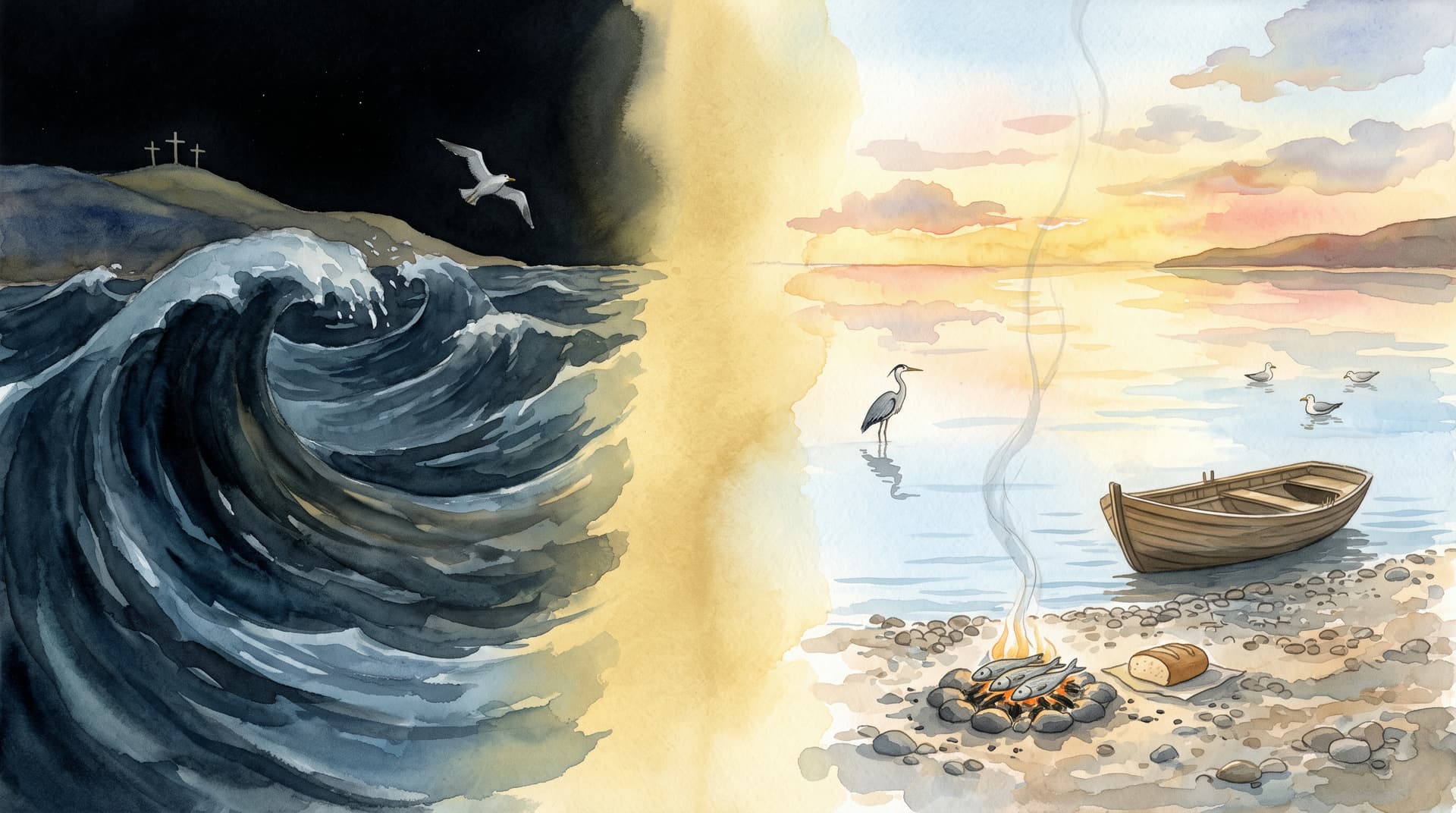
Twelve men rowed all night against a wind they could not beat. On the hillside, the one who sent them was watching every stroke. At the worst hour he came, walking on the water that had them pinned, and the first thing he said was his name.
Gospel Connection
How does this passage connect to the gospel?
Movement 4: The Specific Gospel Connection
Passage: Matthew 14:22-33; Mark 6:45-52; John 6:16-21
"How does Jesus fulfill, complete, or embody what this passage reveals, SPECIFICALLY, not generically?"
The Rule
The connection has to grow out of this passage. Two threads only Jesus can close: the one who walked on the waves later went under them, and Peter's three-word prayer is the meaning of Jesus' own name.
He Walked on the Waters So He Could Go Under Them
In the Psalms, drowning is the picture of the worst suffering a person can face. "Save me, O God! For the waters have come up to my neck... I have come into deep waters, and the flood sweeps over me" (Psalm 69:1-2). The Gospel writers quote Psalm 69 again and again about Jesus' death (John 2:17; 15:25; 19:28-29). Jonah, thrown into the sea, prayed, "All your waves and your billows passed over me" (Jonah 2:3), and Jesus called his own death and resurrection "the sign of Jonah" (Matthew 12:39-40).
On the lake, Jesus stood on top of the waves and no water touched him. On the cross, he went under. Every wave that should have closed over us closed over him: the darkness, the abandonment, the cry "My God, my God, why have you forsaken me?" (Matthew 27:46). Peter only began to sink. Jesus went all the way down, so that no one who calls to him will ever be left there.
Specific connection: the night on the lake shows Jesus has power over the deep. The cross shows what he did with that power. He let the deep take him so it would have to let us go, and on the third day he walked out of it.
"Lord, Save Me" Is His Name
Peter's prayer is three words long in English and is the shortest prayer in the Bible: "Lord, save me" (Matthew 14:30). Matthew's readers had already been told what Jesus' name means. The angel said to Joseph, "you shall call his name Jesus, for he will save his people from their sins" (Matthew 1:21). Yeshua means "the LORD saves."
When Peter cried "Lord, save me," he was praying Jesus' own name back to him. And the hand that reached out immediately to grab him is the same hand that was later nailed to a cross. Peter was pulled out of the water by a hand that would bear the scar of saving him.
Specific connection: nobody walks on water by gripping their faith harder. Peter was saved by being gripped. The gospel works the same way. We are not held up by the strength of our faith in Jesus; we are held up by the strength of Jesus' hold on us.
The Specific Mending
The brokenness this passage reveals: Even when we trust Jesus enough to step out, we look at the wind and start to sink. Even after watching him do something amazing, our hearts can stay hard (Mark 6:52). Fear and doubt pull us in two directions, and we cannot hold ourselves up.
The specific mending: Jesus does not wait for us to stop sinking before he acts. He grabs us mid-sink and climbs into the boat with us. After the resurrection, the same Peter who sank threw himself into this same lake to swim to the risen Jesus on the shore (John 21:7). The man who had been pulled out of the water now jumped in on purpose, because he knew who was waiting for him.
The new earth: When John sees the new heaven and the new earth, one detail stands out: "and the sea was no more" (Revelation 21:1). The deep, dark water that stood in Scripture for chaos, danger, and death will be gone. There will be nothing left to sink in. Every storm that ever pinned a boat in the middle of a lake will be over for good.
The Anti-Moralism Checkpoint
-
"Keep your eyes on Jesus and you won't sink." This is the most common way to teach it, and it turns Peter into a model of technique. The passage does not end with Peter walking better. It ends with Jesus' hand. The good news is who catches you when your eyes drift.
-
"Be brave like Peter." Peter's courage lasted a few steps. The hero of this story is the one who reached out immediately.
-
"Don't be afraid." Jesus never says that alone. He says, "Take heart; it is I. Do not be afraid." The reason not to fear is a person, not a feeling you work up.
-
"And this all points to Jesus who died for our sins." Too generic. This passage specifically points to a Savior who stood on the waves, then went under them for us, and whose name is the prayer of every sinking person.
Why Kids Care
How does this truth intersect with their actual lives?
Movement 5: Why Should a 5-10 Year Old Care?
Passage: Matthew 14:22-33; Mark 6:45-52; John 6:16-21
"What does this mean for their actual lives of play, fun, friendship, and family?"
This movement is a brainstorm, a menu of angles for the teacher to pray through. Pick what fits your kids. Skip the rest.
The Lesson: The Night Jesus Walked on the Waves
The Arc
Three truths kids need to feel:
1. "Jesus saw his friends in trouble, even in the dark, even from far away." He was up on a mountain praying. They were in the middle of the lake in the middle of the night. He saw them anyway. Kids need to know there is no place too dark or too far for Jesus to see them.
2. "Jesus came to them walking on top of the scary thing." The waves were trying to sink the boat. Jesus walked on them like a sidewalk. Whatever is big and scary to a kid is under Jesus' feet.
3. "When Peter started to sink, Jesus grabbed him right away." Peter didn't have to swim back. He didn't have to fix it himself. He said three words, "Lord, save me," and Jesus' hand was already there.
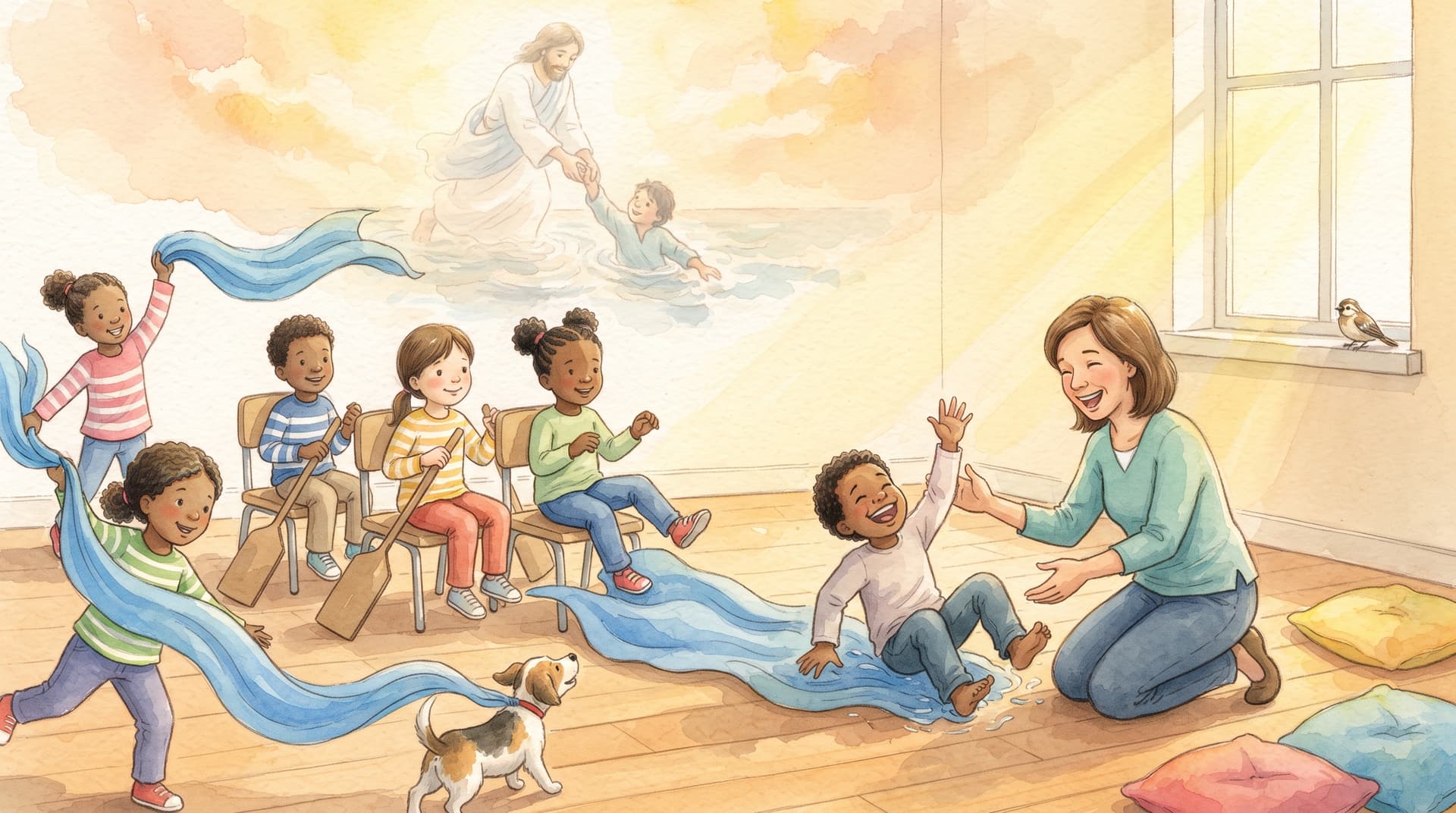
The Role Play: The Boat in the Storm
Characters: Narrator (teacher), Jesus (teacher or a confident older kid), Peter (volunteer), the Disciples (5-6 kids sitting in the "boat"), the Wind and Waves (the rest of the class).
Setup. Line up two rows of chairs as a boat, or tape a boat shape on the floor. The Disciples sit inside holding pretend oars. The Wind and Waves stand around the edges. Jesus stands far away on the other side of the room (the mountain).
Scene 1, Rowing All Night. The Disciples row hard. The Wind and Waves make whooshing noises and sway their arms, getting louder. Narrator: "They rowed and rowed and rowed. And they didn't get anywhere." Have the Disciples row slower and slower, tired arms drooping.
Scene 2, Someone Is Watching. Narrator, pointing at Jesus: "But up on the mountain, someone could see them." Jesus shades his eyes and looks toward the boat.
Scene 3, The Ghost! Turn the lights down. Jesus walks slowly across the room toward the boat, stepping right through the Wind and Waves, who crouch down as he passes. The Disciples point and shout, "A GHOST!" Jesus says, "Take heart! It's me. Don't be afraid."
Scene 4, Peter Steps Out. Peter stands up: "Lord, if it's you, tell me to come!" Jesus: "Come." Peter steps out of the boat and takes a few big, careful steps. Then the Wind and Waves jump up and get loud again. Peter looks at them, gets scared, and starts to sink slowly toward the floor. Peter: "Lord, save me!" Jesus grabs his hand right away and pulls him up.
Scene 5, Calm. Jesus and Peter climb into the boat. The Wind and Waves all sit down silently at once. Narrator: "And the wind stopped. And the friends in the boat bowed down and said..." Whole class: "You really are the Son of God!"
Why Should They Care?
Angle 1: Scared in the Dark
The kid's world: Bedtime with the lights off. A thunderstorm at night. A bad dream. Being sure something is in the closet.
The God-first landing: The disciples were scared in the dark too, so scared they thought Jesus was a ghost. Jesus didn't laugh at them. He said, "It's me. Don't be afraid." When a kid is scared at night, Jesus is the one who sees them, and he is bigger than anything in the dark.
Landing statement: "In the dark, Jesus can still see you. And he says, 'It's me. You don't have to be afraid.'"
Angle 2: When You Feel Like You're Sinking
The kid's world: A really bad day. Messing up in front of everybody. Getting in trouble and feeling like it's all falling apart. Trying hard and still failing.
The God-first landing: Peter tried something brave and started to sink. He didn't have to climb out on his own or promise to do better first. He just called, and Jesus grabbed him immediately. Kids can call to Jesus in the middle of a mess, not just after they've fixed it.
Landing statement: "You don't have to stop sinking before you call Jesus. Calling him is how you stop sinking."
Angle 3: When Jesus Feels Far Away
The kid's world: Praying and nothing seems to happen. Feeling like God is busy or not paying attention. Going through something hard that just keeps going.
The God-first landing: The disciples rowed for hours, and Jesus wasn't in the boat. But Mark says he saw them the whole time. He was praying on the mountain while they rowed. When Jesus feels far away, he is watching, and he knows exactly when to come.
Landing statement: "Even when you can't see Jesus, Jesus can see you. He's never too far away to come."
Object Lesson Option: Sink or Hold
Setup: A clear bowl or pitcher of water, a rock about the size of a fist, and a second rock with a sturdy string tied tightly around it.
Hold up the plain rock. Ask: "Can this rock float if it tries really, really hard?" Drop it in. It sinks to the bottom. Ask: "What happened?" (It sank. Rocks can't hold themselves up.)
Now hold up the rock with the string, holding the string in your hand. Lower it into the water until it is just under the surface, then stop. Ask: "Why isn't this one sinking?" (Because you're holding it.) Lift it out.
Debrief: "Peter was like this rock. He couldn't hold himself up on the water, and neither can we. But Peter didn't stay sunk, because Jesus grabbed his hand. We don't stay up because we're strong. We stay up because Jesus is holding on to us, and he doesn't let go."
Follow-Up Questions
- "Why do you think the disciples thought Jesus was a ghost?"
- "When Jesus walked toward the boat, what was he standing on? What does that tell you about him?"
- "Peter started sinking when he looked at the wind. What's something that feels like 'wind' to you, something scary that's hard to stop looking at?"
- "What did Peter say when he started to sink? Could you pray that prayer?"
Age Notes
Younger (5-6)
- Stay on the dark, the waves, Jesus walking on them, and Jesus grabbing Peter's hand. The role play carries everything.
- Skip the "I am" connection and the Old Testament background.
- Landing: "Jesus walks on scary things. Jesus holds my hand."
Older (8-10)
- Teach them that "It is I" in Greek is "I am," the name God gave Moses. Ask: "Why would that make the disciples even more amazed?"
- Read Job 9:8 aloud ("who alone... trampled the waves of the sea") and ask who it's describing. Then ask who was trampling the waves that night.
- Compare endings: Matthew's disciples worship, Mark's disciples are confused and hard-hearted. Ask which one they're more like and why.
- Connect forward to the cross: Jesus walked on the waves, but later went under the "deep waters" for us.
What to Skip
- The Roman watches of the night. "It was the darkest part of the night, around three in the morning" is plenty.
- The theories about why Mark leaves out Peter's walk. Interesting for the teacher, invisible to a kid.
- The comparison of all three Gospel accounts. For younger kids, tell one story. Matthew's has the most for them.
Landing Statements
Format: God is/does ___. And because of that, you ___.
- "Jesus sees you in the dark, even from far away. So you're never alone in a scary night."
- "Jesus walks on top of scary things. So nothing that scares you is bigger than him."
- "Jesus grabbed Peter right away. So you can call him in the middle of a mess, not just after you've cleaned it up."
- "Jesus' name means 'the Lord saves.' So 'Lord, save me' is always the right prayer."
Kid Questions
"How did Jesus walk on water?" "Because he's God. In the Bible, walking on the sea is something only God does. The disciples saw Jesus doing it and realized that's who he was. The waves that scared them were just a floor to him."
"Why did Peter sink?" "He looked at the wind and got scared, and he started thinking about how big the waves were instead of who was holding out his hand. That happens to everybody. The best part is what happened next: he called out, and Jesus caught him right away."
"Why didn't Jesus just stop the storm before they got in the boat?" "Jesus knew the storm was coming. He let them go out in it so they could see something they'd never forget: that he could come to them right in the middle of it. Sometimes God lets us go through hard things so we can find out how close he is."
"Will Jesus walk on water to me?" "Probably not on actual water! But he does come to you in the middle of scary things. He sees you. He's with you by his Spirit. And when you call him, he holds on to you, just like he held Peter."
The Bottom Line
This lesson gives kids a Jesus who sees them in the dark, walks on top of whatever scares them, and grabs their hand the moment they call. The disciples rowed all night and got nowhere. Jesus came to them at the worst hour, said his name, and the storm was done.
The temptation will be to make this a lesson about keeping your eyes on Jesus so you don't sink. Resist it. Every kid in the room will look at the wind sometimes. The story doesn't end with Peter's eyes. It ends with Jesus' hand.