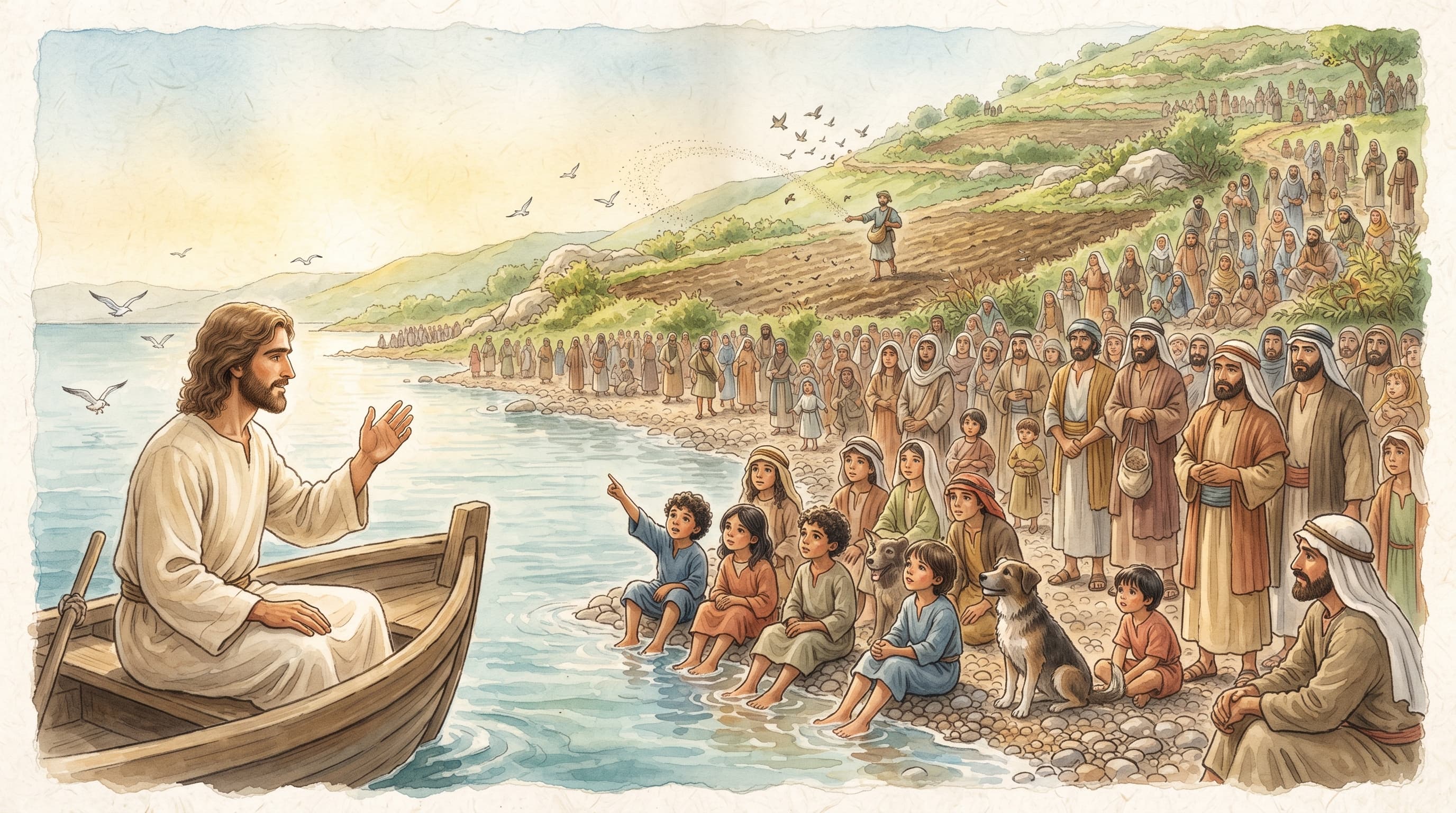
The Parable of the Sower
A lesson preparation guide for teaching 5–10 year olds
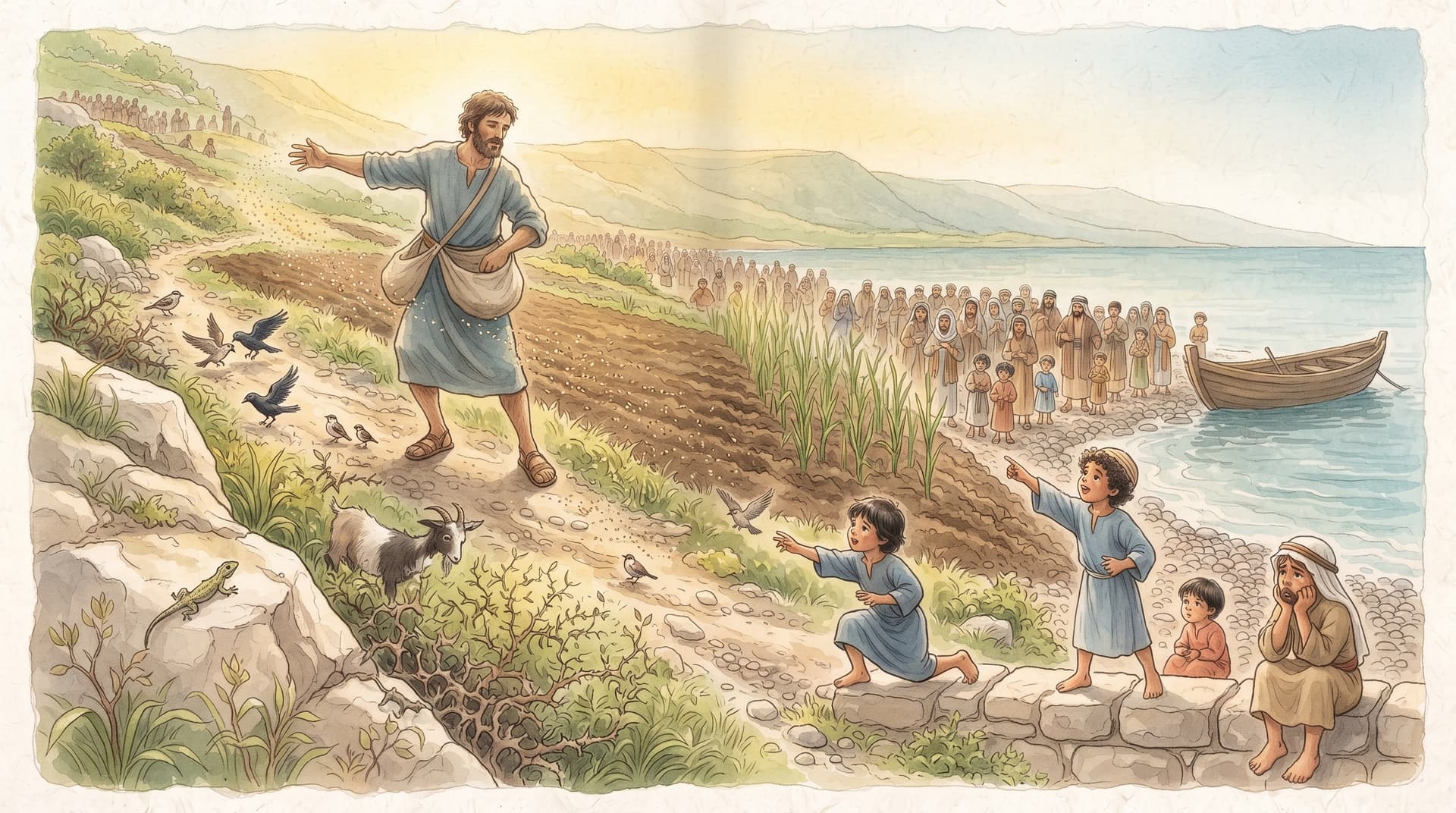
The Original Audience
What did this mean to the people who first heard it?
Movement 1: The Original Audience
Passage: Matthew 13:1-23; Mark 4:1-20
"What did this mean to the people who first heard it?"
A Crowd So Big He Had to Get in a Boat
Both Gospels open the same way: Jesus is beside the Sea of Galilee, and the crowd is so large that he climbs into a boat, pushes out a little from shore, and teaches from the water while the people stand on the beach (Matthew 13:1-2; Mark 4:1). The hillsides around Capernaum slope down to the lake like a natural amphitheater; a voice from a boat carries across still water to hundreds of people. This was a practical solution to a popularity problem. Jesus was, at this moment, the most talked-about man in Galilee.
And then he told them a story about a farmer, in which most of the seed was wasted.
What Everyone in That Crowd Already Knew About Sowing
Almost everyone on that shore had sown seed with their own hands or watched a father do it. The parable assumes a farming method they knew by heart:
Seed went out before the plow, not after. A Galilean farmer walked his field with a bag of grain slung across his chest and flung the seed by the handful in wide arcs. Only afterward did he plow it under. So seed landed everywhere, including on places no one would choose. This was not carelessness. It was simply how it was done.
Footpaths ran straight through the fields. With no fences, neighbors and travelers walked across planted land on paths packed hard as a floor. Seed that landed there sat on the surface, and the birds that followed every sower knew it.
Rocky ground did not mean a field full of stones. Much of Galilee is a thin skin of soil over limestone bedrock. From above it looks like good earth. Seed there sprouts fast because the shallow soil warms quickly, and then dies fast because the roots hit rock and the sun bakes the plant before it can drink.
Thorns were the farmer's oldest enemy. Thorny weeds sprouted alongside the grain, grew faster, and took the light and water first. Every farmer had lost part of a crop this way.
The harvest numbers were enormous. A normal return on seed in that world was somewhere around sevenfold to tenfold. A thirtyfold harvest would have made a farmer the talk of the village. Sixtyfold was extraordinary. A hundredfold sounded like something out of the patriarch stories, where Isaac reaped a hundredfold "and the LORD blessed him" (Genesis 26:12). When Jesus said the good soil produced thirty, sixty, a hundred times what was sown, people would have blinked. Those were not farming numbers. Those were blessing numbers.
What Was Happening Around Jesus When He Told It
The parable came at a turning point. In Matthew, this chapter follows the day the religious leaders accused him of driving out demons by the power of Satan (Matthew 12:24), demanded a sign (12:38), and his own family came to collect him (12:46). In Mark, it follows the scene where his family said, "He is out of his mind," and the scribes from Jerusalem said, "He has an unclean spirit" (Mark 3:21-22).
So the crowd that day was hearing a man who was being loved by thousands and rejected by the people who mattered most: the experts, and his own household. The parable answered a question many in that crowd were quietly asking: if this is really God's kingdom breaking in, why is the response so uneven? Why do some people hear him and change, and others hear him and sneer?
The answer he gave was not "because I am failing." It was "because that is what sowing looks like."
"He Who Has Ears"
Jesus ended the story with a line both writers preserve: "He who has ears to hear, let him hear" (Matthew 13:9; Mark 4:9). Everyone on the shore had ears. The line is a challenge, not a statement of fact. It says: the story just described you, and which soil you are will show in what you do with it.
Later, alone with the disciples, he quoted Isaiah 6:9-10, the prophet's commission to preach to a people who would hear and not understand. The disciples, who had grown up hearing that passage, would have felt the weight of it. Jesus was placing himself in the line of a prophet sent to a nation that mostly would not listen, and placing them among the few who would.
The Emotional Temperature
The crowd was excited and a little confused. The story was plain enough to picture and strange enough that the disciples had to ask what it meant. The religious leaders, already hostile, were being described without being named: hard ground where the seed never gets in. And the disciples were being told something startling in private: "To you has been given the secret of the kingdom of God" (Mark 4:11). Ordinary fishermen were the good soil. The scholars were the path.
Why This Matters for Kids
"Picture a farmer who walks across his whole field throwing seeds everywhere, even on the hard path where he knows birds will eat them. Nobody in that crowd thought the farmer was silly. That is just how you planted a field back then. Jesus said: God's word gets scattered like that. It lands on all kinds of people. Some of it gets snatched, some of it dries up, some of it gets crowded out. And some of it grows so much that nobody can believe the harvest."
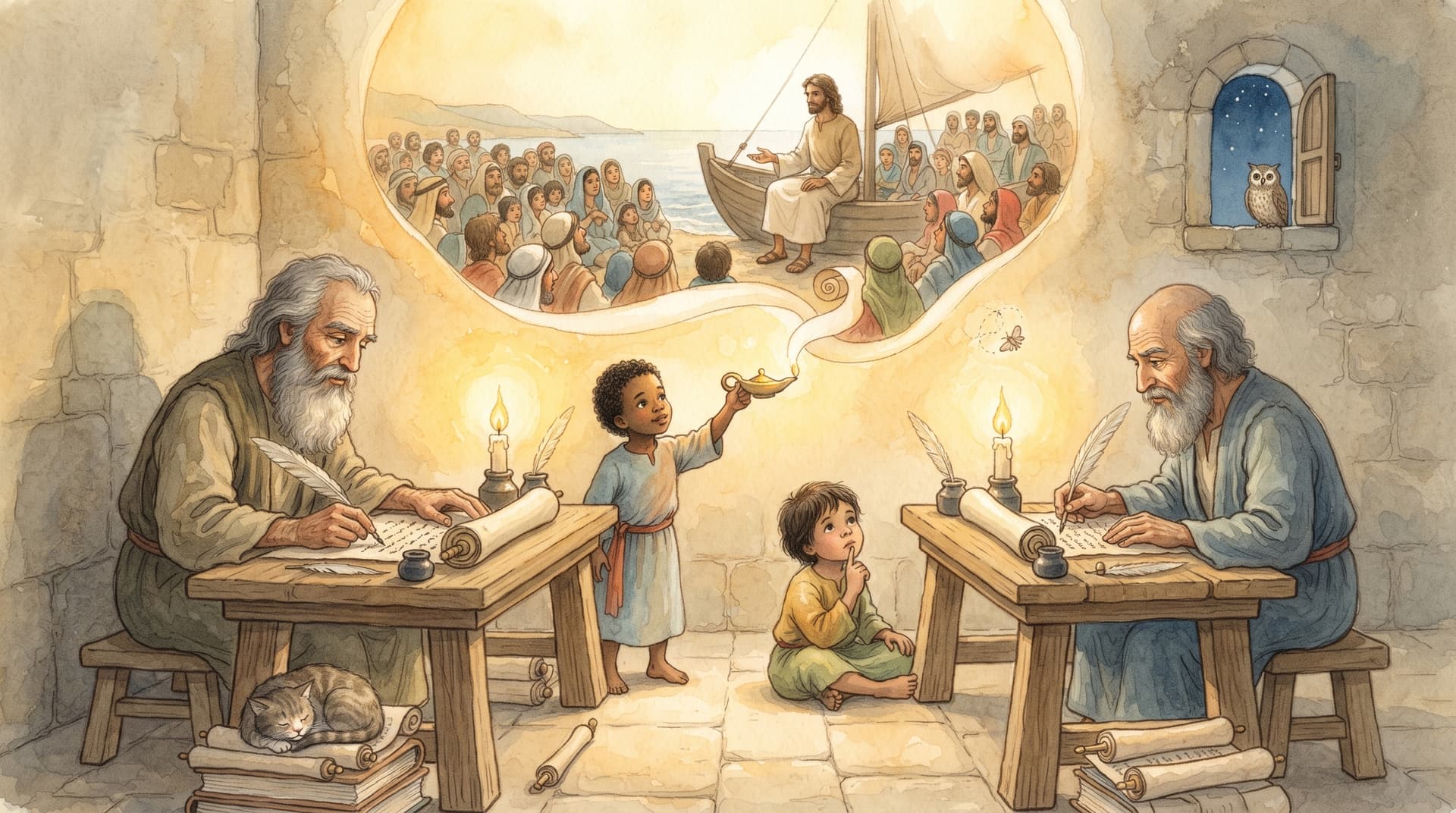
The Author’s Intent
What were the two Gospel writers each trying to show?
Movement 2: The Author's Intent
Passage: Matthew 13:1-23; Mark 4:1-20
"What were the two Gospel writers each trying to show?"
One Parable, Two Angles
Matthew and Mark both record the parable, the disciples' private question, the Isaiah quotation, and Jesus' own explanation of the four soils. (Luke tells it too, in Luke 8:4-15, but this lesson works from the two fullest accounts.) They agree on the story. They differ in where they put it, what they frame it with, and which word they lean on.
Both share the same foundation before either adds anything: this is the first parable Jesus explains line by line in either Gospel. The seed is the word. The soils are hearers. The birds are the evil one. The sun is trouble and persecution. The thorns are the worries of life and the lure of wealth. Every later parable about the kingdom is built on the reader having understood this one.
Matthew: The Kingdom After the Rejection
Matthew builds his Gospel around five long teaching blocks, and chapter 13 is the third. It holds seven parables, and this one leads. Matthew places the whole chapter right after the worst day in Jesus' public ministry so far: chapter 12, where the Pharisees decide he works for Satan, demand a sign, and are told that his true family are those who do the Father's will (Matthew 12:22-50). Matthew wants the reader to hear the parable as Jesus' own commentary on that day. The word has been sown. The leaders were the path. The crowds were the shallow soil. And there is still going to be a harvest.
Matthew is the only one who calls the seed "the word of the kingdom" (13:19). He is also the only one who quotes Isaiah 6:9-10 in full, and the only one who then turns to the disciples with a blessing: "Blessed are your eyes, for they see, and your ears, for they hear. For truly, I say to you, many prophets and righteous people longed to see what you see, and did not see it" (13:16-17). Matthew's disciples are not merely lucky. They are living in the moment the whole Old Testament was waiting for.
Matthew's key word is understand. In his telling, the seed on the path is someone who "hears the word of the kingdom and does not understand it" (13:19), and the good soil is "the one who hears the word and understands it" (13:23). Hearing is not enough. The whole difference between wasted seed and a hundredfold harvest is whether the word gets in and gets grasped.
One small detail shows Matthew's hand: he lists the harvest as "a hundredfold, sixty, thirty" (13:8, 23), starting at the top. Mark counts up: "thirtyfold and sixtyfold and a hundredfold" (Mark 4:8, 20). Matthew leads with the biggest number because he has just watched the leaders reject Jesus, and he wants the reader to know the outcome anyway.
Mark: Listen
Mark's account is the first extended teaching in his Gospel, and he frames it with a command. Jesus' first word is "Listen!" (Mark 4:3), a word no other Gospel includes here. The parable ends with "He who has ears to hear, let him hear" (4:9). Then, after the explanation, Jesus says it again about the lamp: "If anyone has ears to hear, let him hear" (4:23), and "Pay attention to what you hear" (4:24). Mark has wrapped the whole section in the ear. His point is that the kingdom comes by hearing, and the question is what kind of hearer you are.
Mark alone records a line that reframes everything: "Do you not understand this parable? How then will you understand all the parables?" (4:13). This is the parable that unlocks the rest. If you cannot see that the word is seed, that it gets scattered widely and lost often and still produces a harvest, you will not understand anything else Jesus says about the kingdom.
Mark also adds a phrase to the thorns that the others leave out: "the desires for other things" (4:19). Not just money and worry, but the general itch for something else, anything else, than the word you just heard.
Mark then keeps going where Matthew turns to other parables. He alone records the seed growing secretly (4:26-29): the farmer scatters seed, sleeps and rises, "and the seed sprouts and grows; he knows not how." Mark's sower does not make anything grow. He scatters, and God does the rest, and one day it is harvest.
Mark's placement matters too. Just before this, his family came to take him home and the experts called him demon-possessed (3:20-35). Just after the parables, he calms the storm and the disciples ask, "Who then is this?" (4:41). Mark sets the parable of the sower between people who cannot hear who he is and people who are only beginning to.
The Useful Test
Both writers put this parable at the moment the crowds were largest and the opposition was hardening, and both have Jesus explain it as a story about hearing. Matthew presses on whether the word is understood; Mark presses on whether it is heard at all. Neither one lets the reader walk away thinking the kingdom failed because most of the seed was lost. The harvest was always the point.
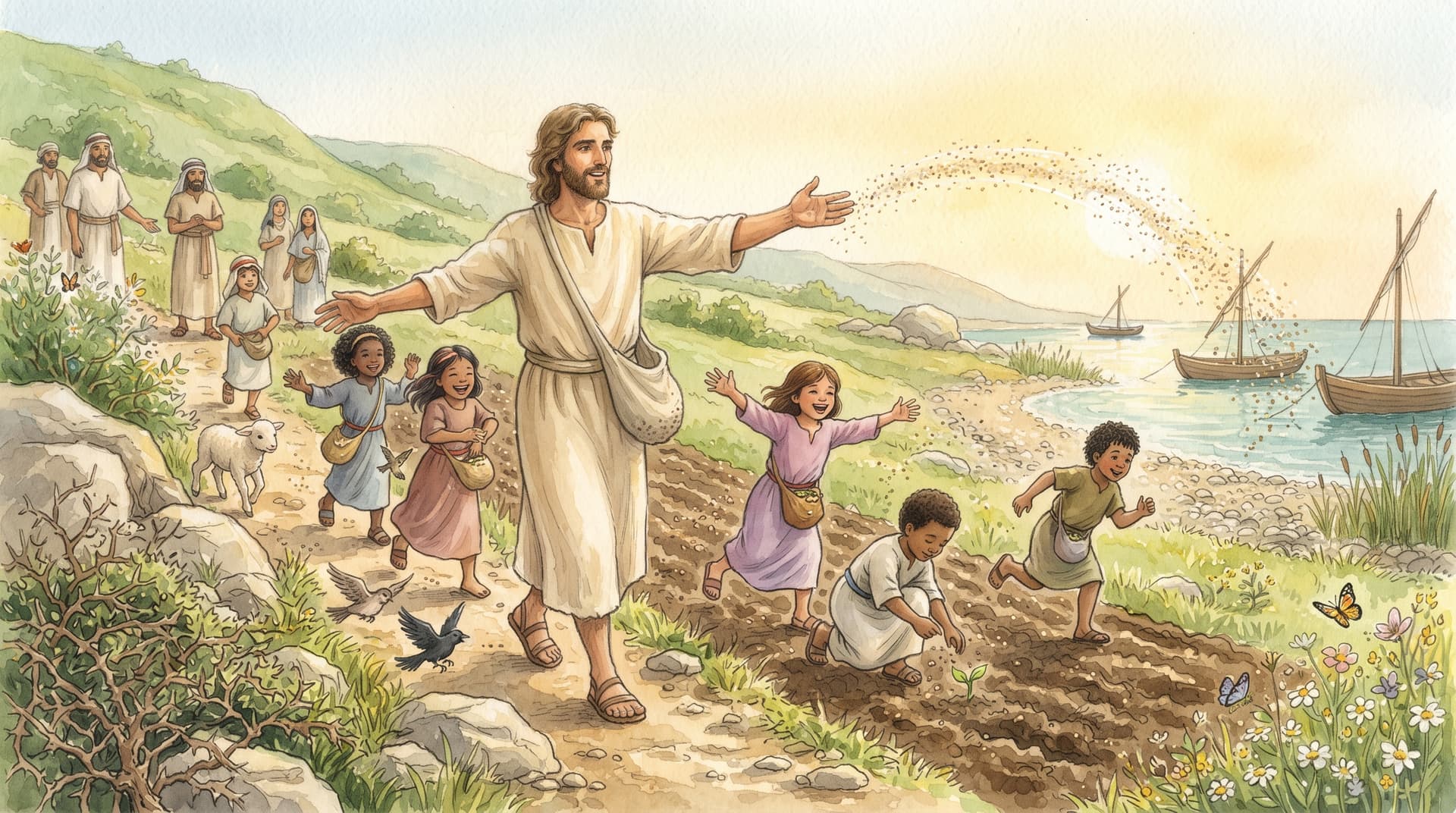
Seeing God
What does this passage reveal about who God actually is?
Movement 3: Seeing God
Passage: Matthew 13:1-23; Mark 4:1-20
"What does this passage show us about God's beauty, glory, or character that we wouldn't see without it?"
The Facet of Beauty: A Sower Who Throws Seed Where He Knows It Will Be Lost
The farmer in the story does not pick his ground. He does not walk around the path, skip the rocky patch, or steer clear of the thorns. He sows the whole field. He knows the birds are coming and he throws seed on the path anyway. That is the God this parable shows: one whose generosity is not rationed by the odds.
What Is Surprising About God Here
He Is Not Careful With His Word
A cautious farmer would sow only where he was sure of a return. God is not that farmer. Jesus taught in synagogues that turned on him, in towns that ran him out, to crowds that would later shout for his death. He put the word in front of Pharisees who were already plotting against him. Seed on the path is not a mistake in the story. It is what God's generosity looks like when it meets hard ground.
He Tells the Story of His Own Losses
Three out of four soils fail. Jesus does not hide that. He tells a crowd of admirers that most of what God sows will be snatched, scorched, or choked, and he says it without embarrassment. God is not anxious about the seed that does not come up. The harvest does not depend on every seed. It depends on the good soil, and the good soil will produce far more than the failures cost.
He Lets the Kingdom Come Hidden
Everyone on that shore wanted a kingdom that arrived like an army. God chose one that arrives like seed: small, buried, slow, invisible for a long time, and then suddenly everywhere. The Isaiah quotation is the hard edge of this. God knew that a kingdom that came this way would be missed by people who wanted to be impressed. He sent it anyway, because seed does something armies cannot: it grows from the inside.
He Gives Back More Than Anyone Sowed
Thirty, sixty, a hundred times the seed. God is not a fair-trade God, returning exactly what was put in. Where the word lands and takes root, he multiplies it past anything the soil could account for. The excess is his signature.
What God's Emotions Look Like Here
Grief, in the Isaiah quotation. "Lest they should turn and I would heal them" (Matthew 13:15) is spoken by a God who wants to heal and is describing people who have made themselves unhealable. It is lament, not gloating.
Delight in the ones who hear. "Blessed are your eyes" (Matthew 13:16) is Jesus looking at a handful of fishermen with open pleasure.
Patience with the slow. Mark's seed grows "he knows not how," night and day, and the farmer sleeps (Mark 4:27). God is not pacing. He planted, and he is content to wait for the harvest.
The Worship Test
The specific facet on display: God scatters his word generously on every kind of heart, including the ones he knows will refuse it, and where it takes root he returns far more than was ever sown.
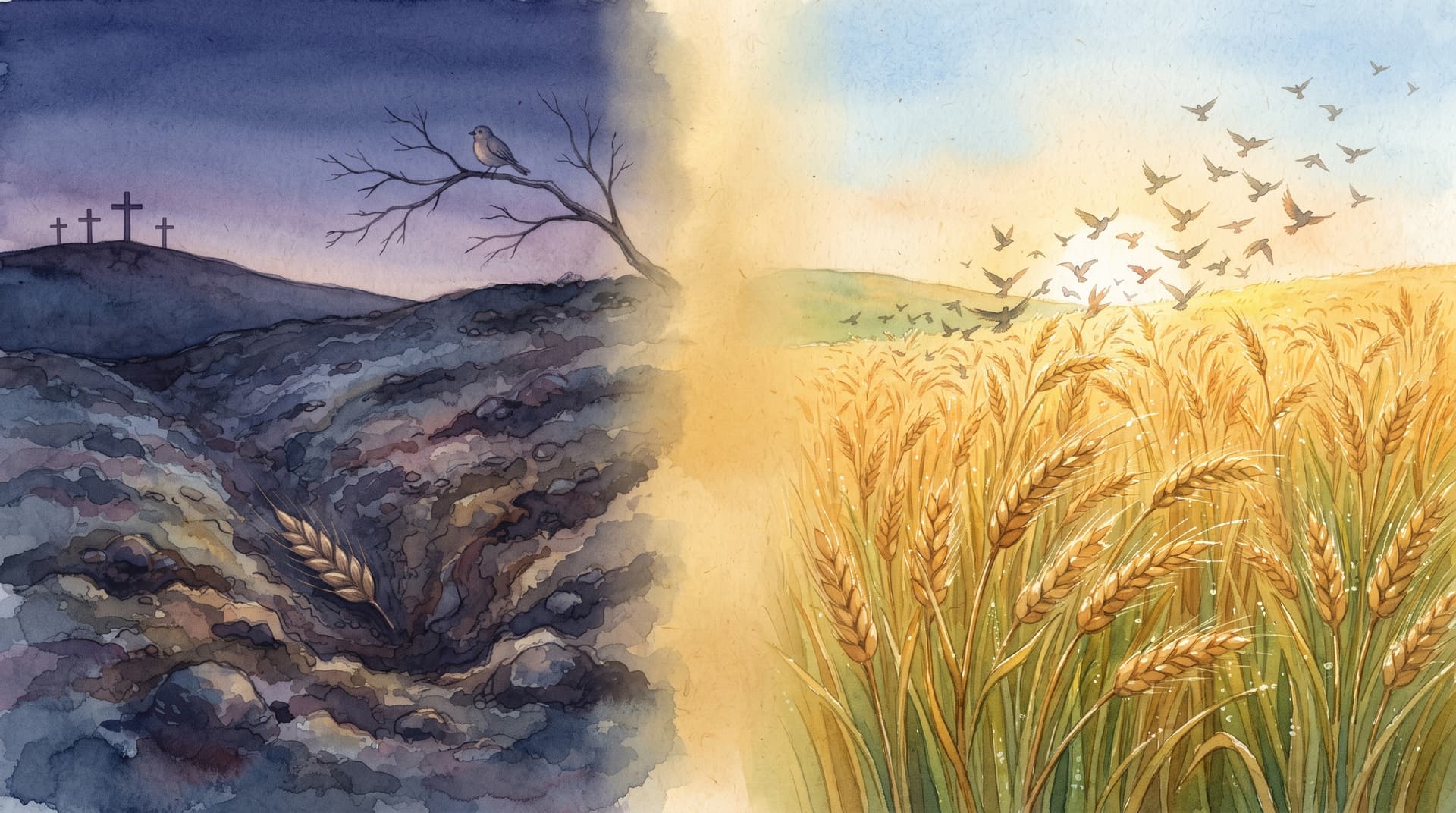
A farmer walked his whole field and threw seed on the hard path, the thin soil, and the thorns, right alongside the good ground. He knew what would happen to most of it. He sowed the whole field anyway, and the part that grew paid for everything a hundred times over.
Gospel Connection
How does this passage connect to the gospel?
Movement 4: The Specific Gospel Connection
Passage: Matthew 13:1-23; Mark 4:1-20
"How does Jesus fulfill, complete, or embody what this passage reveals, SPECIFICALLY, not generically?"
The Rule
The connection has to live in this passage's own soil. Two threads only Jesus can close: the sower who is also the seed, and the one hearer who was ever fully good ground.
Jesus Is the Sower, and Then He Becomes the Seed
In the parable of the weeds, told right after this one, Jesus says plainly who the sower is: "The one who sows the good seed is the Son of Man" (Matthew 13:37). He is the farmer walking the field, scattering the word on every kind of ground.
Then, near the end of his ministry, he says something that turns the parable inside out: "Unless a grain of wheat falls into the earth and dies, it remains alone; but if it dies, it bears much fruit" (John 12:24). The sower did not stay on the path with his seed bag. He went into the ground himself. The word that was scattered on hard hearts became a body laid in a rock tomb, and three days later the harvest began.
Specific connection: the sower in the story loses most of his seed to birds, sun, and thorns. The Sower in history lost himself, on purpose, and the harvest that came up from that one buried seed is every person who has ever believed.
The One Good Soil
The parable describes four kinds of hearers, and if we are honest, every one of us has been all four. We have let the word bounce off. We have sprouted fast and faded. We have let worry and wanting crowd it out. No one has ever been simply and only good soil.
Except one. Jesus heard the Father's word and kept it perfectly. He was tempted in the wilderness, and the word held (Matthew 4:1-11). He was pressed by trouble and persecution, and he did not wither. He was offered every kingdom on earth, and the thorns did not choke him. In Gethsemane, with the hardest word of all in front of him, he said "not my will, but yours" (Luke 22:42). He is the hundredfold harvest.
And the thorns that choke the word in the parable were, in the end, pressed onto his head (Matthew 27:29). He took the crown of the very thing that strangles faith, and he wore it to the cross.
Specific connection: we do not become good soil by trying harder to listen. We are joined to the one who was good soil, and his harvest is counted as ours. "He who began a good work in you will bring it to completion" (Philippians 1:6) is the seed-growing-secretly promise, spoken over people who cannot make themselves grow.
The Specific Mending
The brokenness this passage reveals: Hearts that are hard, shallow, or crowded, and a word that keeps getting lost. Every kid and every teacher knows what it is to hear something true on Sunday and have it gone by Tuesday.
The specific mending: God promised long before Jesus that he would deal with the ground itself: "I will remove the heart of stone from your flesh and give you a heart of flesh" (Ezekiel 36:26). The plowing that the parable does not mention, the Spirit does. Jesus does not stand at the edge of the field hoping the soil improves. He breaks it up, softens it, pulls the thorns, and then sows again.
The new earth: The harvest the parable points toward is not one field but a world. Isaiah saw the wilderness become a garden and the desert blossom (Isaiah 35:1). Revelation ends with a tree of life bearing twelve kinds of fruit, "and the leaves of the tree were for the healing of the nations" (Revelation 22:2). The seed that went into the ground outside Jerusalem is going to come up everywhere.
The Anti-Moralism Checkpoint
-
"Be good soil." This is the most common way to teach the parable, and it turns the story into a self-improvement project. The parable never tells the soils to fix themselves. It describes them. The good news is that God changes ground.
-
"Don't let worries and stuff crowd out Jesus." True, but it is a warning, not a gospel. Kids need to hear that the sower keeps sowing, and that Jesus wore the thorns so they would not have the last word.
-
"And this all points to Jesus who died for our sins." Too generic. This parable specifically points to a Sower who became the seed, went into the ground, and rose as the first of a harvest that includes us.
Why Kids Care
How does this truth intersect with their actual lives?
Movement 5: Why Should a 5-10 Year Old Care?
Passage: Matthew 13:1-23; Mark 4:1-20
"What does this mean for their actual lives of play, fun, friendship, and family?"
This movement is a brainstorm, a menu of angles for the teacher to pray through. Pick what fits your kids. Skip the rest.
The Lesson: The Farmer Who Threw Seed Everywhere
The Arc
Three truths kids need to feel:
1. "A farmer threw seed all over his whole field, even the bad parts." Kids will want to know why he didn't aim. Tell them: that is just how farmers planted back then, and it is how God plants. He throws his word everywhere, at everyone.
2. "The same seed landed on four different kinds of ground, and four different things happened." Birds ate it on the path. It sprouted and dried up on the rocks. It got choked in the weeds. And in the good dirt, it grew and grew and grew. Let them picture each one.
3. "The good dirt didn't grow a little more. It grew a hundred times more." Make the number big for them. If you planted one seed and got one hundred back, you'd never run out. That is what happens when God's word gets in and stays.
The Role Play: The Four Soils
Characters: Narrator (teacher), the Sower (teacher or a confident volunteer, carrying a bag of "seed" such as cotton balls, paper scraps, or dried beans), four groups of kids as the four soils, two or three kids as Birds, one kid as the Sun.
Setup. Divide the room into four zones with tape or chairs: Path, Rocks, Thorns, Good Dirt. Assign a few kids to each zone. Everyone starts crouched down small.
Scene 1, The Path. The Sower walks along tossing seed onto the Path kids. Before they can even move, the Birds swoop in flapping and "eat" the seed (grab it and carry it off). Path kids stay crouched. Narrator: "It never even got in."
Scene 2, The Rocks. The Sower tosses seed onto the Rock kids. They pop up fast, arms up, big smiles. Then the Sun kid walks over, arms wide, making a "sizzle" noise. The Rock kids slowly wilt back down. Narrator: "It came up fast, but it had no roots, so the hot sun dried it right up."
Scene 3, The Thorns. The Sower tosses seed onto the Thorn kids. They start to rise, but two "thorn" kids (or the Birds, doubling up) crowd in close, waving their arms in their faces until they sink back down. Narrator: "It started to grow, but the weeds took all the room."
Scene 4, The Good Dirt. The Sower tosses seed onto the Good Dirt kids. They rise slowly, then stand tall, then stretch their arms as wide as they can, then get up on tiptoe. Narrator: "And this one grew thirty, sixty, a HUNDRED times more." Have the whole room count with you: "Thirty! Sixty! A hundred!"
Scene 5, The Question. Narrator, to everyone: "Jesus said the seed is God's word. The dirt is us. What kind of dirt do you want to be?" Let them shout it.
Why Should They Care?
Angle 1: Hearing It and Forgetting It by Lunch
The kid's world: Sitting through a Bible story, nodding, and having no idea what it was about by the time the snacks come out. Being excited about Jesus at church and forgetting him by Tuesday.
The God-first landing: Jesus described that exact thing. Seed on the rocks sprouts fast and dries up fast, because it never got roots. God does not want a kid who is excited for ten minutes. He wants the word to get down deep, where it can hold on when things get hard. And the good news is he is the one who softens the ground. You can ask him to.
Landing statement: "God's word isn't a story to hear once. It's a seed that wants to grow in you all week."
Angle 2: Too Much Stuff in the Way
The kid's world: Screens, games, toys, worries about school, wanting the thing a friend has. A brain so full there's no room left for anything God said.
The God-first landing: Jesus named the thorns: worries and wanting more stuff. They don't kill the seed on purpose. They just take all the space. But the Sower does not give up on a thorny field. He keeps sowing, and he pulls thorns. A kid who feels crowded can ask Jesus to make room, and he will.
Landing statement: "When your head is too full for Jesus, you don't need to try harder. You need to ask him to clear some space, and he will."
Angle 3: When a Friend Doesn't Want to Hear About Jesus
The kid's world: Telling a friend about church and getting a shrug. Inviting someone and being told no. Feeling like it didn't work.
The God-first landing: The farmer threw seed on the path knowing the birds would take it. He wasn't failing. He was sowing. A kid who tells a friend about Jesus is scattering seed, and what happens next is not their job. Some ground is hard today and soft next year. God keeps the field.
Landing statement: "Your job is to throw the seed. God's job is to make it grow. You don't have to make anybody believe."
Object Lesson Option: Four Cups of Dirt
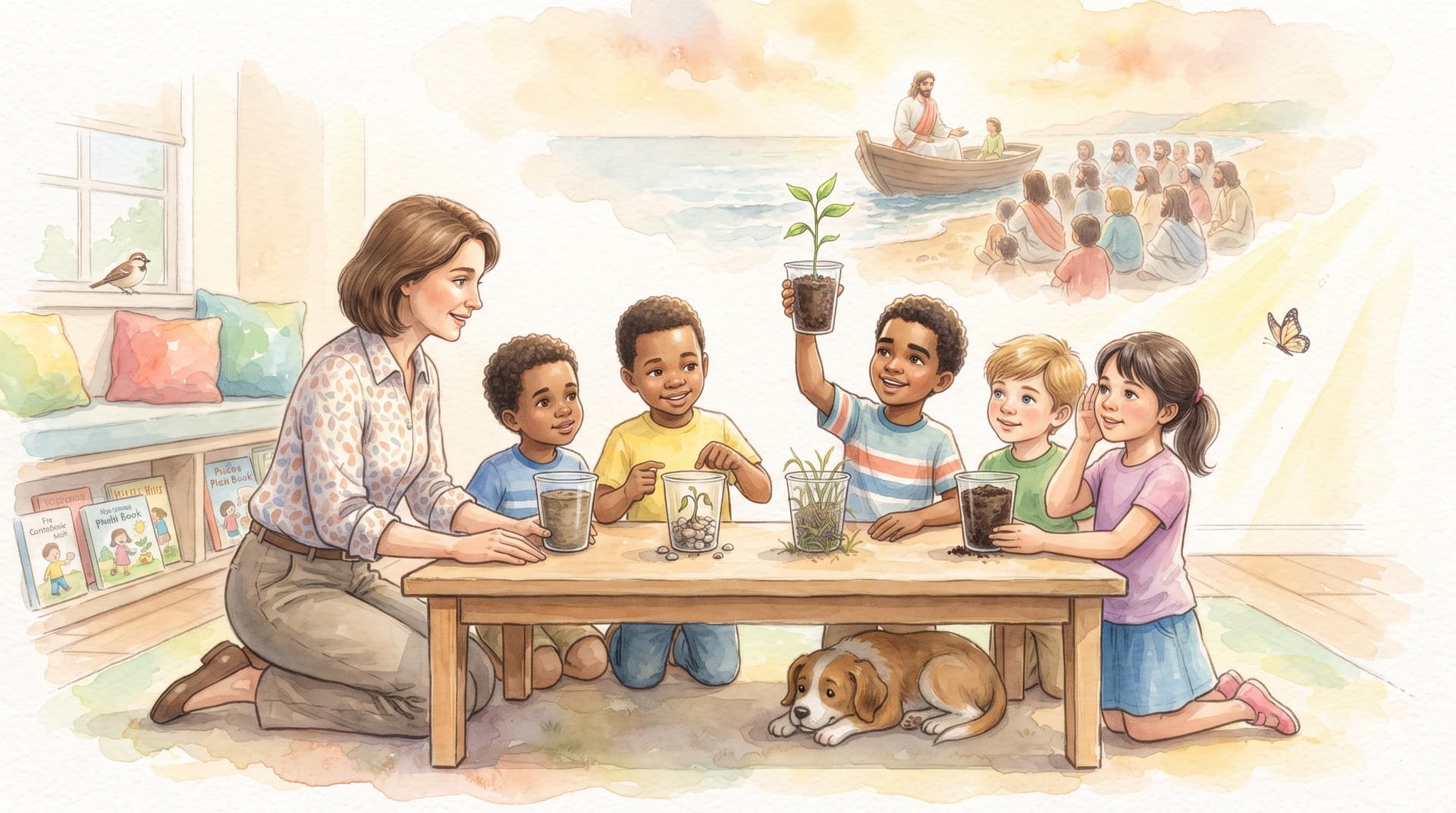
Setup: A week ahead, plant a few fast-sprouting seeds (beans, grass seed, or wheat berries) in four clear cups: one packed hard with clay or sand and pressed flat, one with a thin layer of soil over a stack of pebbles, one with soil plus a thick tangle of grass and weeds, one with loose, dark potting soil. Water them all. By lesson day, the good-soil cup should have visible sprouts and the others should show much less.
Line the cups up and let the kids guess which is which. Ask: "Did I give one cup better seed?" (No, same seed.) "Did I water one more?" (No.) "So why is this one the only one that really grew?" (The dirt.)
Debrief: "Jesus said God's word is like seed. It's the same seed for everybody. The difference is what kind of ground it lands in. And here's the best part: dirt can't change itself, but God can change dirt. He softens hard hearts, pulls out weeds, and gives roots. If you want to be the good cup, you ask him."
Follow-Up Questions
- "Why do you think the farmer threw seed on the path when he knew the birds would eat it?"
- "Which of the four grounds do you think is most like you today? Why?"
- "What are some 'thorns' in your life, things that crowd out thinking about Jesus?"
- "If God's word is a seed, what does it look like when it grows in a person?"
Age Notes
Younger (5-6)
- Stay on the four grounds and what happened to each. The role play carries the whole lesson.
- Skip the Isaiah quotation and the "why parables" question entirely.
- Landing: "God throws his word everywhere, even at me. I want it to grow in me."
Older (8-10)
- Bring in Jesus' explanation and let them map each soil to a real situation (a kid who laughs at church, a kid who loves it at camp and forgets it at home, a kid who's too busy).
- Push on "who makes the seed grow?" Use Mark 4:27, "he knows not how," to show that the farmer sleeps and God does the growing.
- Connect forward to John 12:24. Jesus is the seed that went into the ground and came up as a harvest. Ask them what that means for a person who feels like bad dirt.
What to Skip
- The Isaiah 6:9-10 quotation and the "why do you speak in parables" exchange. Essential for the teacher's prep. Confusing for a seven-year-old.
- The differences between Matthew's and Mark's ordering. Keep the harvest numbers big; don't teach the source comparison.
- First-century farming technique. One sentence ("that's how they planted back then") is enough.
Landing Statements
Format: God is/does ___. And because of that, you ___.
- "God throws his word at everybody, even people he knows will ignore it. So you never have to wonder if he meant it for you."
- "God's word is a seed, not a story. It wants to grow in you all week, not just on Sunday."
- "You can't make yourself good dirt. But God can, and he will if you ask."
- "Your job is to scatter the seed. God's job is to grow it. You don't have to make anyone believe."
Kid Questions
"Why didn't the farmer just plant in the good dirt?" "Because that's not how farmers planted back then, and it's not how God plants either. He doesn't look at a person and decide they're not worth it. He throws the word at everyone. Some of it gets lost. He knows that. He sows anyway, because the part that grows is worth more than everything that didn't."
"What if I'm the bad dirt?" "Everybody has been all four kinds of dirt at some point. That's not the end of the story. The best news in this whole parable is that dirt can't change itself, but God can change dirt. He said he'd take out hearts of stone and give hearts that can feel. If you're worried you're hard ground, that worry is already a little crack in it. Ask him to keep going."
"What is the seed, actually?" "Jesus said the seed is God's word. That means the Bible, but it also means every true thing you hear about Jesus: that he loves you, that he died for you, that he's alive. When one of those lands in you and you hold onto it, that's a seed starting to grow."
"How do I know if it's growing in me?" "Fruit. Jesus said the good dirt makes a crop. In a person, that looks like loving people you didn't used to love, telling the truth when it's hard, wanting to know God more. It's slow, like a real plant. You don't see it move, but one day you notice it's taller."
The Bottom Line
This lesson gives kids a God who is not stingy with his word and not panicked when most of it seems lost. He throws seed on the hard path. He knows the birds are coming. He sows anyway, because the good soil is going to pay a hundred times over.
The temptation will be to make this a lesson about being good dirt. Resist it. Kids cannot change their own ground, and the parable never asks them to. It shows them a Sower who went into the ground himself, and a God who softens stone. The harvest was always his to grow.