The Year of the Lord’s Favor
A lesson preparation guide for teaching 5–10 year olds
The Original Audience
What did this mean to the people who first heard it?
Movement 1: The Original Audience
Passage: Luke 4:16-30
"What did this mean to the people who first heard it?"
The Village and the Synagogue
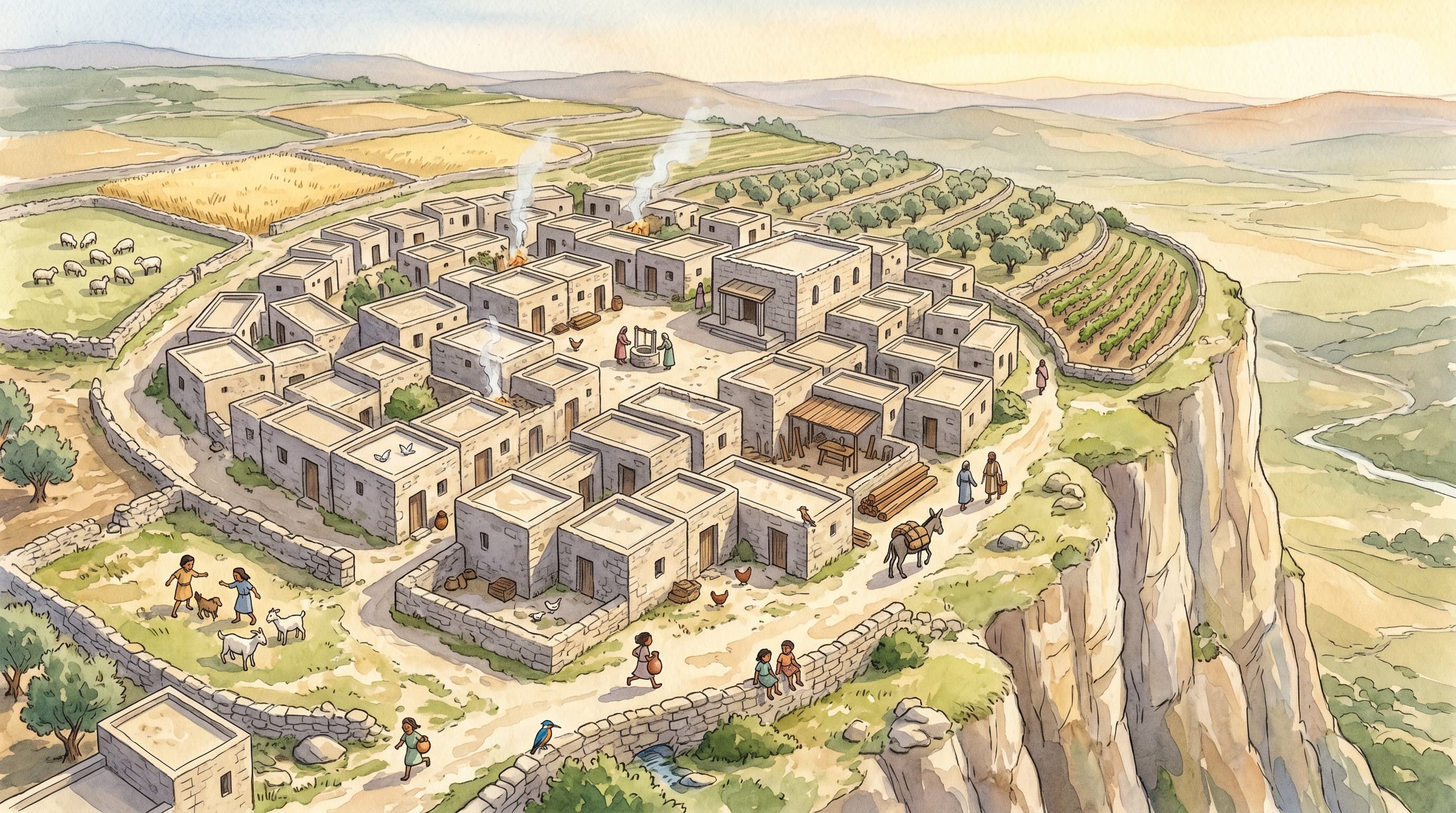
Nazareth was a hill village of maybe four hundred people, twenty miles from any road that mattered. Everyone knew everyone. Joseph the carpenter's family had been there for years; Jesus had grown up in those streets, his neighbors watching him learn his father's trade.
Galilee was occupied. Rome's taxes ate the farmers' margins. A generation earlier, Roman troops had crucified two thousand Galileans after a revolt nearby. The hope they nursed was simple and angry: God would send a Messiah who would throw Rome out.
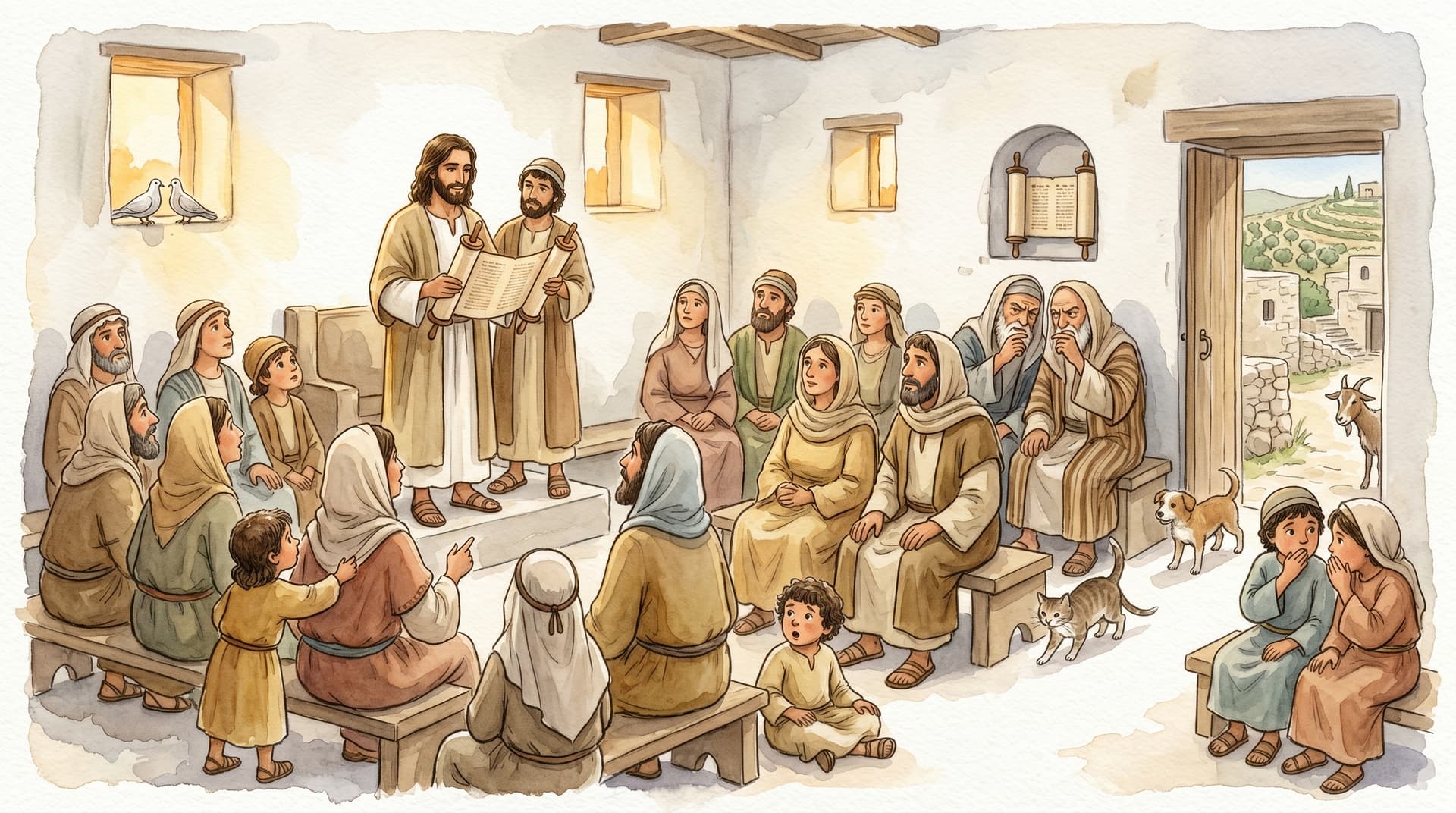
The Sabbath service was a shape they knew by heart. Stand for the Shema and the prayers; sit for the readings — Torah first, then the prophets. Any male in the room could be invited to read and teach. The scroll was passed; you stood to read, sat to comment.
The Reading: Where He Stopped
They handed him Isaiah. He unrolled to chapter 61 — a famous Messianic passage, the song of Jubilee. In Leviticus the Jubilee year was the year of release: debts forgiven, slaves freed, family land returned. Isaiah picks up that language and applies it to a coming deliverer.
The Spirit of the Lord is upon me, because he has anointed me to proclaim good news to the poor. He has sent me to proclaim liberty to the captives and recovering of sight to the blind, to set at liberty those who are oppressed, to proclaim the year of the Lord's favor. (4:18-19)
Then he stops. Mid-sentence. The next clause in Isaiah is "and the day of vengeance of our God." He doesn't read it. He rolls the scroll up and sits down.
That clause was the part the congregation was waiting for. They wanted to hear that God's anointed had come to repay Rome for forty years of injustice. He cut it. They felt it.
"Today this Scripture has been fulfilled in your hearing." (4:21)
He has just claimed, in the synagogue he grew up in, to be the One Isaiah was talking about.
The Hometown Problem
The first reaction is wonder. Gracious words, Luke calls them (4:22). Then the question that turns the room: Isn't this Joseph's son?
In a culture where identity ran through family and place, Joseph's son from this village was a category. It could not also contain Messiah. They were not being malicious. They had known him too long to see him.
The Sermon: Where the Mercy Went
Jesus reads the room. He names what they want: do here what we heard you did in Capernaum. Prove it on home turf.
Then he hands them two stories they already knew. During the famine in Elijah's day, plenty of widows in Israel were starving — but Elijah was sent to a Gentile widow in Sidon. Many lepers in Elisha's day were Israelite — but the one cleansed was Naaman, a Syrian general. Two of Israel's greatest prophetic moments. Both times, the mercy went outside.
He is showing them a pattern. The God they think they have a claim on has always moved past the categories they wanted to keep. The Jubilee he just announced is going to land on the people they wrote off.
The Cliff
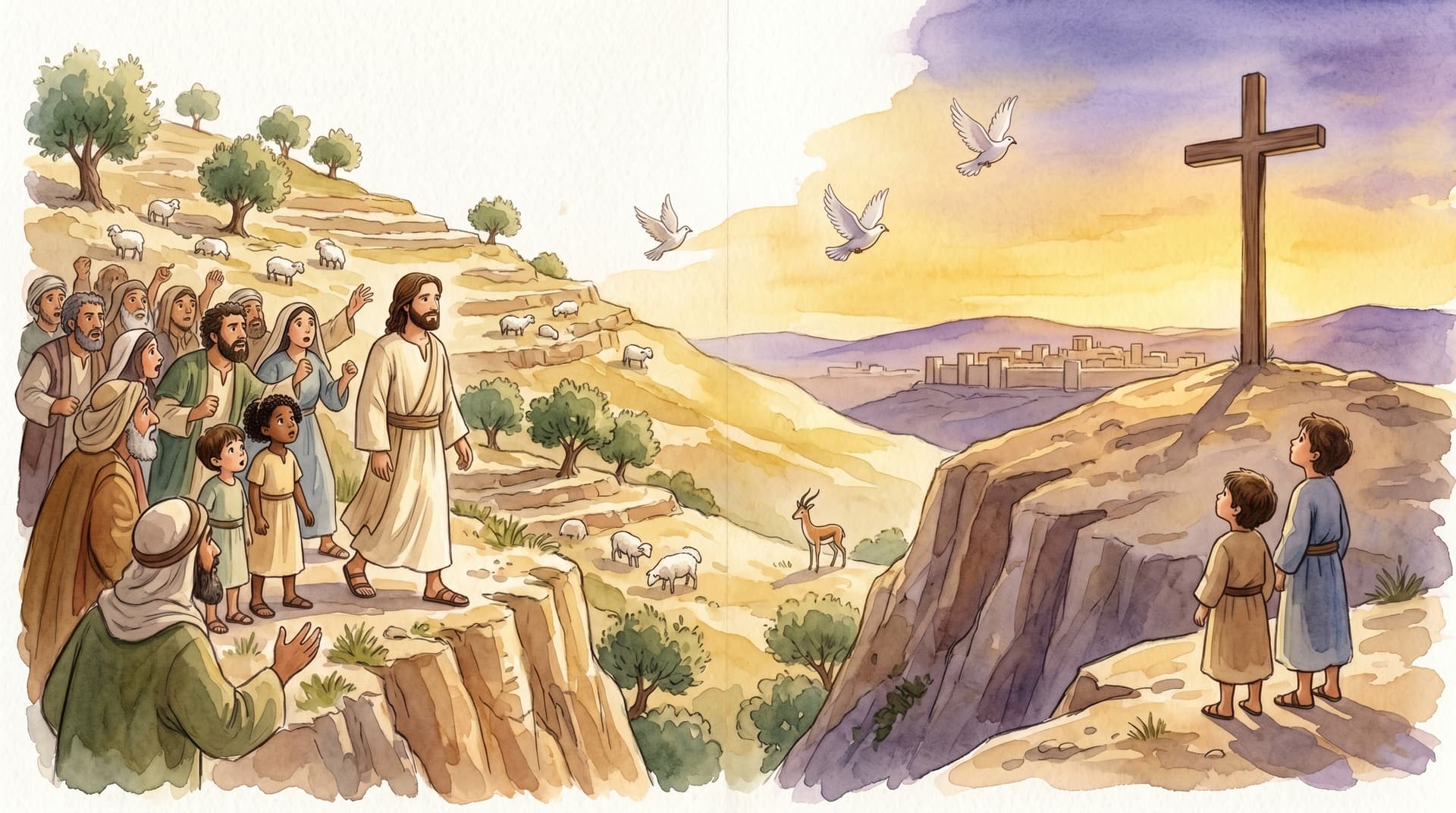
Wonder turns to rage in minutes. They drive him out of the village, to the brow of the hill, intending to throw him down. (Stoning sometimes began with a fall from a cliff.) Luke barely narrates the escape: passing through their midst, he went away. The hour is not yet. There is a different hill.
What the Original Audience Heard
A hometown boy claiming to be the Messiah they had been waiting for — and then telling them his blessing would step over them and reach the people they hated.
The Author’s Intent
What is Luke doing with this scene?
Movement 2: The Author's Intent
Passage: Luke 4:16-30
"What is Luke doing with this scene?"
Why Luke Moves It to the Front
Mark and Matthew tell the Nazareth rejection later in their narratives — almost a sad note along the way (Mark 6, Matthew 13). Luke pulls it forward, before any of Jesus' public ministry has unfolded. This is the inaugural address.
That is a deliberate move. Luke is using Nazareth as the programmatic statement of everything that follows. This scene is the key. Read the rest of the Gospel through it.
The Jubilee Is the Table of Contents
Isaiah 61's list — good news to the poor, liberty to the captives, sight to the blind, freedom for the oppressed, the year of the Lord's favor — is not a sermon outline. It is the structure of Luke's Gospel.
Watch what Jesus does after this scene: forgives a paralytic (5:20), eats with tax collectors (5:30), heals lepers (5:13, 17:14), restores a Gentile centurion's servant (7:9), tells a story of a father running to a returning son (15:20), forgives a thief on a cross (23:43). Every line of the Isaiah scroll gets a concrete body in the chapters that follow. Luke is showing the reader that the announcement at Nazareth was not poetry; it was the agenda.
The Gentile Examples Foreshadow Acts
Luke wrote a second volume. Acts is the story of the gospel walking out of Jerusalem, through Samaria, and into the Gentile world. Paul's sermons in Acts come back again and again to the same logic: when the synagogue rejects, we turn to the nations (Acts 13:46-47, 18:6, 28:25-28).
Luke 4 is the seed. The Elijah-and-Elisha examples Jesus cites are not random barbs. They are Luke planting the pattern: when Israel will not receive, mercy goes outside. Acts is going to show that pattern repeating until the church is full of people Nazareth would have written off.
The Crowd Rehearses the Cross
The emotional arc — wonder → suspicion → rage → attempted murder — is a small-scale model of what will happen at the trial. They take him to the brow of a hill to throw him down. Luke is not subtle. This is what Jerusalem is going to do.
But Luke also notes: he passed through their midst. He decides when. The hour of the cross is not the hour of the cliff. The cross, when it comes, will be given, not taken.
The Useful Test
Luke wrote this scene as Jesus' first public sermon because the audience needed to understand: the Jubilee is here, it is going further than they imagined, and the people who refuse it will not stop it.
Seeing God
What does this passage reveal about who God actually is?
Movement 3: Seeing God
Passage: Luke 4:16-30
"What does this passage show us about God's beauty, glory, or character that we wouldn't see without it?"
The Facet of Beauty: A God Whose Mercy Will Not Be Possessed
Most people who guard a treasure end up smaller because of it. The treasure becomes a wall. The thing they were given to share defines who they keep out.
This God moves the other way. He has every right to a claim on his own people — he gave them the prophets, the Scriptures, the temple, the land. And here, in the synagogue Jesus grew up in, he announces that the Jubilee he promised through Isaiah is going to flow past the people who thought they owned it. The God of Israel will not be kept by Israel. The mercy does not work that way.
This is not abandonment. It is bigger love. The God who chose Israel chose them to be the route, not the destination. When the route tries to close itself off, the mercy keeps going.
What Is Surprising About God Here
He Announces the Jubilee in a Village
Not in Jerusalem. Not in the temple. In a synagogue in a hill town no one outside Galilee knew existed. The kingdom that will fill the whole earth opens its mouth in the smallest possible room. Glory does not need a big stage to begin.
He Reads Half the Sentence
Isaiah 61:2 reads, the year of the Lord's favor, and the day of vengeance of our God. Jesus reads the first clause and stops. He is not editing the prophet — both clauses are real. He is naming the hour. Today is the year of favor. The day of vengeance has a different date. He came first to absorb the vengeance, not to inflict it.
He Names the Gentile Stories on Purpose
He could have softened it. He doesn't. The Sidonian widow and the Syrian general are the stories he chooses. He wants the synagogue to see that the God they are listening to has always crossed the line they wanted to keep. Mercy that stops at the right people is not the mercy of this God.
He Walks Through Them
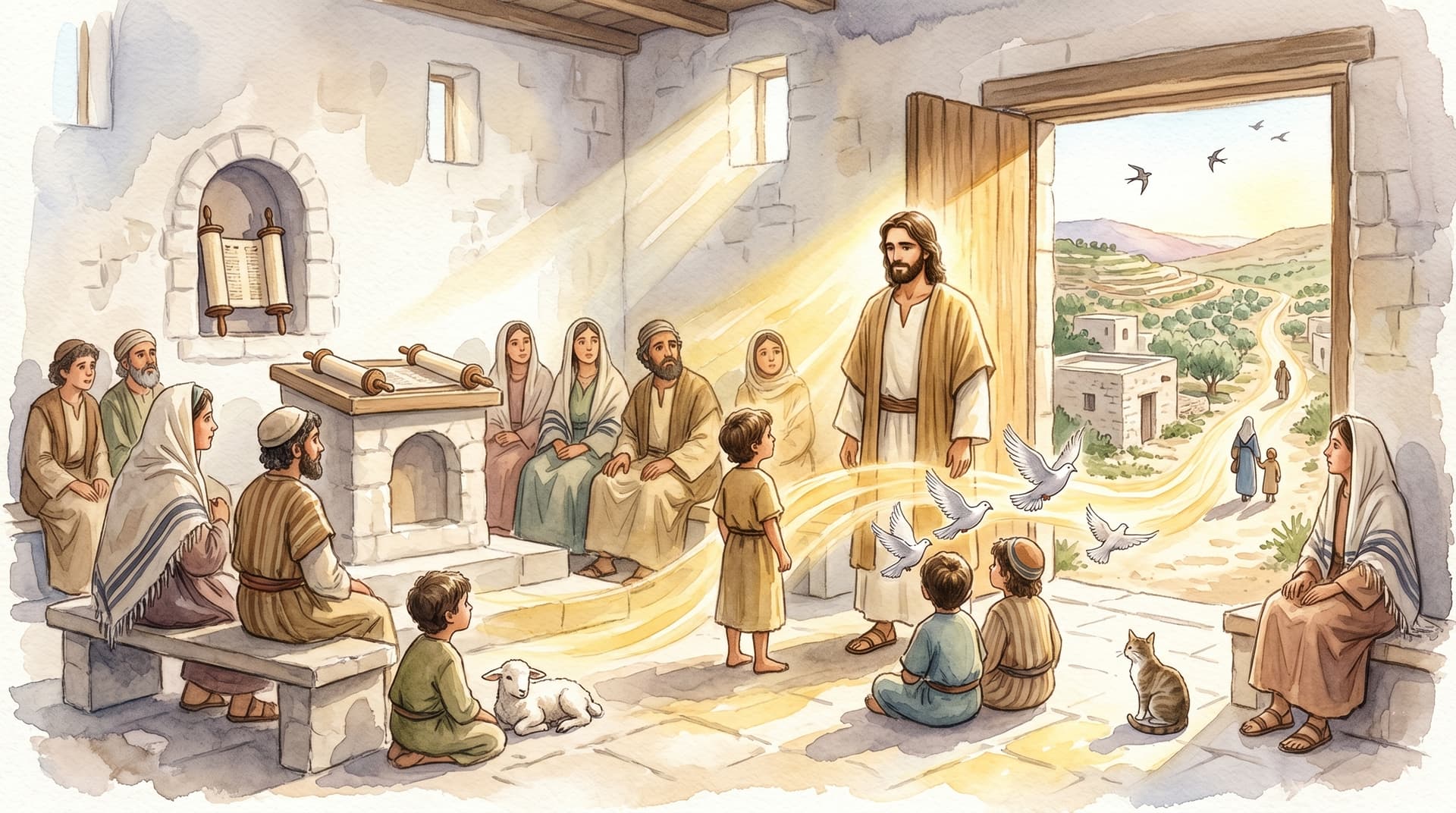
The cliff scene is one of the strangest moments in Luke. There is no resistance, no rebuke, no miracle described — just passing through their midst, he went away (4:30). The hour of his death is not at the choice of an angry crowd. He decides. Even his refusing to die looks like grace from a different angle: there is still favor to announce, and he is going to announce it for three more years.
What God's Emotions Look Like Here
Confident calm. He does not hedge the Elijah/Elisha examples. He does not soften the room. He tells the truth and lets the truth land.
Grief underneath. He is reading them their own diagnosis. The blindness Isaiah named was happening in front of him to the people he had grown up with.
Patience that keeps moving. They reject him. He goes to Capernaum. The favor does not stop because Nazareth said no. It just walks down the road.
The Worship Test
The specific facet on display: God's mercy is bigger than the categories of the people he chose to channel it through. The Jubilee was always going further than the hometown expected.
The Nazareth synagogue heard the most generous sentence ever spoken in their village, and it landed as an insult — because the generosity included people they would not have included.
Gospel Connection
How does this passage connect to the gospel?
Movement 4: The Specific Gospel Connection
Passage: Luke 4:16-30
"How does Jesus fulfill, complete, or embody what this passage reveals -- SPECIFICALLY, not generically?"
The Rule
The connection has to be in the passage's own grain. Three threads only Jesus could close: the Jubilee announced today, the omitted clause he goes on to absorb, and the cliff he walks through on his way to a different hill.
Jesus Is the Jubilee
Isaiah 61 promised a year. Jesus says today. That single word is the gospel. He does not announce that the year of favor is coming. He announces that it is here -- because he is here. He IS the release. He IS sight for the blind. He IS good news to the poor. Every line Isaiah promised gets a body in this man.
The Jubilee year in Leviticus required everybody to give back what they had gained. Land returned to the first family. Debts forgiven. Slaves let go. The cost of restoration fell on whoever was holding the gain. Jesus turns that inside out. The restoration arrives -- and the cost falls on him.
Specific connection: he did not announce the Jubilee from the outside. He stood up, said today, and meant I. The year of favor opened the day he opened his mouth in Nazareth.
He Stopped Reading Because He Was Going to Take the Rest
The clause he omitted -- and the day of vengeance of our God -- is real. Vengeance against evil, injustice, and the powers that have ruined the world is coming, and it is just. Jesus is not pretending otherwise. He is naming the hour. Today is the favor. The vengeance has a different date. When the date comes, he is the one who takes it. The cross is the day the vengeance fell -- and it fell on him, so the favor could keep running.
That is why he could stop mid-sentence. The unread clause was not deleted. It was about to be absorbed.
Specific connection: the day of vengeance and the year of favor are both kept. He just took them in the right order, and the second one fell on him.
The Hometown Cliff Foreshadows Calvary
They take him to a hill to throw him down. He walks through them. The next time he is on a hill, surrounded by an angry crowd, he will not walk through. He will let them lift him up. The Nazareth scene is the dress rehearsal that ends in his refusal to die. The Jerusalem scene is the performance that ends in his consent to die. Both are the same will at work. The God of the favor decides when.
Specific connection: he refused the cliff so he could choose the cross. Even his escape was on purpose.
The Specific Mending
The brokenness this passage reveals: We want a Messiah who fits our story. We want the version of Jesus who confirms the right enemies and rewards the right family. We are most blind to him when we are most sure we already know him. The Nazareth synagogue was not godless. They were religious. They had memorized Isaiah. They were just sure the blessing came down their line. That certainty almost threw Jesus off a cliff.
The specific mending: Jesus does not fix this by handing us the Messiah we wanted. He fixes it by going to the cross -- refusing the throne, absorbing the vengeance -- so that the favor can reach the people who never thought they were on the list, including us. The Spirit he then pours out is the One who finally lets us recognize him without the hometown filter on.
The new earth: A great multitude that no one could count, from every nation, tribe, people, and language (Revelation 7:9), standing before the Lamb. The Jubilee that opened its mouth in a hill village finishes its work when the whole new earth is the city. Good news to the poor finally has nothing left to mean -- because there is no more poor. Sight for the blind has nothing left to do -- because every eye is open. The favor Jesus announced in Nazareth keeps running until it is the only thing left.
The Anti-Moralism Checkpoint
-
"Don't be like the Nazareth crowd." Too thin. They were not uniquely bad. They were religious people who were sure they knew. The cure is not trying not to be them. The cure is asking the Spirit to show you the Jesus you stopped seeing because you grew up in church.
-
"Welcome outsiders like Jesus did." Real but generic. The point is not tolerance training. The point is that the Jesus who walked past the people clutching at him is the same Jesus who walks toward you when you are sure you do not deserve it.
-
"Be brave like Jesus, who stood up and read." Misses the engine. He was not being brave for bravery's sake. He was announcing the Jubilee. The boldness was the news he carried, not the muscle he showed.
-
"And this all points to Jesus who died for our sins." Too generic. This passage shows Jesus specifically as the one who opened the Jubilee, stopped before the vengeance clause to absorb it himself, and walked through the cliff crowd because there was a different hill on his calendar.
Why Kids Care
How does this truth intersect with their actual lives?
Movement 5: Why Should a 5-10 Year Old Care?
Passage: Luke 4:16-30
"What does this mean for their actual lives of play, fun, friendship, and family?"
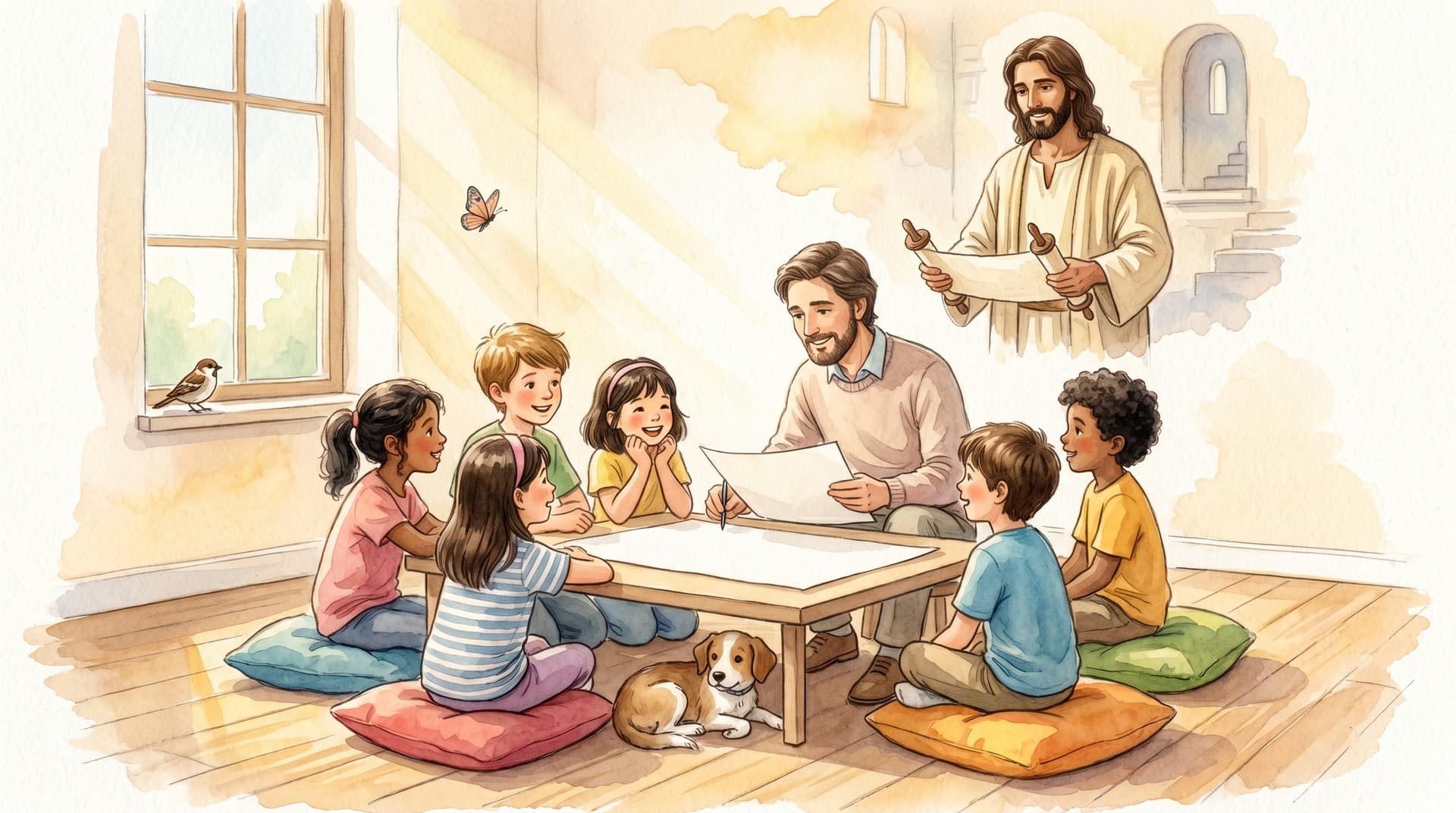
This movement is a brainstorm -- a menu of angles for the teacher to pray through. Pick what fits your kids. Skip the rest.
A translation note: This is a layered passage -- Jubilee, the Gentile examples, the cliff, the omitted clause. Kids don't need every layer. The two that land hardest at 5-10: the blessing reaches the kid who wasn't on the list, and the people who knew Jesus best didn't see him because they thought they already knew. The cliff and the omission belong in the enactment as side notes, not standalone teaching points.
The Lesson: The Sermon That Almost Got Him Killed
The Arc
Three truths kids need to feel:
1. "Jesus stood up in his hometown synagogue and said: I am the One you have been waiting for." His neighbors had watched him grow up. He stood up in the synagogue, read from Isaiah about the coming Messiah, and said -- that's me. Today. Right now.
2. "Then he said something they didn't want to hear." He told them two old stories. Once during a famine, God sent the prophet Elijah to feed a foreign widow -- not an Israelite. Once a foreign general was healed from leprosy when there were plenty of Israelites with leprosy. The point: God's blessing has always crossed the lines people wanted to keep. The Jubilee he was bringing was for the people they had written off.
3. "They tried to throw him off a cliff. He walked away. He had a different hill in mind." The crowd went from praising him to wanting to kill him in minutes. They drove him to the edge of a hill to throw him down. Jesus walked right through the crowd. Today is not the day, and that is not the hill. He had a different hill -- Calvary -- where, when the day came, he would not walk away.
The Enactment: The Synagogue Scene
Characters: Narrator (teacher), Jesus (volunteer), the Attendant (kid who hands over the scroll), the Congregation (rest of the class).
Scene 1 -- The Service. Class sits like a synagogue. The narrator sets the scene: Sabbath, a small village, everybody in town is here. Jesus stands up to read. The Attendant hands him a paper scroll. He unrolls it.
Scene 2 -- The Reading. Jesus reads aloud: "The Spirit of the Lord is on me, because he has anointed me to proclaim good news to the poor, to set captives free, to give sight to the blind, to set the oppressed free, to proclaim the year of the Lord's favor." He rolls the scroll back up. He sits down. He looks at the class slowly and says: "Today, this is happening. Right here. In front of you."
Scene 3 -- The Turn. Congregation reacts: at first, marveling. ("Wow!" "Did you hear that?") Then murmuring. ("Wait -- isn't that the kid from down the street?" "That's just Joseph's son.") Then Jesus tells them God's blessing has always crossed lines -- even gone to foreigners during Israel's biggest moments. The murmuring turns to anger. They stand up.
Scene 4 -- The Hill. They drive Jesus toward an imaginary cliff at the edge of the room. Just before he gets there, Jesus turns and walks back through them, calmly. (Kids will love this.) Narrator: "He had a different hill in mind."
Why Should They Care?
Angle 1: When You Feel Like the Wrong Kid for the List
The kid's world: Not being picked for a team. Not being invited to a birthday party. Hearing about a club, a class, a moment that wasn't for kids like you. The quiet voice that says, that's not your list.
The God-first landing: Jesus opened his ministry by reading a beautiful list -- good news to the poor, freedom for captives, sight for the blind, favor for the oppressed -- and then he told the synagogue: the names you didn't expect are on this list. He named two foreigners as examples. The first sermon Jesus ever preached announced that God's blessing had always gone further than the "right people" thought it should. If you have ever felt like the wrong kid for the list, that sermon was for you. Jesus led with you on purpose.
Landing statement: "Jesus did not just include the kids nobody noticed. He led with them. You were not added at the end."
Angle 2: When You've Already Decided What Someone Is
The kid's world: The classmate everyone calls weird. The sibling you have slotted into "the loud one" or "the annoying one." The kid at church you stopped paying attention to because you already know what they are going to say.
The God-first landing: The people who knew Jesus best were the ones who could not see him. They had him in a box -- Joseph's son, the carpenter's boy -- and that box could not hold Messiah. The God of the Bible can step out of every box, including the box your brain has put a person in. Jesus didn't get smaller when they refused to see him. Their categories did. The same is true of the kid at school you've decided is "weird." There is more there than your box. The Spirit that opens blind eyes opens those eyes too.
Landing statement: "The people who were most sure they already knew Jesus were the ones who missed him. Stay open to seeing what you stopped looking for."
Angle 3: When God's "No" Is a Bigger "Yes"
The kid's world: Asking God for something specific -- to make somebody be nice, to fix a situation, to give them the thing they really wanted -- and not getting it. The quiet conclusion: maybe God isn't listening.
The God-first landing: The Nazareth crowd wanted vengeance against Rome. They had been waiting forty years for it. Jesus skipped right over the vengeance line in Isaiah. They were disappointed. Furious. But here is what they couldn't see: the vengeance Jesus didn't bring down on Rome, he was going to take onto himself at the cross -- so the favor could reach the people they had written off. His "no" to their script was a "yes" to a bigger story than any of them had imagined.
Landing statement: "When God doesn't give you what you asked for, he is often saying yes to something bigger. The Nazareth crowd missed it. You don't have to."
Object Lesson Option: The Guest List
Setup: Bring a printed list of names -- make up "important-sounding" names (Mayor Smith, Pastor Jane, Teacher Brown). Have a few visibly crossed out and a few unexpected ones added (a kid's name, a homeless person's name, a foreign-sounding name, your own name).
Tell the kids: this is the guest list for a party. Who got crossed off? Who got added? Why? Let them guess.
Then reveal: actually, the host is the only one who decides the list. The names crossed off were crossed off by someone else, not the host. The names added -- the host put them there. And here is what the host said: every name I put on this list is on this list. No one else gets to take a name off.
Debrief: "That is exactly what Jesus did when he stood up in the synagogue at Nazareth. He read a beautiful list -- good news for the poor, freedom for captives, favor for the people who had been forgotten. Then he reminded them: God's pattern has always been to include people the religious crowd had crossed off. Foreigners. The wrong kind of person. The 'not on our list' people.
Here is why this matters for you. There will be times you feel like you are not on somebody's list. Your name didn't make it. They don't think you belong. Jesus is the host of the only list that really counts. If your name is in his book -- and it is, if you are reaching for him -- nobody else can cross it off."
Follow-Up Questions
- "Have you ever felt like you weren't on a list -- not invited, not picked, not seen?"
- "Why do you think the people in Nazareth couldn't see who Jesus was?"
- "Has there ever been a kid you decided you already knew -- and then they surprised you?"
- "Have you ever been disappointed that God didn't do what you wanted? What if his 'no' was a bigger 'yes'?"
- "What does it feel like to know your name is on Jesus' list and nobody else can take it off?"
Age Notes
Younger (5-6)
- Stay on the list. They have been picked and not picked. They know the feeling. Jesus put your name on his list himself.
- Skip the Elijah/Elisha examples. Just say: "Jesus told them God's blessing was going to people they didn't expect."
- Skip the cliff in detail. Just say: "They got really mad, but Jesus walked right past them."
- Landing: "Jesus has a list. Your name is on it. He put it there himself."
Older (8-10)
- Push the we-already-know-him problem. "Who at school have you stopped really looking at because you decided you already knew them? What might change if you looked again?"
- Push the bigger yes angle. "What is something you really wanted God to do and he didn't? What if he was doing something else even bigger?"
- Mention the omitted clause briefly: "Jesus stopped reading in the middle of a sentence on purpose. The part he didn't read was about God's anger at evil -- and that part was real, but he was going to take it onto himself at the cross instead of dropping it on Rome. The favor came first because he was about to absorb the rest."
What to Skip
- The geography of Galilee, Sidon, and Syria. "A place far away" is enough.
- The mechanics of synagogue liturgy. "He stood up to read like people did on the Sabbath."
- The Hebrew/Greek word study. Dei, sēmeron, charis -- useful for the teacher, invisible to the kids.
- The historical Jewish-Gentile tension in fine detail. "There were people the Israelites didn't like. Jesus said God's blessing was going to those people too. That made the synagogue very mad."
Landing Statements
Format: God is/does ___. And because of that, you ___.
- "Jesus has a list. He put your name on it himself. Nobody else can cross it off."
- "The people who were most sure they knew Jesus missed him. You can keep looking -- he is bigger than your box."
- "When God says no to what you asked for, he is often saying yes to something bigger than you knew to ask for."
- "Today is the year of God's favor. Jesus opened it. It hasn't closed yet. You are inside it right now."
Kid Questions
"Why did the people in Nazareth get so mad at Jesus?" "Because he told them God's blessing was going to people they did not think deserved it. They had been waiting their whole lives for the Messiah to come and crush their enemies. Instead, Jesus said the Messiah was here to help the people they thought of as enemies. That was a hard thing to hear. Sometimes when God surprises us with how big his love is, we get angry instead of grateful, because we wanted his love to stay the size we expected."
"How did Jesus walk through them when they were trying to throw him off a cliff?" "The Bible doesn't tell us how. Just that he did. Sometimes the Bible shows you a miracle and moves on. What it does tell us is why -- Jesus was not going to die on that hill. He had a different hill in mind. When the day came, on that other hill, he was not going to walk away. He was going to stay there for you."
"What's the Jubilee?" "A long time ago, God told Israel that every fifty years they should do something amazing: forgive everybody's debts, let all the slaves go free, give back the land that families had lost. A whole year where everything got reset. They called it the Jubilee. Jesus stood up at Nazareth and said the real Jubilee was happening now -- not just for one year, but forever. The reset he was bringing wasn't about money. It was about every broken thing getting put right. And he was the one doing it."
"Why did Jesus stop reading in the middle of a sentence?" "Because the next sentence was about God's anger at evil. That sentence is real -- God's anger at evil is good and right. But Jesus came first to bring the favor, not the anger. When the day for the anger came, he didn't drop it on us. He took it onto himself at the cross. He stopped reading because he was about to take that part of the sentence himself."
The Bottom Line
This lesson gives kids a Jesus who opened his ministry by reading a list of who is most welcome at God's table -- and then leading with the names everybody had crossed off. The same Jesus walked through an angry crowd at one hill because he had a different hill in mind, where he would let the crowd win so the list could keep growing.
The temptation will be to land on "welcome outsiders" or "don't judge a book by its cover." Resist both. The story is not about good behavior. It is about a Messiah who came in the size of the village and the shape of a carpenter's son, who stopped mid-sentence to absorb the anger himself, and who has your name on the list because he put it there. The kids who feel like the wrong kid for somebody's list need to hear that Jesus led with them on purpose. That's the whole lesson.